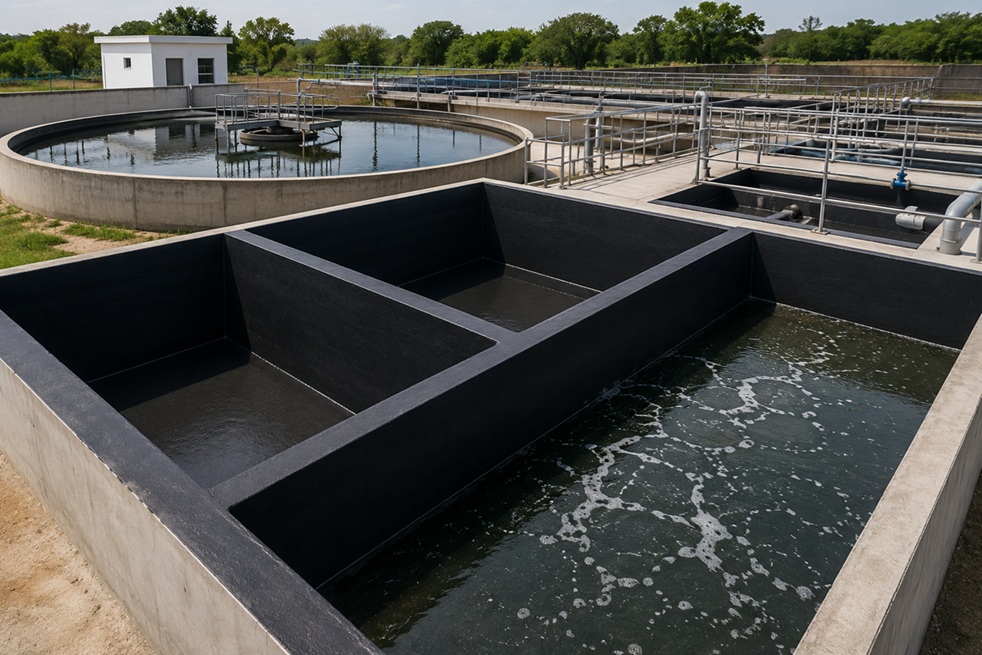
Sewage Treatment Plants (STPs) and Effluent Treatment Plants (ETPs) are among the most demanding structures from a waterproofing perspective. These facilities continuously store, transport, and process sewage, industrial effluents, chemically contaminated water, and sludge. The structures are constantly exposed to moisture, hydrostatic pressure, aggressive chemicals, biological contaminants, and cyclic wetting and drying conditions. Without effective waterproofing, deterioration of reinforced concrete begins much earlier than anticipated, leading to leakage, corrosion of reinforcement, structural damage, contamination of groundwater, and increased maintenance costs.
Why Waterproofing is Essential in STPs and ETPs
Wastewater treatment structures remain in contact with water throughout their service life. Leakage or deterioration can lead to several operational and environmental problems.
Major objectives of waterproofing include:
- Prevent leakage of untreated sewage and industrial effluents
- Protect reinforced concrete from deterioration
- Prevent corrosion of steel reinforcement
- Resist chemical attack
- Improve structural durability
- Reduce maintenance requirements
- Prevent groundwater contamination
- Extend service life of treatment facilities
Proper waterproofing also improves operational efficiency by maintaining water-tightness of tanks and process units.
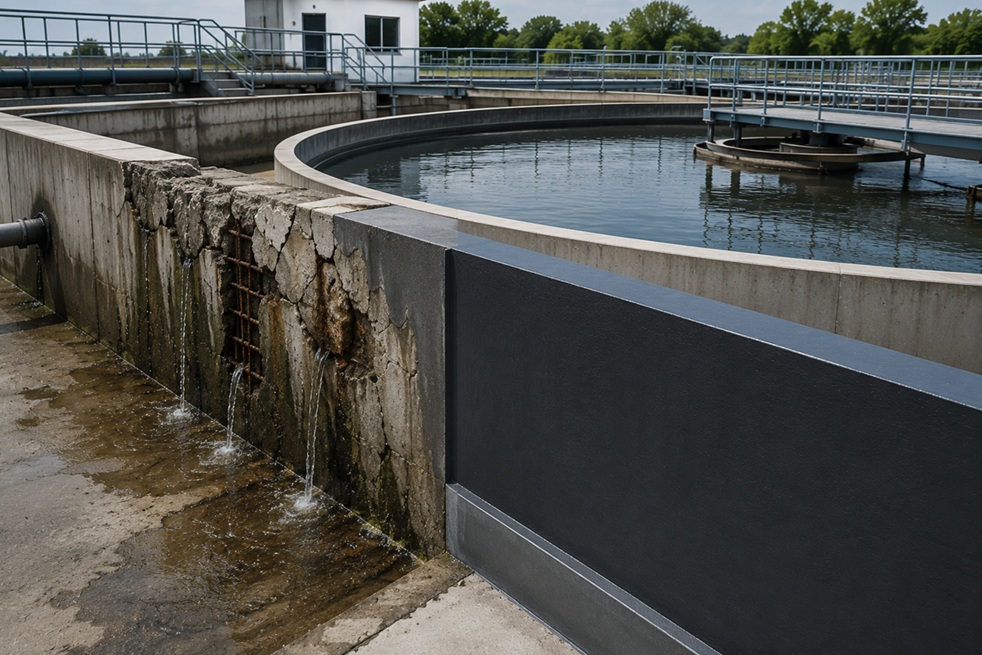
Challenges Faced by STP and ETP Structures
- Continuous Water Exposure – Permanent contact with water keeps concrete saturated.
- Hydrostatic Pressure – Positive, negative, and fluctuating water pressures stress the structure.
- Chemical Attack – Sulphates, chlorides, acids, alkalis, industrial chemicals, oils, and organic compounds degrade concrete.
- Biogenic Sulphuric Acid Attack – Hydrogen sulphide converts to sulphuric acid, severely damaging concrete and mortar.
- Reinforcement Corrosion – Water and chlorides cause steel corrosion, leading to cracking, delamination, and spalling.
- Abrasion and Erosion – Sand, grit, and flowing wastewater wear away concrete surfaces.
- Cracking – Structural movement, shrinkage, and thermal stresses create pathways for water and chemicals.
- Leakage and Seepage – Damaged joints and cracks result in water loss and contamination.
- Joint Deterioration – Construction and expansion joints are vulnerable to leakage and chemical attack.
Structures Requiring Waterproofing
Almost every component of an STP or ETP requires waterproofing.
These include:
- Equalization tanks
- Collection wells
- Aeration tanks
- Clarifiers
- Primary settling tanks
- Secondary settling tanks
- Digesters
- Sludge holding tanks
- Sump pits
- Chemical storage tanks
- Filter beds
- Pump rooms
- Underground pipelines
- Lift stations
- Inspection chambers
- Underground reservoirs
- RCC channels
Common Sources of Leakage in STP and ETP Structures
- Construction Joints – Poorly treated joints allow water seepage.
- Expansion Joints – Inadequate sealing leads to leakage due to structural movement.
- Honeycombing – Voids in concrete create direct paths for water ingress.
- Shrinkage Cracks – Plastic and drying shrinkage cracks permit water penetration.
- Pipe Penetrations – Improper sealing around service pipes causes leakage.
- Tie Rod Holes – Unsealed formwork tie holes become leakage points.
- Cold Joints – Poor bonding between successive concrete pours results in seepage.
- Surface Cracks – Thermal and structural cracks facilitate water ingress.
- Porous Concrete – High permeability allows water and chemicals to penetrate.
- Damaged Waterproofing – Deteriorated or defective waterproofing systems lead to leakage.
Waterproofing Requirements for STPs and ETPs
Waterproofing systems must provide more than water resistance.
An ideal system should offer:
- Continuous waterproof barrier
- Chemical resistance
- Crack-bridging capability
- Adhesion to damp concrete
- Resistance to hydrostatic pressure
- Abrasion resistance
- Compatibility with potable and wastewater environments
- Long service life
- Ease of maintenance
Waterproofing Systems Used in STPs and ETPs
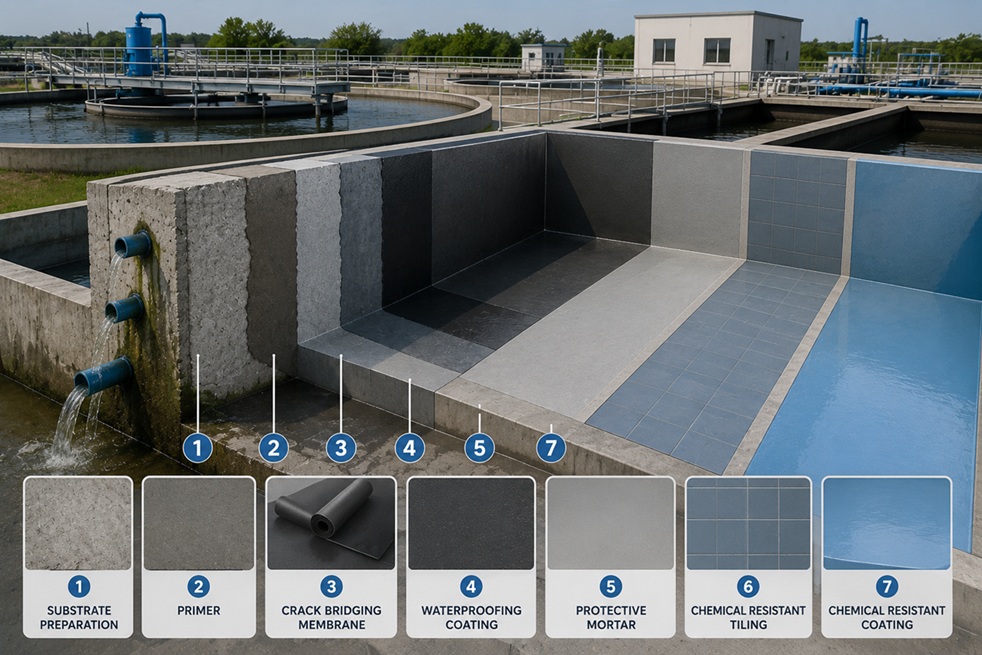
The selection of a waterproofing system for STPs and ETPs depends on the structure, hydrostatic pressure, and chemical exposure. Since these structures operate under continuous contact with wastewater, a combination of waterproof concrete, joint sealing systems, and protective coatings is generally adopted for long-term durability.
Integral Waterproofing Systems
Integral waterproofing admixtures are added to concrete during batching to reduce permeability and improve durability. They minimize water absorption, enhance resistance to chloride penetration, and reduce the risk of reinforcement corrosion. However, they are usually combined with surface waterproofing systems for complete protection.
Cementitious Waterproof Coatings
Polymer-modified cementitious coatings are widely used for waterproofing treatment tanks and underground structures. They provide excellent adhesion to concrete, can be applied on damp surfaces, resist positive and negative water pressure, and accommodate minor cracks. Their ease of application and cost-effectiveness make them a preferred choice for many projects.
Crystalline Waterproofing
Crystalline waterproofing reacts with moisture and cement hydration products to form insoluble crystals that block concrete pores and microcracks. It provides long-term waterproofing, reduces water permeability, offers self-sealing of hairline cracks, and performs effectively under both positive and negative hydrostatic pressure.
Polyurethane Waterproof Coatings
Polyurethane coatings form seamless, flexible membranes with excellent crack-bridging ability and strong adhesion to concrete. They also provide good chemical resistance and are commonly used on exposed roofs, slabs, and other treatment plant structures subjected to movement and weather exposure.
Epoxy Coatings
Epoxy coatings are used where high chemical and abrasion resistance is required. They form a dense protective lining with excellent adhesion and mechanical strength, making them suitable for chemical dosing rooms, industrial ETP tanks, chemical storage areas, and equipment foundations.
Polyurea Coatings
Polyurea is a spray-applied waterproofing system that cures rapidly to form a seamless and highly durable membrane. It offers superior flexibility, abrasion resistance, chemical resistance, and crack-bridging capability, making it particularly suitable for rehabilitation projects requiring minimal downtime.
HDPE and PVC Membranes
HDPE and PVC geomembranes provide complete impermeability and excellent resistance to chemicals and UV exposure. They are widely used in wastewater lagoons, sludge containment areas, leachate ponds, and large storage reservoirs where long-term leak protection is essential.
Waterproofing of Construction Joints
Construction joints are among the most vulnerable locations for leakage in water-retaining structures. Proper joint treatment is essential to maintain watertightness.
PVC Water Bars: Embedded during concreting, PVC water bars prevent water migration through construction and expansion joints and are commonly used in tank walls, base slabs, and reservoirs.
Hydrophilic Water Bars: These water bars expand when exposed to water, sealing small gaps at construction joints. They are easy to install and provide an effective secondary barrier against leakage.
Injection Hose Systems: Injection hoses are embedded along construction joints during concreting. If leakage develops later, polyurethane or epoxy grout can be injected through the hose to seal the joint without excavation or structural damage.
Waterproofing of Pipe Penetrations
Pipe penetrations are common leakage points in STPs and ETPs due to differential movement between pipes and concrete. Effective waterproofing is achieved using non-shrink grout, polyurethane or hydrophilic sealants, mechanical seals, and rubber collars. Proper detailing around pipe penetrations ensures long-term watertight performance and prevents leakage during plant operation.
Waterproofing During Construction
Waterproofing begins before concrete placement.
Important construction practices include:
- Proper concrete mix design
- Low water-cement ratio
- Adequate compaction
- Proper curing
- Controlled joint spacing
- Good reinforcement detailing
- Correct installation of water bars
- Surface preparation before coating
Quality construction minimizes future waterproofing failures.
Rehabilitation of Existing STPs and ETPs
Many older treatment plants develop leakage due to ageing.
Typical rehabilitation process includes:
Condition Assessment
Inspection identifies:
- Cracks
- Leakage paths
- Corrosion
- Delamination
- Concrete deterioration
Crack Repair
Methods include:
- Epoxy injection
- Polyurethane injection
- Routing and sealing
Concrete Repair
Damaged concrete is removed and repaired using polymer-modified repair mortars.
Waterproof Coating
The repaired surface receives an appropriate waterproofing system.
Protective Chemical Coating
Additional chemical-resistant coatings may be applied where aggressive industrial effluents are present.
Best Practices for Long-Term Performance
To maximize the durability of STPs and ETPs, project teams should adopt a comprehensive waterproofing strategy:
- Conduct a detailed assessment of water and chemical exposure conditions.
- Design concrete mixes with low permeability and appropriate supplementary cementitious materials.
- Install water bars and sealants correctly at all joints and penetrations.
- Select waterproofing systems compatible with the expected chemical environment.
- Ensure proper surface preparation before applying coatings or membranes.
- Perform quality checks during every stage of construction.
- Carry out water-retention tests before commissioning tanks.
- Implement periodic inspections and preventive maintenance throughout the facility’s service life.
A well-executed waterproofing system is significantly more cost-effective than repeated repairs after commissioning.
Conclusion
Waterproofing is one of the most important aspects of the design, construction, and maintenance of Sewage Treatment Plants and Effluent Treatment Plants. These structures operate under continuous exposure to water, chemicals, biological activity, and hydrostatic pressure, making them highly susceptible to leakage and deterioration if not adequately protected.
Selecting the appropriate waterproofing materials, detailing construction and expansion joints correctly, ensuring quality concrete construction, and following proper application practices are essential for achieving durable and leak-free structures. For existing facilities, timely condition assessment, repair, and rehabilitation can restore watertightness and extend service life while minimizing operational disruptions.