
For construction specifiers working on commercial and institutional projects in the current market, the humble levelling compound has quietly become one of the more consequential product decisions on the finished floor specification. The chemistry has moved on. The installation window has shortened. The product category has subdivided in ways that reward the specifier who understands the material and penalise the one who treats it as a commodity line.
For contractors and consultants looking at the new generation of levelling products, a few technical points are worth being clear about.
The chemistry that has changed
The traditional domestic levelling product was a cement-based mixture with limited polymer modification. It achieved acceptable flow at a relatively high water-to-powder ratio, set in several hours, and required a long curing window before the floor finish could be laid. The failure modes were familiar. Cracking along the perimeter. Dusting at the surface. Loss of bond to the substrate under thermal cycling. Reduced strength if the mix water was off.
The newer generation of polymer-modified compounds has addressed most of these failure modes directly. Latex and acrylic co-polymers introduced into the cement matrix improve both the workability at lower water ratios and the flexural strength after cure. Modified set accelerators shorten the walk-on window to a few hours. Fibre reinforcement, in the better products, controls early-age shrinkage cracking. Silica fume additions increase bond strength to a primed substrate.
The practical consequence for the specifier is that the newer products can be specified at applied thicknesses of two to three millimetres, cure to foot traffic strength within four to six hours, and receive a bonded floor finish within twenty-four hours. The shorter cycle has material programme implications on any project with a compressed finishing sequence.
Where specification goes wrong
The commonest specification errors on levelling compound projects fall into a short list. Mismatching the compound to the floor finish above it, particularly where the finish requires a specific bond strength or vapour permeability. Under-specifying the applied thickness for a substrate with significant variation, resulting in insufficient levelling or feather-edge failure. Specifying a cement-based product under a moisture-sensitive finish without accounting for residual moisture. Omitting or under-specifying the primer, which is the single most common cause of adhesion failure.
A good specification sheet closes each of these points explicitly. The compound product is specified by name. The applied thickness range is defined against the measured substrate variation, not an assumed average. The primer is specified. The permissible residual moisture is stated. The acceptance criteria for the levelled surface are set numerically.
The better specifiers also commission a substrate survey before issuing the final specification. Measuring the actual variation across the floor, rather than estimating from a site visit, is the single step that most improves the quality of the finished installation.
How the product has moved into the mainstream
For most of its history, the levelling compound was a specialist product used primarily on commercial fit-outs and industrial installations. The newer product chemistries, combined with rising expectations on domestic and institutional flooring performance, have moved the product into mainstream specification. Projects that would once have skipped the levelling layer now include it as standard. The better chemists in the category have responded by producing products optimised for a wider range of substrates and finishes.
The practical effect is that a serious specifier dealing with any finish more demanding than loose-laid carpet should be treating self-levelling compounds as a default rather than an option. The newer generation of products, applied correctly, deliver the substrate condition that modern floor finishes require to perform the way the manufacturer promised.
Installation best practice for the contractor
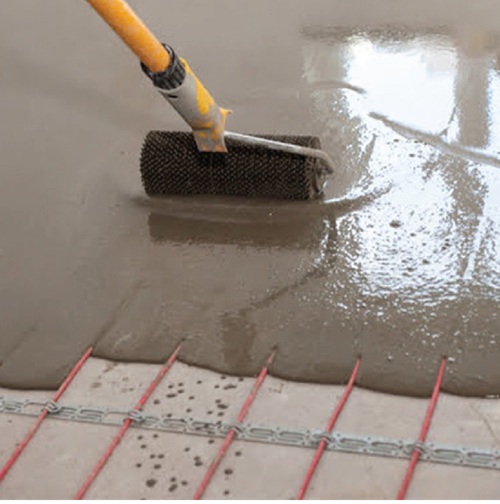
For contractors on site, three habits distinguish the installations that succeed from the installations that develop problems within the first year. First, the substrate is thoroughly prepared and primed before any pour, with loose material, dust, and incompatible residues removed. Second, the compound is mixed to the exact manufacturer’s water ratio, measured by volume rather than estimated, with mechanical mixing continued for the full specified time. Third, the compound is poured continuously across the area rather than in sequential batches that create cold joints, with a spiked roller worked through the wet surface to release entrained air.
Attention to these three habits accounts for the majority of the variance between a good installation and a poor one. The chemistry of the compound sets the ceiling of what is possible. The installation discipline determines whether that ceiling is reached.
What the next generation of projects will specify
The direction of travel in the product category is clear. Lower applied thicknesses. Faster turnaround from pour to finish. Broader compatibility with modern floor finishes and underfloor heating systems. More exacting primer and preparation protocols documented in the manufacturer’s technical data sheets.
Specifiers and contractors who learn to work fluently with the newer generation of these products are, in effect, working at the current standard of the industry. Those still specifying and installing to the standards of a decade ago are quietly falling behind it.






