
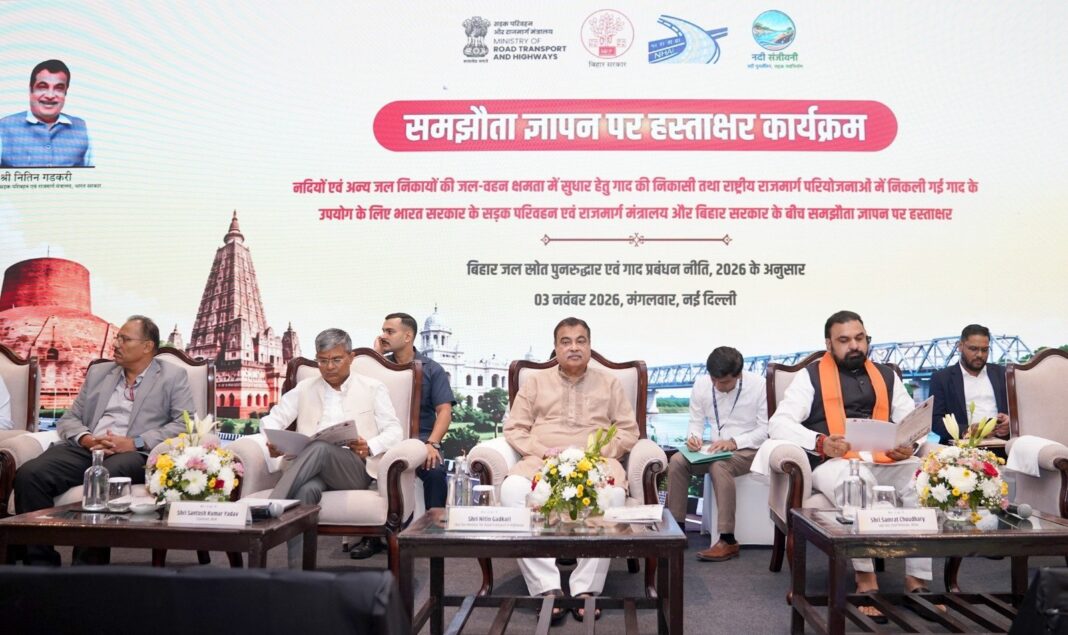
The Ministry of Road Transport and Highways (MoRTH) and the Bihar government have signed a Memorandum of Understanding (MoU) to utilise excavated river silt in the construction of National Highways across the state. The agreement has been signed under the Nadi Sanjeevani initiative, which aims to combine scientific desilting of water bodies with the use of excavated material for infrastructure development.
The agreement was witnessed by Union Minister for Road Transport and Highways Nitin Gadkari and Bihar Chief Minister Samrat Choudhary in New Delhi. Through this initiative, the state plans to address two important requirements: managing silt accumulation in rivers and water bodies and ensuring the availability of suitable construction material for highway projects.
According to the National Highways Authority of India (NHAI), approximately 243 lakh cubic metres of silt will be required for ongoing and proposed National Highway projects in Bihar. Under the agreement, the same quantity of excavated silt will be supplied free of cost for 16 ongoing highway projects in the state.
The initiative is expected to reduce the use of agricultural soil for infrastructure construction while creating an alternative source of material for road development.
243 Lakh Cubic Metres of Silt Identified for Highway Projects
The availability of construction material is an important consideration in the execution of large-scale highway infrastructure projects. Traditional road construction activities often require substantial quantities of soil and other locally available materials for embankments and associated works.
Bihar’s new arrangement seeks to meet part of this requirement by using silt removed through the scientific desilting of rivers and water bodies. With NHAI identifying a requirement of around 243 lakh cubic metres, the material generated through desilting activities can be directed towards highway construction.
The agreement provides for the free supply of this quantity of silt to 16 ongoing National Highway projects. This could help reduce the dependence of these projects on agricultural soil, which is also an important resource for farming activities.
The proposed arrangement also establishes a link between water resource management and infrastructure development. Instead of treating accumulated silt only as a challenge for water bodies, the initiative seeks to utilise the excavated material for construction purposes wherever it is technically suitable.
Nadi Sanjeevani Initiative to Address Silt Accumulation
The Nadi Sanjeevani initiative focuses on the scientific removal and management of silt from water bodies. Silt accumulation has been a recurring concern in Bihar, where rivers and water bodies play an important role in the state’s water management system.
The accumulation of sediment can affect the carrying capacity of water bodies and contribute to challenges associated with water flow and flooding. Bihar regularly faces flood-related difficulties, making the management of river systems and water resources an important part of its infrastructure and development planning.
Through the MoU, the state government aims to connect desilting activities with the material requirements of road infrastructure projects. The approach is intended to support the restoration of water bodies while ensuring that the excavated material is put to productive use.
The use of river silt in highway construction will also depend on its suitability for the intended construction applications and the relevant technical requirements.
Bihar Introduces Silt Management Policy, 2026
Bihar has become the first state in India to introduce a comprehensive silt management policy. The initiative has been formulated under the Bihar Water Resource Restoration and Silt Management Policy, 2026.
The policy provides a framework for managing silt accumulation and integrating the removal of sediment with water resource restoration activities. The MoU with MoRTH is part of this broader approach, linking the state’s water management objectives with its expanding infrastructure requirements.
For Bihar, the initiative offers an opportunity to coordinate water resource management with the development of its National Highway network. The identified requirement of 243 lakh cubic metres of silt for 16 ongoing projects provides a substantial demand for the material generated through desilting operations.
Linking Water Resource Management with Road Infrastructure
The agreement between MoRTH and the Bihar government introduces an approach in which desilting and highway construction are planned as interconnected activities. By supplying excavated silt for National Highway projects, the initiative aims to reduce the use of agricultural soil and improve the utilisation of material removed from water bodies.
The arrangement also highlights the scope for coordination between state governments and central infrastructure agencies in addressing material requirements for large construction projects.
The implementation of the MoU across the 16 identified highway projects will be important in determining how effectively the excavated silt can be utilised. Its execution will involve coordinating desilting activities, material supply and project-level construction requirements.
With the Nadi Sanjeevani initiative and the Bihar Water Resource Restoration and Silt Management Policy, 2026, the state is seeking to establish a framework that connects water body restoration with infrastructure development. The initiative could provide a reference for other states exploring ways to manage accumulated silt while meeting the material requirements of road construction projects.
Image – x.com/MORTHIndia






