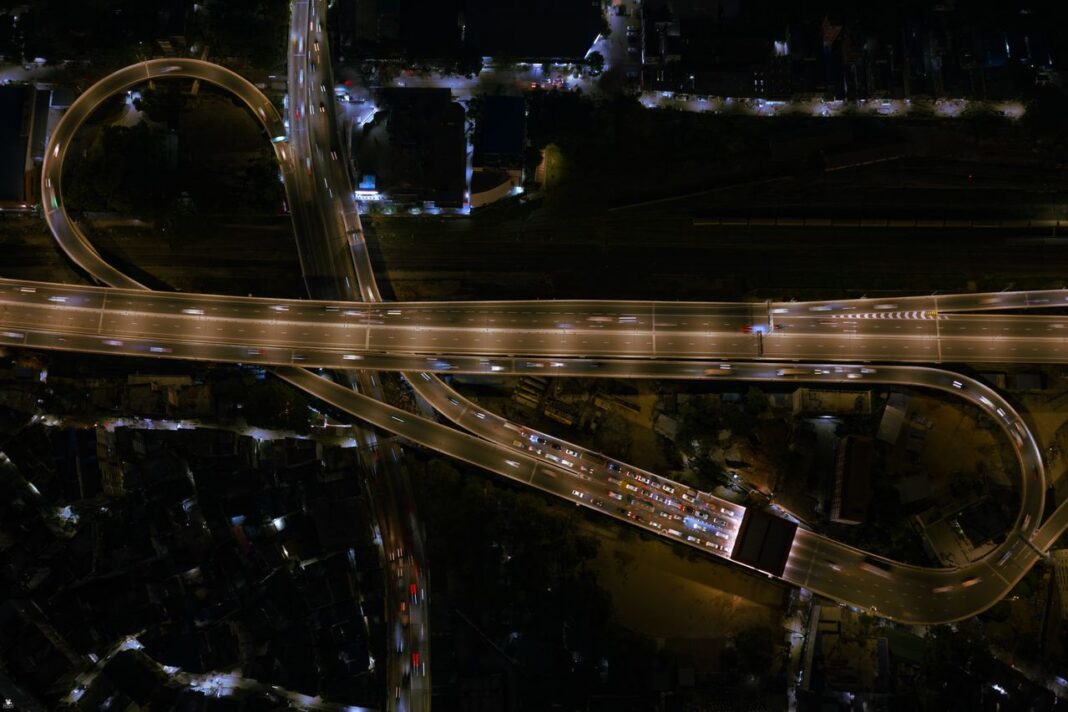
Delhi’s newly inaugurated Barapullah Phase-III flyover has run into traffic problems within days of opening, with severe congestion reported near Sundial Park. The issue has been linked to the way multiple traffic streams converge at a narrow section where the new elevated corridor connects with the existing Barapullah corridor.
The flyover was opened to traffic on 29 September with the objective of improving connectivity between Mayur Vihar and south Delhi and reducing travel time to around 15 minutes. However, commuters have reported delays of 40 to 60 minutes during peak periods since the corridor became operational.
A joint inspection by Delhi Traffic Police and the Public Works Department (PWD) on 1 October identified geometric and traffic-flow issues at the merger point. The three-lane Phase-III flyover meets other three-lane approaches, including routes from the Sundial side towards Sarai Kale Khan and from the Ashram and DND side. This results in traffic from roughly eight to nine lanes converging towards only three lanes on the older section of the Barapullah corridor.
The sharp alignment at the junction has added to the problem. Instead of a gradual transition, the new flyover connects with the existing structure through a relatively constrained, almost rectangular alignment. Vehicles approaching from different directions therefore have limited space to merge, creating conflicts and slowing traffic movement.
Traffic police drone surveys reportedly recorded queues extending up to 3.5 km on the first morning of operation. Officials also estimated that around 500,000 to 600,000 vehicles converged on the route, putting substantial pressure on the surrounding road network.
The congestion has raised questions about whether the downstream capacity of the existing corridor was adequately matched with the additional traffic expected from the new elevated section. While the flyover has increased road capacity on the approach, the reduction from multiple incoming lanes to three lanes at the convergence point has created a bottleneck.
Traffic personnel have been deployed to regulate vehicle movement around the affected junction. The PWD and traffic authorities are also considering structural and geometric modifications to improve the flow of vehicles.
The Barapullah Phase-III project was intended to provide a faster east-south Delhi connection and ease pressure on existing roads. The immediate congestion, however, highlights the importance of designing elevated corridors as part of an integrated road network rather than treating individual stretches as standalone infrastructure.
The authorities’ proposed changes will now be important in determining whether the new corridor can deliver the intended reduction in travel time once the merger-related bottleneck is addressed.