
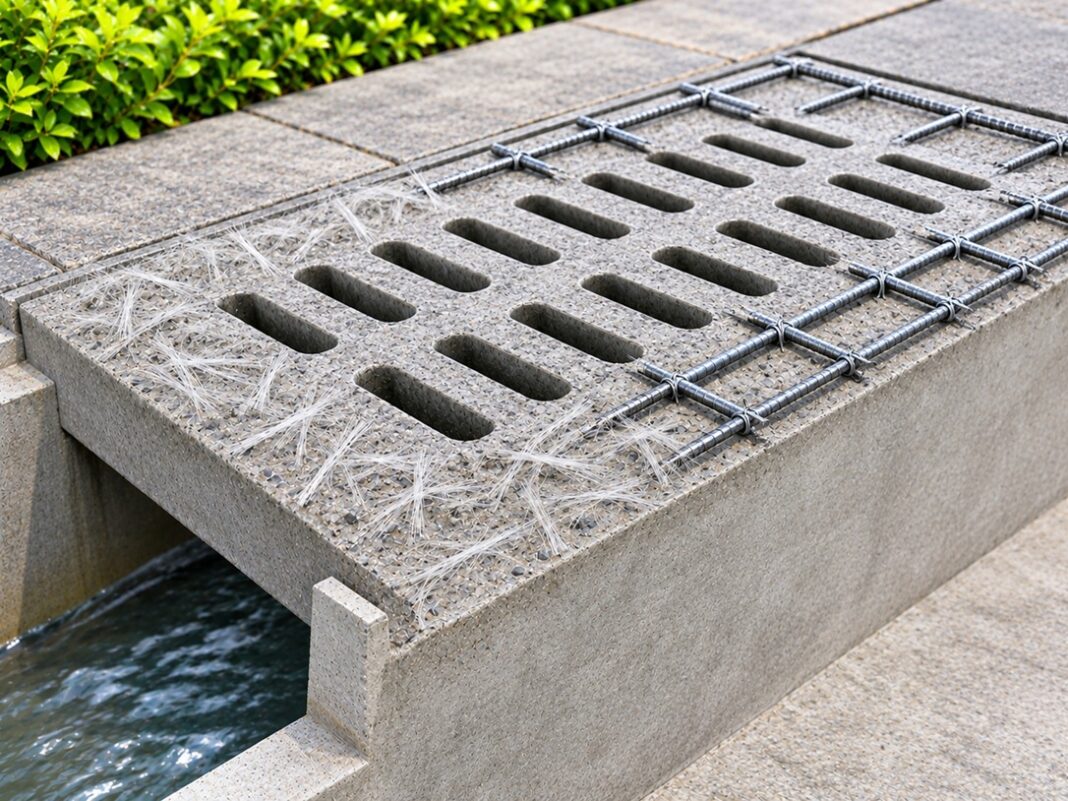
Drain cover slabs are exposed to repeated loads, impact and handling stresses during their service life. Selecting the right reinforcement is important to improve their toughness, energy absorption capacity and cost efficiency. A performance evaluation conducted by Kalyani Polymers Private Limited examines different combinations of steel reinforcement and macro synthetic fiber to identify suitable reinforcement options for concrete drain cover slabs.
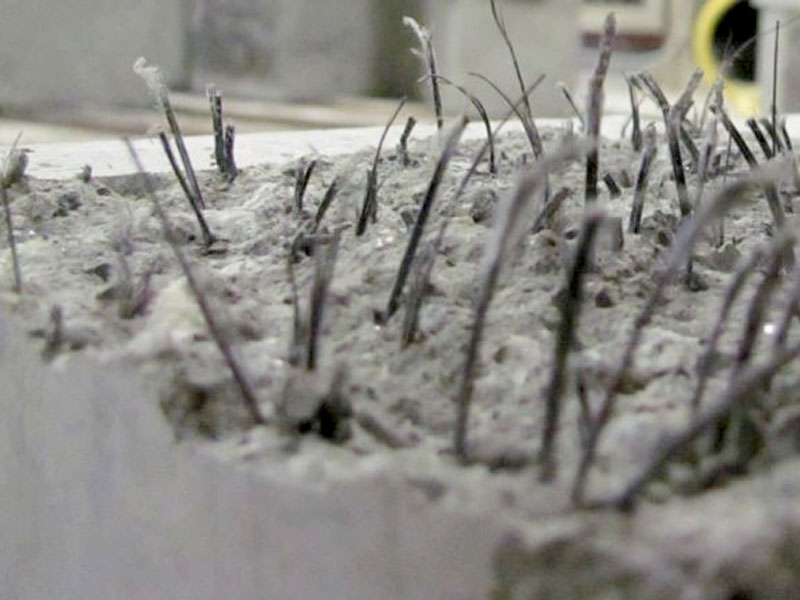
Steel and Fiber Reinforcement for Improved Drain Cover Performance
The study, titled Optimization of Toughness and Energy Absorption in Drain Cover Slabs Using Steel and Fiber Reinforcement, was conducted for Super Tiles & Marbles Pvt. Ltd. The report, dated March 3, 2025, compares four reinforcement configurations to assess their energy absorption performance at different concrete ages and their reinforcement costs.
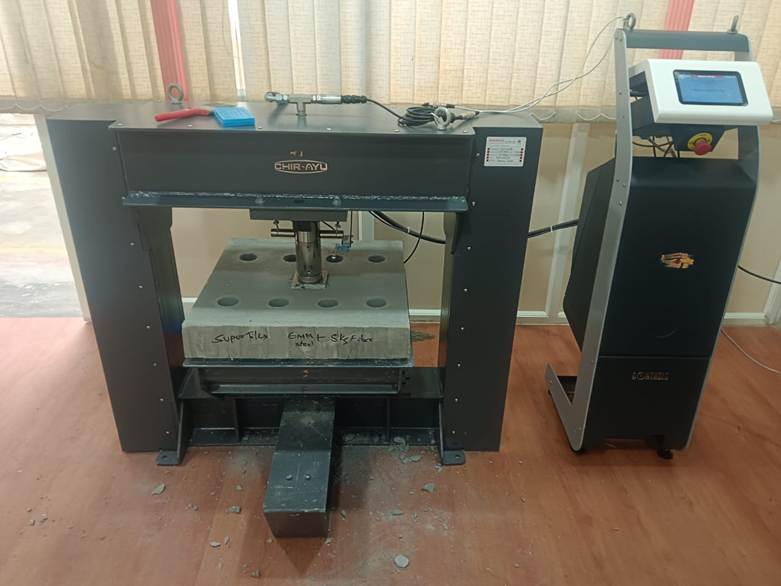
The evaluation used drain cover slabs measuring 600 × 600 × 100 mm. The specimens were cast on February 1, 2025, and tested on March 1, 2025, following EN 14488-5:2006. The objective was to identify a cost-effective reinforcement strategy that maintains suitable energy absorption and impact resistance.
Fiber Characteristics and Reinforcement Configurations
The study used embossed macro fibers manufactured by Kalyani Polymers Private Limited under the FIBERCRETE brand. The fibers had a length of 55 mm, a diameter of 0.60 mm, a tensile strength exceeding 550 MPa and a modulus of elasticity exceeding 6 GPa.
Four reinforcement configurations were evaluated:
- Regular 8 mm steel reinforcement: The conventional reinforcement option used as the reference for comparison.
- 8 mm and 6 mm steel with fiber: A hybrid arrangement combining two steel reinforcement sizes with 4 kg of fiber.
- 6 mm steel with fiber: A combination of 6 mm steel reinforcement and 5 kg of fiber.
- Fiber-only reinforcement: A configuration using 10 kg of fiber without steel reinforcement.
The evaluation compared the energy absorption of each configuration at 9 and 28 days to understand how reinforcement selection affected toughness over time.
Energy Absorption and Performance Evaluation
Energy absorption was assessed to compare the ability of the reinforced drain cover slabs to withstand loading and absorb energy before failure. The results indicated differences between conventional steel reinforcement, hybrid reinforcement and the fiber-only configuration.
The combination of 6 mm steel reinforcement and 5 kg of fiber recorded the highest reported energy absorption value of 1,673 joules at 28 days. This configuration performed better than the other tested options in the reported comparison.
The fiber-only specimen, containing 10 kg of fiber, recorded lower energy absorption values than the hybrid steel-and-fiber configurations. This indicates that combining steel reinforcement with macro fibers can provide better energy absorption performance than relying exclusively on fibers under the conditions evaluated.
The report also noted that all specimens except the conventional steel-reinforced specimen showed an increase in energy absorption between 9 and 28 days. This suggests that the hybrid reinforcement configurations continued to develop their energy absorption performance as the concrete matured.
Reinforcement Cost Comparison
The report compared reinforcement costs per slab using assumed prices of ₹55 per kg for steel and ₹250 per kg for fiber. Steel fabrication charges were excluded from the calculation.
The reported reinforcement costs were:
- Regular 8 mm steel reinforcement: ₹155 per slab
- 8 mm and 6 mm steel with 4 kg of fiber: ₹122 per slab
- 6 mm steel with 5 kg of fiber: ₹105 per slab
- 10 kg fiber-only reinforcement: ₹90 per slab
The fiber-only option had the lowest reported reinforcement cost. However, its energy absorption performance was lower than that of the hybrid configurations. The 6 mm steel and 5 kg fiber combination offered a balance between the reported cost and energy absorption performance.
Compared with the conventional steel option at ₹155 per slab, the hybrid configuration at ₹105 per slab represents a reported reinforcement cost reduction of approximately 32%. This comparison is based on the report’s stated material prices and excludes steel fabrication charges.
Key Findings from the Evaluation
The study highlights several considerations for drain cover slab reinforcement:
- Hybrid steel-and-fiber reinforcement can improve energy absorption compared with the tested fiber-only configuration.
- The 6 mm steel and 5 kg fiber combination recorded the highest reported energy absorption at 28 days.
- Introducing fibers reduced the calculated reinforcement cost across the tested hybrid configurations.
- The fiber-only configuration had the lowest reinforcement cost but did not deliver the highest energy absorption.
- Energy absorption increased between 9 and 28 days for all tested specimens except the conventional steel-reinforced option.
These findings indicate that reinforcement selection should consider both mechanical performance and material cost rather than focusing on the lowest initial reinforcement expense alone.
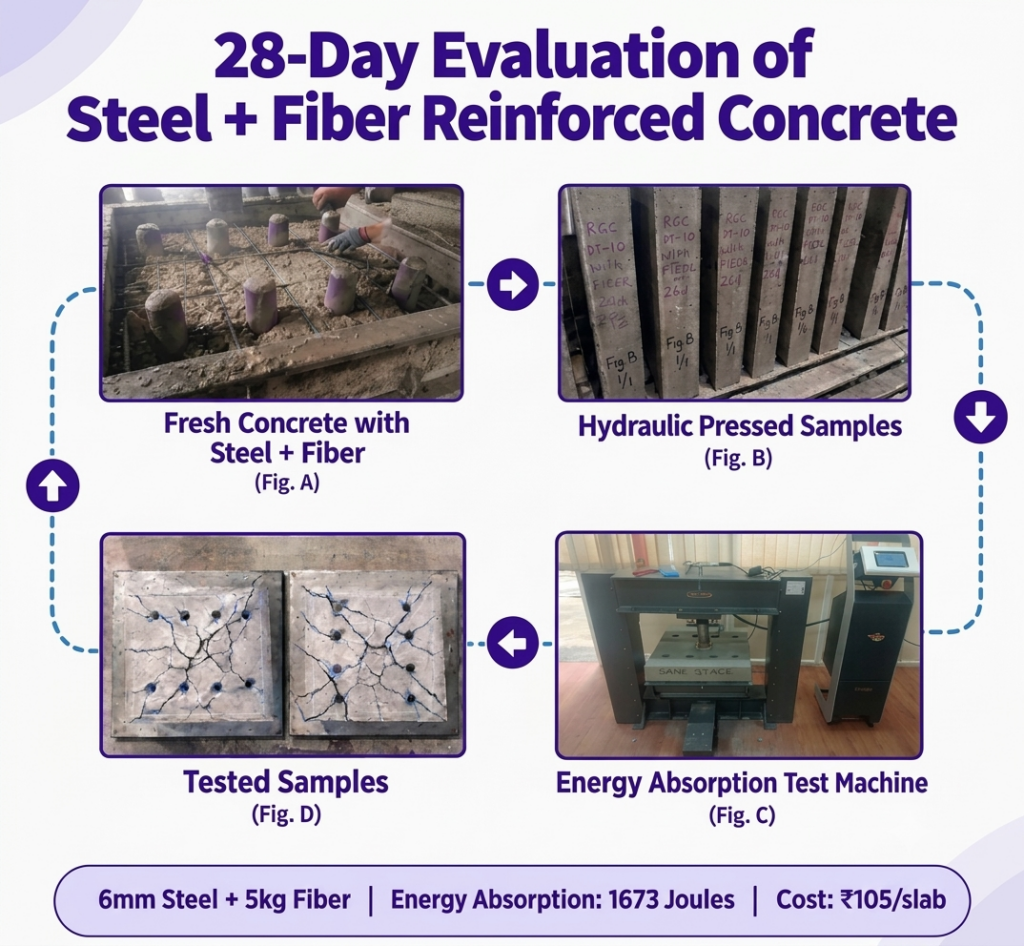
The evaluation identifies the combination of 6 mm steel reinforcement and 5 kg of embossed macro fiber as the best-performing option among the four configurations tested, recording 1,673 joules of energy absorption at 28 days at a reported reinforcement cost of ₹105 per slab.
The results demonstrate the potential of hybrid reinforcement to balance energy absorption and material cost in precast concrete drain covers. However, the findings apply to the specific slab dimensions, materials, test conditions and reinforcement configurations used in this study. Further assessment of load capacity, crack behavior, durability and applicable project requirements is necessary before adopting the configuration for a particular application.
Kalyani Polymers Private Limited, through its FIBERCRETE range of synthetic concrete fibers, continues to develop reinforcement products for construction applications. The study on drain cover slabs highlights the potential of combining macro synthetic fibers with steel reinforcement to improve energy absorption and manage reinforcement costs. Such evaluations help demonstrate the performance of fiber-reinforced concrete and support manufacturers and construction professionals in selecting suitable reinforcement options for precast concrete products based on project requirements.

“ENHANCE. ENERGIZE. ELEVATE”
KALYANI POLYMERS PVT LTD
46/1, 11th KM Off Kanakapura Road, Doddakalasandra. Bangalore – 560062 Karnataka, INDIA
Phone: +91-80-40991198, +91-80-40991001
Email: sales@fibercrete.in
Website: www.fibercrete.in






