
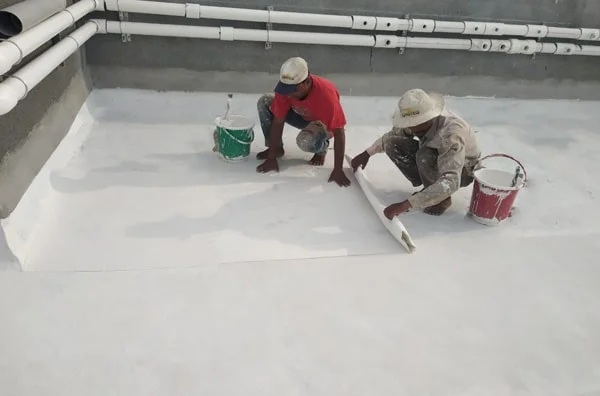
Waterproofing is one of the most important considerations in civil construction, yet it is often treated as a finishing operation rather than a fundamental part of structural design. Buildings, tunnels, foundations, retaining walls, bridges, reservoirs, and underground infrastructure are continuously exposed to moisture, groundwater pressure, temperature fluctuations, and chemical contaminants. Without an appropriate waterproofing system, water infiltration can gradually compromise structural materials, accelerate corrosion, damage interior spaces, and increase long-term maintenance costs.
The performance of a waterproofing system depends heavily on the materials used to create it. Modern polymer-based technologies, including polyvinyl chloride (PVC) geomembranes and flexible waterproofing coatings, have expanded the options available to engineers. These materials offer different combinations of chemical resistance, elasticity, durability, and substrate compatibility.
Understanding the material science behind these solutions allows construction professionals to make better specification decisions, particularly when projects involve challenging environmental conditions or extended service-life requirements.
Why Material Selection Determines Waterproofing Performance
A waterproofing system must do more than prevent water from passing through a surface. It needs to maintain its protective properties under mechanical stress, environmental exposure, and changing operating conditions.
For example, a basement foundation may experience continuous hydrostatic pressure, while a bridge deck must withstand temperature variations, vibration, and repeated traffic loading. A wastewater treatment facility faces another challenge: prolonged contact with chemically aggressive liquids.
These different conditions require materials with specific physical and chemical characteristics.
Engineers generally evaluate several performance factors before selecting a waterproofing product:
- Water impermeability: The material must prevent liquid water from penetrating through its structure, joints, or interfaces.
- Chemical resistance: It should withstand exposure to salts, acids, alkalis, oils, and other substances expected at the project site.
- Flexibility: The waterproofing layer must accommodate substrate movement, thermal expansion, and minor structural deformation.
- Mechanical strength: Resistance to punctures, abrasion, tearing, and installation damage is particularly important for exposed membranes.
- Durability: The material should retain its essential properties throughout the intended service life.
- Substrate compatibility: Adhesion, chemical interaction, and movement compatibility must be appropriate for the underlying construction material.
No single product performs equally well under every condition. Material selection therefore requires an understanding of both the polymer itself and the environment in which it will operate.
Understanding PVC Geomembranes and Their Material Properties
Polyvinyl chloride is a widely used thermoplastic polymer in construction and industrial applications. Its versatility comes from the ability to modify its properties through formulation, processing, and the incorporation of additives.
In waterproofing applications, flexible PVC geomembranes are particularly valuable because they combine low permeability with the ability to accommodate movement. Unlike rigid waterproofing barriers, flexible membranes can deform within their designed limits without immediately losing their protective function.
The Role of Plasticizers in Flexibility
Pure PVC is naturally rigid. To produce flexible membranes, manufacturers incorporate plasticizers that reduce intermolecular forces within the polymer structure, allowing polymer chains to move more freely.
This modification improves elongation and flexibility, making the material suitable for applications involving uneven surfaces, settlement, or thermal movement.
However, plasticizer selection is important. Different plasticizer chemistries influence flexibility, migration resistance, volatility, and long-term aging behavior.
If plasticizers gradually migrate out of a membrane, the material may become harder and less flexible. This can increase its vulnerability to cracking, particularly when exposed to low temperatures or repeated deformation.
Consequently, engineers should consider not only the initial flexibility of a PVC membrane but also its ability to retain that flexibility over time.
Chemical Resistance and Polymer Stability
PVC has a useful resistance profile against many inorganic acids, alkalis, salts, and other chemical substances. This makes appropriately formulated PVC membranes suitable for various industrial and civil engineering environments.
Nevertheless, chemical resistance is formulation-dependent. Concentration, temperature, exposure duration, and the presence of multiple chemicals can significantly influence performance.
For example, a membrane used in a water containment structure may encounter relatively mild conditions, whereas a lining installed in an industrial wastewater facility could face continuous exposure to aggressive compounds.
Project specifications should therefore require chemical compatibility data relevant to the actual service environment rather than relying on general statements about PVC resistance.
Material consistency also begins with the quality of the polymer inputs. Working with an established PVC resins supplier can help manufacturers evaluate resin characteristics, processing suitability, and consistency when developing formulations for demanding construction applications.
Flexible Waterproofing Coatings: An Alternative to Sheet Membranes
PVC geomembranes are not the only polymer-based waterproofing solution available. Liquid-applied coatings provide another approach, particularly where complex geometries, numerous penetrations, or irregular surfaces make sheet installation difficult.
These products are generally applied as liquids and subsequently cure or dry to form a continuous protective layer.
Common polymer-based coating technologies include:
- Polyurethane coatings
- Acrylic waterproofing membranes
- Polymer-modified cementitious coatings
- Epoxy-based protective systems
- Hybrid elastomeric coatings
Each technology has a different chemical structure and performance profile.
Polyurethane Waterproofing Coatings
Polyurethane systems are frequently used where flexibility and resistance to water exposure are important. Depending on their formulation, they can form seamless membranes with good adhesion to prepared concrete and other compatible substrates.
Their elastic properties allow them to accommodate certain levels of substrate movement. This makes them useful for terraces, balconies, podium decks, and selected below-grade applications.
However, moisture conditions during application, curing requirements, film thickness, and ultraviolet exposure must be considered. Some polyurethane formulations also require protective layers when exposed to prolonged sunlight.
Acrylic and Cementitious Polymer Systems
Acrylic coatings are often selected for above-ground applications where weather resistance, flexibility, and ease of application are relevant. They can be particularly useful on roofs and exposed construction surfaces.
Polymer-modified cementitious waterproofing products combine cement-based materials with polymer components to improve adhesion, flexibility, and water resistance.
These systems are frequently used in bathrooms, water tanks, concrete foundations, and other areas where compatibility with mineral substrates is important.
Their movement accommodation is generally different from that of highly elastic polyurethane coatings or flexible PVC membranes. Engineers should therefore assess the expected crack movement and structural deformation before specifying them.
Temperature Resistance and Long-Term Flexibility
Temperature variation is a major factor affecting waterproofing performance.
Construction materials expand when heated and contract when cooled. If the waterproofing layer cannot accommodate these dimensional changes, stresses may develop at joints, interfaces, and areas of restricted movement.
In colder environments, some polymer membranes become less flexible. This can increase the risk of cracking during installation or under mechanical loading.
At elevated temperatures, polymer chains may become more mobile, potentially changing stiffness, dimensional stability, and mechanical strength. Prolonged heat exposure can also accelerate oxidation and other aging processes.
For this reason, engineers should examine the operating temperature range of a waterproofing product rather than relying exclusively on its standard laboratory performance.
Relevant evaluation parameters include:
- Flexibility at low temperatures
- Tensile strength at different temperatures
- Elongation at break
- Dimensional stability under heat
- Resistance to thermal cycling
- Retention of mechanical properties after accelerated aging
Thermal cycling tests can be particularly useful because they simulate repeated temperature changes rather than evaluating performance at a single fixed condition.
The location of the waterproofing system also matters. A membrane installed beneath protective concrete may experience a relatively stable temperature environment, while an exposed roof membrane may undergo substantial daily temperature fluctuations.
Substrate Compatibility and Adhesion Requirements
Even a high-quality waterproofing material can fail if it is incompatible with the surface beneath it.
Concrete, masonry, steel, and existing waterproofing layers each present different installation challenges. Surface porosity, moisture content, roughness, contamination, and chemical composition can influence adhesion and long-term performance.
Waterproofing on Concrete
Concrete is a common substrate in civil construction, but it is not always a uniform surface. Differences in curing, surface preparation, moisture content, and cracking can affect waterproofing application.
Liquid-applied coatings generally require appropriate surface preparation to achieve reliable adhesion. Loose particles, dust, oil, laitance, and incompatible coatings should be removed according to the manufacturer’s instructions.
Sheet membranes may be installed using mechanical fastening, adhesive systems, or loose-laid arrangements with suitable joint detailing. The preferred method depends on the membrane design and application.
Movement at Joints and Penetrations
Construction joints, expansion joints, pipe penetrations, and changes in surface direction are particularly vulnerable to leakage.
These areas require careful detailing because the waterproofing layer must remain continuous even when adjoining structural components move relative to one another.
Flexible membranes can help accommodate movement, but their effectiveness depends on appropriate installation details. Welded seams, compatible sealants, reinforcement layers, and termination bars may all contribute to system reliability.
A waterproofing specification should therefore address the complete assembly rather than describing only the membrane or coating material.
Durability, Aging, and Expected Service Life
Waterproofing systems are often installed in areas that are difficult and expensive to access after construction. Replacing a failed basement membrane, for example, may require excavation, structural disruption, and extensive repair work.
Long-term durability is consequently one of the most important specification considerations.
Polymer degradation can occur through several mechanisms:
Oxidation: Exposure to oxygen, heat, and certain environmental conditions can gradually alter polymer chains and reduce mechanical performance.
Ultraviolet degradation: Sunlight can cause surface deterioration, discoloration, embrittlement, or changes in material strength, depending on polymer chemistry and stabilization.
Plasticizer migration: In flexible PVC, the loss or migration of plasticizers can reduce elasticity over time.
Chemical attack: Continuous exposure to incompatible substances may cause swelling, softening, discoloration, or deterioration.
Mechanical fatigue: Repeated movement, vibration, and loading can gradually damage membranes and coatings, particularly around joints and stress concentrations.
Manufacturers may use stabilizers, reinforcing materials, protective layers, and carefully selected additives to improve resistance to these mechanisms.
For project specifiers, accelerated aging tests and retained-property measurements provide useful information. However, laboratory results should be interpreted alongside actual exposure conditions, installation quality, and maintenance requirements.
Testing Standards and Performance Verification
A material specification should establish measurable acceptance criteria rather than relying on general product descriptions.
Several testing categories are particularly relevant to waterproofing systems.
| Performance parameter | What it evaluates |
| Tensile strength | Resistance to pulling forces |
| Elongation at break | Ability to stretch before failure |
| Tear resistance | Resistance to propagation of tears |
| Puncture resistance | Ability to withstand localized penetration |
| Water permeability | Resistance to water transmission |
| Low-temperature flexibility | Performance under cold conditions |
| Chemical resistance | Stability during chemical exposure |
| Accelerated aging | Retention of properties after simulated aging |
| Seam strength | Integrity of joined membrane sections |
Standards such as ASTM D4437 provide guidance for field seaming of geomembranes, while ASTM D6392 addresses destructive seam testing of nonreinforced geomembranes joined by thermal methods.
For liquid-applied systems, ASTM D6083 and other application-specific standards may be relevant depending on the coating chemistry and intended use.
Engineers should verify the latest applicable editions and determine whether the selected test methods match the particular product category. A test result from one material classification should not automatically be treated as proof of compliance for another.
Installation Quality: The Link Between Material Science and Field Performance
Waterproofing failures are not always caused by defective materials. Poor installation practices can undermine even well-formulated polymer systems.
For sheet membranes, common issues include inadequate seam welding, insufficient overlap, wrinkles, punctures, and improper termination details.
For liquid-applied coatings, inconsistent application thickness, insufficient curing, poor surface preparation, and unfavorable weather conditions can create weak points.
Quality assurance should begin before installation and continue throughout the construction process.
A practical inspection program may include:
- Verifying that delivered materials match the approved technical submittals.
- Checking substrate condition and preparation.
- Confirming application temperature and environmental requirements.
- Inspecting membrane seams, overlaps, and penetrations.
- Measuring coating thickness where applicable.
- Performing specified leak-detection or water-tightness tests.
- Documenting repairs and final acceptance inspections.
For large geomembrane installations, seam testing and systematic inspection are particularly important because a small localized defect can compromise the containment function of a much larger area.
Selecting the Right Waterproofing Material for Different Civil Projects
The best waterproofing material depends on the project’s exposure conditions, structural design, installation constraints, and expected service life.
Underground foundations: Flexible sheet membranes and compatible liquid-applied systems may provide protection against groundwater and hydrostatic pressure. Joint detailing and resistance to soil contaminants are especially important.
Water reservoirs and containment structures: PVC geomembranes can provide an effective impermeable barrier when the selected formulation is compatible with the stored liquid and designed exposure conditions.
Tunnels and underground infrastructure: Waterproofing systems must accommodate structural movement, groundwater pressure, and complex connections. Membrane continuity and installation inspection are critical.
Roofs and exposed decks: Polyurethane and acrylic coatings may be suitable where seamless application and weather resistance are priorities. Ultraviolet stability and drainage design require careful consideration.
Industrial facilities: Chemical compatibility becomes a major selection criterion. Engineers should evaluate the actual substances, concentrations, operating temperatures, and exposure periods.
In every case, the selection process should consider the entire waterproofing assembly, including primers, adhesives, protection boards, drainage layers, sealants, and termination components.
Building More Reliable Waterproofing Specifications
High-performance waterproofing is the result of matching material properties to real construction conditions. Polymer chemistry determines many of the characteristics that make modern waterproofing systems effective, but those characteristics must be evaluated within the context of structural movement, environmental exposure, substrate behavior, and installation quality.
PVC geomembranes offer a useful combination of impermeability, flexibility, and chemical resistance for suitable containment and civil engineering applications. Flexible coatings provide additional options for complex surfaces and applications requiring seamless coverage. Neither technology is universally superior; each has advantages and limitations that must be understood during specification.
For civil engineers and project managers, the most reliable approach is to establish clear performance requirements, review technical documentation, verify chemical and substrate compatibility, and incorporate installation quality controls into the project plan.
Ultimately, effective waterproofing is not simply about selecting a product that prevents water penetration on the day of installation. It is about choosing a material system capable of maintaining its protective function under the conditions it will encounter throughout its intended service life.






