
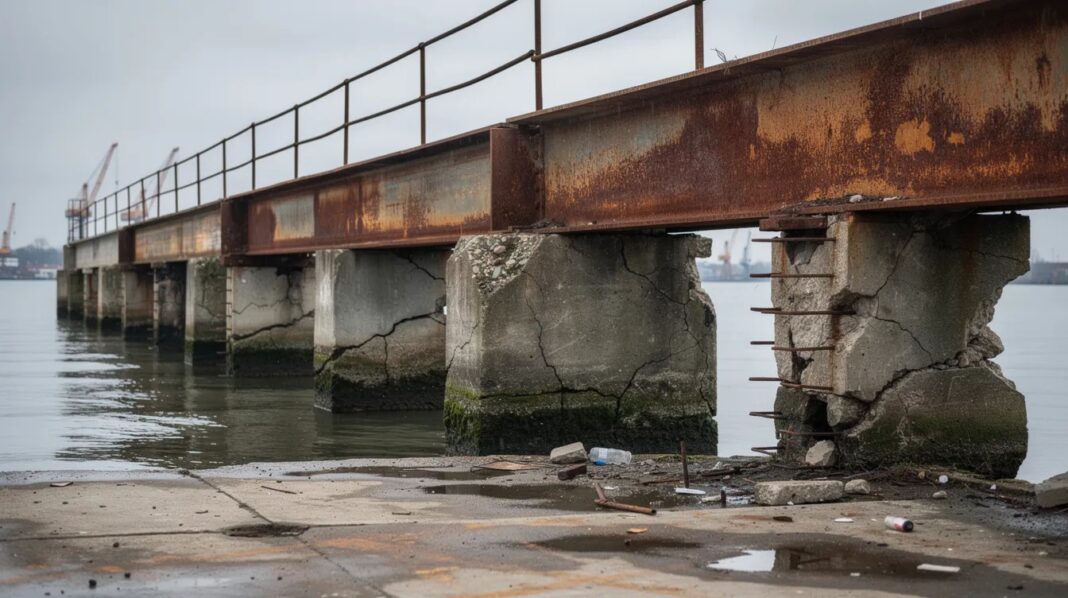
Marine environments present some of the most aggressive conditions for structural engineering worldwide. Between the constant assault of airborne salinity, relentless tidal cycles, and harsh ultraviolet exposure, steel and reinforced concrete assets face an ongoing battle against structural deterioration. For port facilities, coastal bridges, and offshore platforms, the operational demands are immense. Without robust protective barrier systems in place, the resulting structural failure can lead to catastrophic mechanical breakdowns, significant safety hazards, and immense financial burdens. Understanding the specific mechanisms of this decay is essential for effective asset management.
The Economic and Structural Toll of Salinity
When coastal concrete structures reach an advanced state of deterioration, repair costs routinely escalate to between 30 and 60 percent of the asset’s original construction cost. The financial stakes are remarkably high. Marine corrosion specifically affecting coastal and offshore structures accounts for an estimated $30 billion to $80 billion per year in direct global losses. According to the IMPACT Study by NACE International, the global cost of corrosion across all sectors is estimated at US$2.5 trillion annually, yet industries could save up to $875 billion each year by implementing proper corrosion management and assessment protocols.
Chloride-ion penetration from airborne coastal salinity is widely recognised as the primary trigger for structural failure in coastal reinforced concrete. These chlorides easily breach porous concrete to break down the passive oxide layer that protects internal steel rebar. Once protective barrier coatings fail in highly aggressive tidal and splash zones, localised corrosion rates can rapidly reach 0.5 to 1.5 millimetres per year. Even shallow defects of just one or two millimetres can significantly increase stress concentration factors, effectively reducing the fatigue life of marine structural components by an entire order of magnitude.
Verifying Defence Lines Against Deterioration
Because the consequences of unchecked decay are so severe, applying heavy-duty epoxy and polyurethane barriers is only the first step in asset protection. Routine verification of these protective systems is absolutely vital. A rigorous marine coating inspection ensures that surface preparation and application adhere to required benchmarks before the environment has a chance to compromise the underlying substrate.
The risks of ignoring these protocols are very real. A recent National Transportation Safety Board investigation into a bulk carrier crane collapse highlighted how undetected deterioration leads directly to catastrophic structural failures when detailed visual assessments are missed. These evaluations must be highly systematic. Standards like NACE No. 2 establish mandatory surface preparation benchmarks required before applying durable high-build marine coatings. Furthermore, recent revisions to ISO standards introduced Corrosivity Category CX to specifically address the extreme saline conditions of offshore and coastal environments. Modern engineering also heavily favours cyclic corrosion testing, which accurately simulates the wet and dry cycles unique to actual coastal climates rather than relying solely on continuous salt spray tests.
Key Focus Areas in Protective Coating Assessments
When engineering teams evaluate infrastructure durability, they look for specific indicators of coating breakdown. As highlighted across extensive industry resources covering construction durability and anti-corrosion applications on Constro Facilitator, understanding the exact mechanisms of failure helps engineers proactively reinforce critical assets.
During a typical structural evaluation in a coastal zone, certified inspectors focus on several critical failure points:
- Surface Adhesion and Blistering: Identifying areas where osmotic pressure has drawn moisture through the coating, causing it to detach from the steel or concrete substrate.
- Chalking and UV Degradation: Checking for the breakdown of the binder on the surface of the paint system, which can thin the protective layer over time.
- Micro-Cracking: Using specialised magnification tools to spot microscopic fractures that allow airborne chlorides to reach the structural core.
- Dry Film Thickness: Measuring the exact thickness of the applied paint system to ensure it meets the strict criteria required for Corrosivity Category CX environments.
Modern Innovations in Asset Maintenance
Evaluating these protective systems on massive maritime structures has traditionally been a logistical challenge. However, to combat access difficulties on large-scale infrastructure, there is a rapidly growing industry trend of utilising aerial drones and Remotely Operated Vehicles (ROVs). These modern tools assist certified evaluators in assessing coating degradation in hazardous or hard-to-reach offshore splash zones. By deploying ROVs, engineering teams can capture high-resolution visual data without requiring expensive and time-consuming scaffolding setups.
Additionally, maintaining optimal environmental conditions during maintenance work is critical. To ensure new barrier systems adhere properly without trapping moisture, industrial desiccant dehumidification systems are increasingly deployed during shipyard and port infrastructure maintenance. This precise atmospheric control ensures that the underlying steel remains completely dry before an inspector signs off on the final application.
Ultimately, proactive maintenance procedures are far more cost-effective than reactive major repairs. By enforcing strict assessment protocols and maintaining high-quality barrier systems, civil engineers and port managers can confidently extend the operational lifespan of vital coastal infrastructure.






