
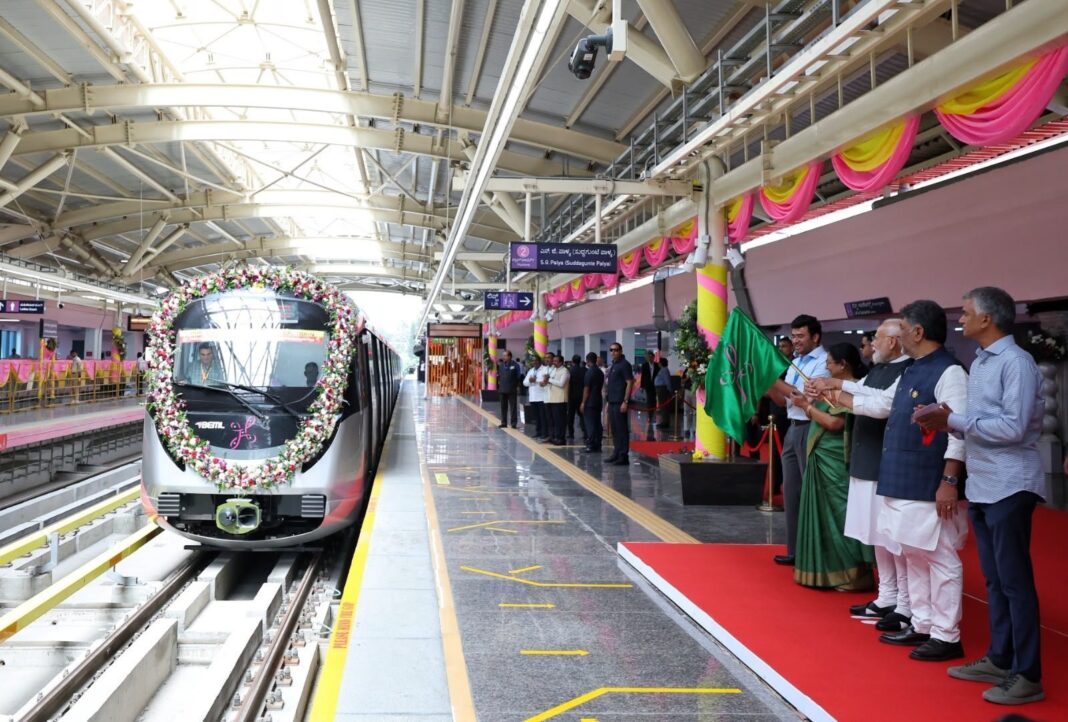
Prime Minister Narendra Modi inaugurated the Bengaluru Metro Pink Line on November 13, 2026, taking the city’s operational metro network beyond the 100 km mark for the first time. The newly opened elevated section connects Kalena Agrahara to Tavarekere over a distance of 7.5 km and includes six stations along Bannerghatta Road in South Bengaluru. The extension is expected to improve public transport connectivity across the southern parts of the city and provide commuters with better access to residential, commercial and institutional areas.
The inauguration was attended by Karnataka Chief Minister DK Shivakumar, Governor Sudha Yadav, Bengaluru South MP Tejasvi Surya and Greater Bengaluru Development Minister Krishna Byre Gowda. Before flagging off the service, Prime Minister Modi and Chief Minister Shivakumar purchased their metro tickets through the Unified Payments Interface (UPI) at the station counter.
The leaders subsequently travelled together on the new stretch from SG Palya to IIM Bengaluru station, marking the commencement of passenger services on the corridor.
Six Stations Along the Elevated Corridor
Developed at an estimated cost of Rs 3,470 crore, the newly inaugurated 7.5 km elevated section features six stations:
- Kalena Agrahara
- Hulimavu
- Bilekahalli-IIMB
- JP Nagar 4th Phase
- Jayadeva Hospital
- SG Palya
The corridor runs along Bannerghatta Road, one of Bengaluru’s important southern transport routes. The new stations are expected to improve access to key residential neighbourhoods, educational institutions, healthcare facilities and commercial destinations in the area.
The connection is particularly relevant for commuters travelling towards the IIM Bengaluru area and other major destinations in South Bengaluru. It will also provide an alternative to road-based transport on a corridor that experiences regular traffic movement.
Bengaluru Metro Network Crosses 100 Km
The inauguration marks an important development in Bengaluru’s urban transport infrastructure, with the operational metro network crossing 100 km for the first time. The expansion reflects the city’s ongoing efforts to strengthen mass rapid transit capacity in response to increasing population, urban development and commuting requirements.
The metro network plays an important role in connecting residential areas with employment centres, educational institutions and commercial districts. The addition of the Pink Line’s elevated section is expected to improve public transport options for residents in South Bengaluru and support better integration with the city’s wider metro system.
Bengaluru’s growing road traffic has increased the need for reliable public transport infrastructure. Metro expansion is expected to encourage more commuters to shift from private vehicles to mass transit, helping reduce pressure on major roads and improve travel efficiency.
The Pink Line inauguration also represents a significant step in the city’s broader metro expansion programme. With further corridor development and network integration, Bengaluru Metro is expected to strengthen connectivity across different parts of the city and support its long-term urban mobility requirements.






