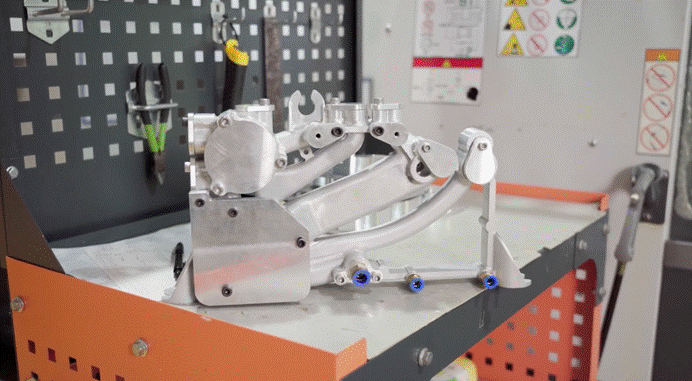
Flow channel components must satisfy more than dimensional requirements. Internal passages may need to remain visible, airtight, or electrically conductive. These functions influence material selection, machining, joining, and finishing. For CNC aluminum machining, the manufacturing route must account for channel geometry, thin walls, surface treatment, and inspection so the final component performs as intended.
The Manufacturing Challenges Behind Flow Channel Components
Internal channels are difficult to inspect due to hidden surfaces that exist post-machining. The complexity of the internal path such as curved passages, intersecting paths, and narrow walls limit tool access while also increasing risk of deformation. Therefore the orientation of the tool, as well as workholding and sequence of cuts need to be considered prior to cutting the part. This is important when producing custom machining parts.
Another major constraint to consider is material behavior. Aluminum has excellent strength-to-weight ratio, is highly conductive and offers many other benefits; however, once aluminum has been anodized, it will have altered electrical and surface characteristics. These considerations are necessary when planning CNC aluminum machining for flow channel components.
On the other hand, transparent engineering plastics pose their own challenge: the surface finish created by machining will often provide a frosted appearance which makes viewing through the channel impossible. In this case, a route must be developed to machine around the functionality of the channel, rather than just its dimensions.
Additionally, in cases where an economical method of producing a single piece with a curved channel does not exist, joining may become necessary. However, splitting the component would allow for cutter access to all areas of the channel. The joint must maintain alignment, flatness, and airtightness.
Sealing, Transparency, and Conductivity: Three Common Engineering Requirements
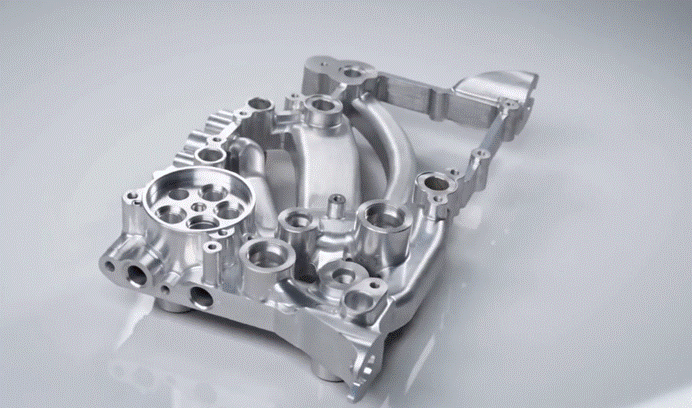
Transparency is useful when airflow or fluid movement must be observed directly. In the Ultem 1000 dual-solenoid valve manifold, the material itself was transparent, but CNC machining left the internal channel surfaces frosted. Vapor polishing was therefore added after finishing to restore optical clarity to the channel walls.
Vapor polishing can reach internal channels and apertures that are difficult to polish mechanically. WayKen applies the process to suitable plastics where internal surface clarity is required.
Sealing creates a different manufacturing problem.
In the automotive air-conditioning flow-channel plate, curved internal geometry required the component to be divided into upper and lower sections before joining. For custom machining parts with complex internal geometry, splitting can improve tool access. Conventional welding risked large weld seams and heat-affected zones, making airtightness and the required 0.3 mm post-weld flatness difficult to control. Friction stir welding provided a lower-heat joining route, with staged sealing tests incorporated into production.
Conductivity can conflict with protective finishing.
In the pneumatic manifold, hard anodizing required a 25–30 micron layer for hardness, wear, and corrosion resistance, while selected areas around the channel ends had to remain conductive. Critical holes also required 0.1–0.3 mm positional accuracy. Secondary machining removed anodizing from precision holes, while laser engraving removed it from areas without strict positional requirements. Chromate treatment then restored corrosion protection to exposed areas.
How WayKen Selects the Right Process for Complex Flow Channel Parts
Selecting the right process for complex flow-channel parts should always start with the part’s functional requirements. An open-through passageway would likely require machining plus polishing; a sealed through passageway could have machined in two halves which are then assembled using some type of join or fastener that is controlled.
An aluminum passageway with requirement for electrical conductivity might be required to use selective surface removal of previous anodic coatings, and/or other coatings. Critical holes within the passages will often require final machining after coating has been applied; conversely, surfaces intended for assembly will require sufficient material quantity prior to assembly and should be flat as well.
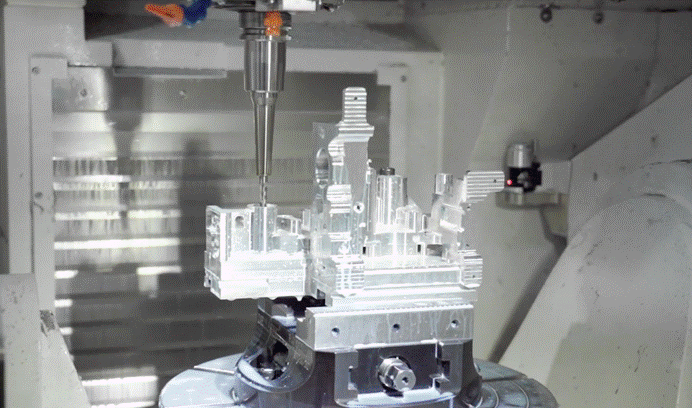
WayKen’s five-axis machining work on medical articulated-arm components demonstrates the importance of internal accessibility. The parts had internal passageways, undercuts, slanted holes, and intersecting passageways. Simulation software utilizing CAM evaluation was used to determine optimal tool approach to each area of the part, along with use of long-reach cutters and five axis directional drilling to achieve difficult-to-access areas.
When inspecting CNC aluminum machining parts, it is important to go beyond the dimensional check. Dimensional verification will be needed for flow passageways; leakage tests may also be required for joints; and resistivity checks will be necessary for electrically conductive areas.
Conclusion
Flow channel manufacturing requires processes to work together around the component’s function. Transparency may depend on specialized polishing, sealing may require controlled joining and leak testing, while conductivity can require selective coating removal. Machining, surface treatment, joining, and functional inspection should therefore be selected together.