
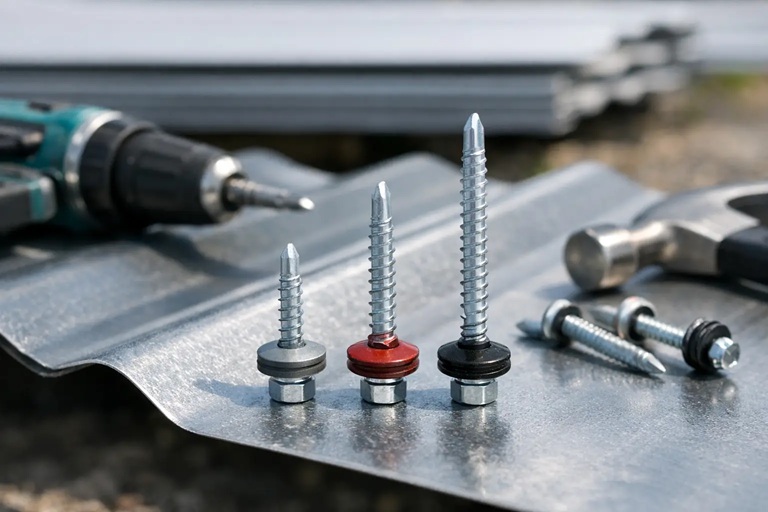
Metal roofing gets a lot of attention for its panels: the gauge, the coating, the profile. The screws holding those panels down get far less. That’s a problem, because on an exposed-fastener roof, the screws are often the first thing to fail.
A single roof can have thousands of fasteners. If they’re the wrong type, the wrong length, or installed badly, every one of them is a potential leak. Here’s what to look at when choosing and installing metal roofing screws.
Know what you’re fastening into
The first question is what sits under the panel. Metal roofing screws are built for one of two jobs.
- Metal to wood. These have a sharp point and coarse threads that bite into timber purlins, battens, or roof decking. They’re the standard choice for residential roofs, barns, and sheds framed in wood.
- Metal to metal. These have a drill point that cuts through steel purlins before the threads engage. The drill point is rated for a range of steel thickness, so match it to the purlin gauge. A point that’s too small for thick steel will burn out before it breaks through.
Using a wood screw on steel framing, or a drill point screw on soft timber, leads to stripped holes and loose panels.
Get the size and length right
Roofing screws are sold by gauge (diameter) and length. Gauges 10, 12, and 14 are the most common. Larger gauges give more holding power and are used on heavier panels or in high-wind areas.
Length matters just as much. For metal to wood, the screw should pass through the panel and penetrate the wood by at least an inch, more where local codes or the panel manufacturer require it. Measure the full stack: panel, any insulation or underlayment, and the framing member.
On ribbed panels, screws placed through the high rib need to be longer than those in the flat, because they travel through the air gap before reaching the framing. Always follow the panel manufacturer’s fastening pattern, since it’s what the wind rating is based on.
Don’t overlook the washer
The sealing washer does the waterproofing. Most roofing screws use an EPDM rubber washer bonded to a metal backing. EPDM stays flexible through heat and cold and resists UV, which is why it’s the industry standard.
The washer only works if the screw is driven correctly:
- Under-driven: the washer doesn’t compress, leaving a gap for water to get in.
- Over-driven: the washer squashes out sideways, splits, or dimples the panel. It will leak sooner rather than later.
- Driven at an angle: the washer seals on one side only.
The target is a washer compressed just enough to bulge slightly at the edge. A screw gun with a depth-setting nose piece or an adjustable clutch makes this consistent across a whole roof.
Match the material to the environment
This is where many roofs come up short. The panel might carry a 40-year coating, but if the screws rust out in ten, the roof still fails.
Zinc-plated carbon steel screws are fine for many inland jobs. Near the coast, around livestock buildings, or anywhere with heavy moisture or chemical exposure, they corrode much faster. In those settings, fully stainless steel roofing screws are the safer choice, because there’s no plated shaft to corrode under the washer.
Be careful with screws that have only a stainless head on a zinc-plated shaft. They look stainless from above, but the shaft inside the panel can still rust. Zinc-aluminum capped heads are another option that adds corrosion protection to the exposed head.
Also avoid mixing metals that react with each other. Fasteners should be compatible with the panel material, especially with aluminum or copper roofing, to prevent galvanic corrosion.
Choose the right head for the job
Most exposed-fastener roofs use a hex washer head, which is easy to drive and seats the washer evenly. A few specialty heads are worth knowing:
- Pancake or low-profile heads for fastening standing seam clips and trim, where a hex head would interfere with the panel above.
- Color-matched heads that are painted to blend with the panel finish.
- Oversized repair screws for re-roofing or fixing stripped holes, where the original screw no longer holds.
Build inspection into maintenance
Even good fasteners need checking. Thermal movement loosens screws over time, and washers age faster on roofs that bake in the sun all year.
A quick inspection every year or two, plus after major storms, catches problems early. Look for backed-out screws, cracked or brittle washers, and rust streaks below fastener lines. Replacing a few hundred screws is cheap compared to repairing water damage in the structure below.
The bottom line
The screws are a small part of a roofing budget but a big part of how long the roof lasts. Match the screw to the substrate, size it to the full stack, drive it to the right depth, and choose a material that suits the environment. Get those four things right and the fasteners will last as long as the panels they hold.






