
Introduction
Retail businesses have always needed to understand customer behaviour. Knowing how many people visit a store, how they move through different areas, and what influences purchasing decisions can directly affect operational efficiency and revenue growth.
For many years, retailers relied on traditional footfall counters to measure visitor numbers. These systems provided basic information, such as how many people entered or exited a location.
However, modern retail requires more detailed insights.
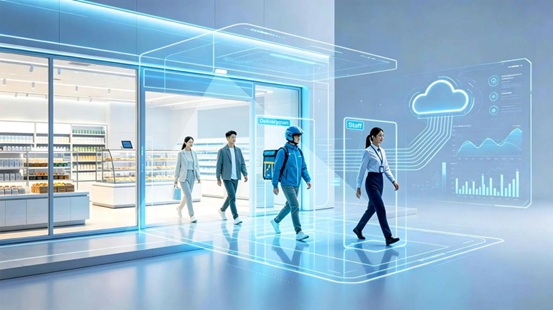
A store entrance does not only record potential customers. It may also include employees arriving for work, delivery riders collecting online orders, and existing customers entering multiple times during the day. Counting every movement as a new visitor can create inaccurate business data.
This is where an AI people counting system becomes valuable.
By combining artificial intelligence, computer vision, and data analytics, modern counting solutions help businesses understand real customer activity instead of simply measuring movement.
What Is an AI People Counting System?
An AI people counting system is an intelligent analytics solution that uses artificial intelligence technologies to detect, track, and analyse human movement in physical environments.
Unlike traditional counters that only record the number of entries and exits, AI-based systems can analyse additional information, including:
- Visitor flow patterns
- Occupancy levels
- Customer movement trends
- Dwell time
- Repeat visits
- Staff and visitor differences
The goal is not only to count people but to transform movement data into meaningful business insights.
In retail environments, this technology supports better decisions related to store management, marketing evaluation, layout optimisation, and customer experience improvement.
Why Traditional Footfall Counting Has Limitations
Traditional footfall measurement remains useful, but it has an important limitation: it treats every detected movement equally.
For example, a retail store may record hundreds of additional entries from:
Employees
Staff members frequently enter and exit stores throughout the day. Shift changes, breaks, and operational activities can increase traffic numbers without creating new sales opportunities.
Delivery Riders
With the growth of online ordering, delivery riders collecting customer orders have become a common source of additional store traffic. Although they enter the store, they are usually not browsing or purchasing products.
Repeat Visitors
Some customers may enter the same store multiple times in one day. Traditional systems may count each visit as a separate customer, increasing traffic numbers without reflecting actual visitor growth.
These examples create a difference between raw foot traffic and real shopping activity.
For retailers, understanding this difference is essential because inaccurate traffic data can affect conversion analysis, staffing decisions, and marketing evaluation.
How Artificial Intelligence Improves Retail Analytics
The development of computer vision has significantly improved the capabilities of people counting technology.
A modern AI people counting system can analyse visual information and identify patterns that simple sensors cannot detect.
Key technologies include:
Computer Vision
Computer vision allows systems to detect and analyse human presence within a defined area. Advanced algorithms can identify movement direction, track visitors, and improve counting accuracy in complex environments.
Edge AI Processing
Edge AI enables data processing directly on local devices rather than relying completely on cloud servers.
This approach provides faster responses, reduces network dependency, and supports privacy-conscious applications by minimising unnecessary data transmission.
Behaviour Recognition
AI algorithms can analyse movement patterns to distinguish between different visitor activities.
For example, a system can help identify whether traffic comes from employees, delivery activities, or genuine customer visits.
Data Analytics
After collecting movement information, analytics platforms convert raw data into useful business intelligence.
Retailers can evaluate customer traffic trends, identify busy periods, and compare store performance using more meaningful measurements.
The Role of Effective Customer Traffic in Modern Retail
One important concept emerging in retail analytics is effective customer traffic.
Unlike traditional footfall, which measures all detected visitors, effective customer traffic focuses on visitors who represent genuine business opportunities.
This approach helps retailers answer more valuable questions:
- How many visitors are potential shoppers?
- Which locations attract stronger customer interest?
- Are marketing campaigns generating valuable store visits?
- Does store traffic translate into purchasing opportunities?
By filtering out employee movement, delivery collection visits, and repeated entries, businesses gain a clearer understanding of actual customer demand.
Solutions developed by companies such as FOORIR demonstrate how AI-powered people counting technology is helping retailers move from simple visitor measurement toward more meaningful traffic intelligence.
Applications of AI People Counting Technology
AI people counting systems are now used across different industries.
Retail Stores
Retailers use traffic analytics to understand customer behaviour, optimise store layouts, and improve staffing strategies.
Shopping Malls
Shopping centres analyse visitor flow between different areas to evaluate tenant performance and improve customer experiences.
Museums and Public Facilities
Visitor counting helps organisations monitor occupancy, manage resources, and improve safety.
Smart Buildings
Building operators use occupancy analytics to improve space utilisation and energy management.
How AI Traffic Analytics Supports Better Decisions
Accurate customer traffic analysis provides benefits across multiple business functions.
Marketing teams can better evaluate campaign performance by understanding whether increased visits represent valuable customers.
Store managers can schedule employees based on actual customer demand instead of relying only on general visitor numbers.
Business leaders can compare locations more accurately and make better expansion decisions using reliable data.
The value of AI people counting is not only in collecting information. It is in creating information that businesses can trust.
The Future of AI-Based Retail Analytics
As physical retail becomes more data-driven, businesses will continue looking for better ways to understand customer behaviour.
Simple visitor counting is gradually becoming part of a larger retail intelligence ecosystem that combines artificial intelligence, analytics, and operational decision-making.
The future of retail measurement will not focus only on how many people enter a store. It will focus on understanding who those visitors are, what actions they take, and how their behaviour contributes to business outcomes.
AI people counting systems represent an important step in this transformation.
By turning ordinary movement data into actionable insights, artificial intelligence is helping retailers create smarter, more efficient, and more customer-focused environments.






