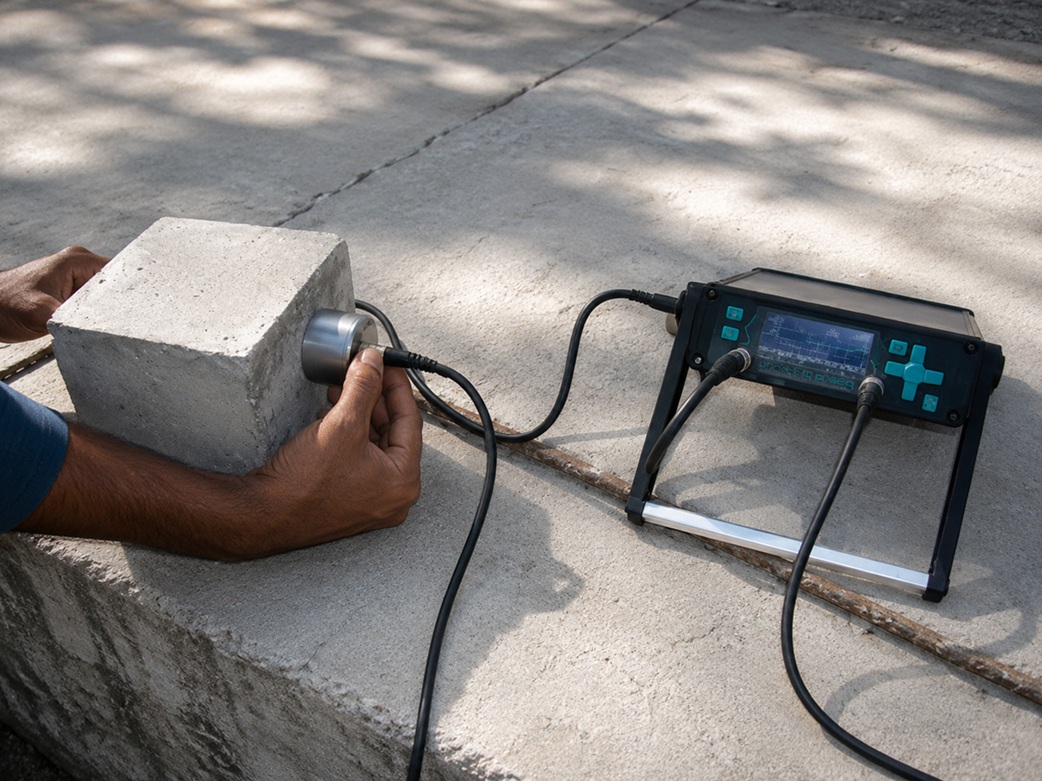
The Ultrasonic Pulse Velocity (UPV) test is a widely used non-destructive testing (NDT) method in civil engineering for assessing the quality, uniformity, and internal condition of concrete structures. It is a simple, fast, and effective technique that helps engineers evaluate concrete without damaging the structure. The main idea behind this test is straightforward: sound waves travel through good-quality concrete faster than through cracked, porous, or weak concrete.
Principle of UPV Test
The UPV test works on the principle of wave propagation through solids.
An ultrasonic pulse is introduced into the concrete using a transmitting transducer. The wave travels through the material and is received by a receiving transducer placed at a known distance. The time taken by the pulse to travel through concrete is measured electronically.
The velocity is calculated using:
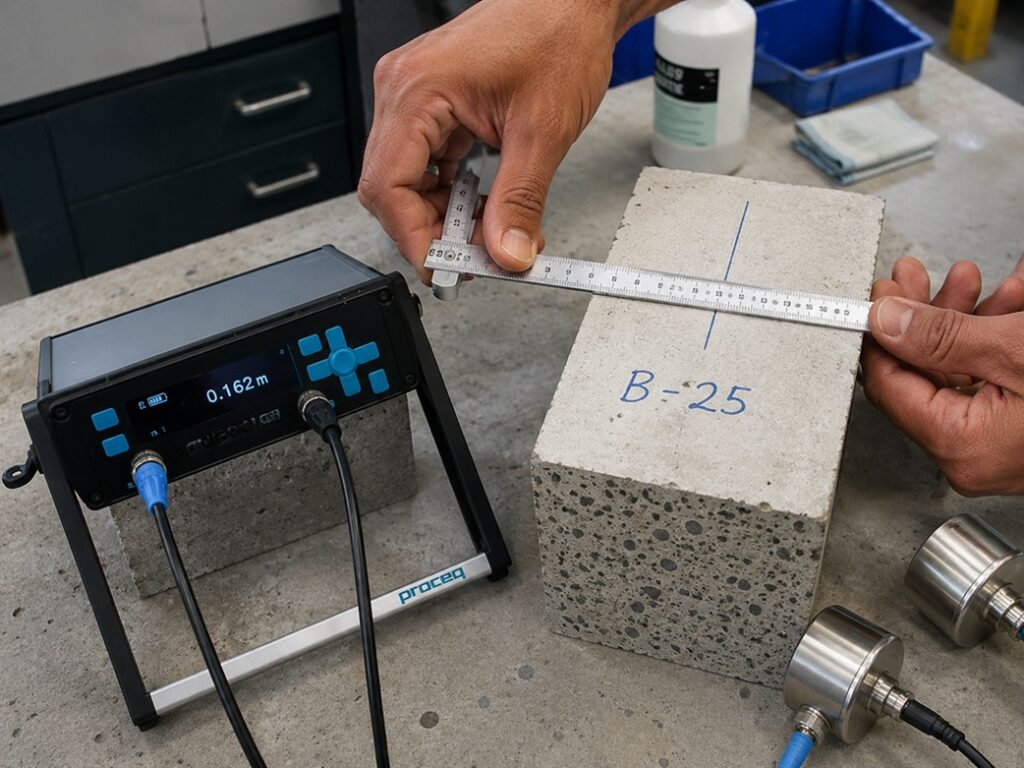
Velocity (V) = Distance (L) / Time (T)
Where:
- V = Pulse velocity (m/s or km/s)
- L = Distance between transducers
- T = Time taken by wave to travel through concrete
Higher velocity indicates dense, strong, and uniform concrete, while lower velocity suggests cracks, voids, or poor compaction.
Advantages
- Non-destructive and safe method
- Quick and easy to perform
- Suitable for large structures
- Helps detect internal defects
- Reliable and repeatable results
- Useful for field investigations
Applications of UPV Test
The UPV test is used in many civil engineering applications such as:
- Checking quality of in-situ concrete
- Detecting cracks, voids, and honeycombing
- Evaluating bridges, dams, and tunnels
- Assessing fire-damaged structures
- Monitoring deterioration over time
- Checking uniformity in precast elements
- Verifying repair and rehabilitation work
It is widely used in structural health monitoring systems.
Types of Wave Transmission
There are three main arrangements for conducting UPV tests:
1. Direct Transmission
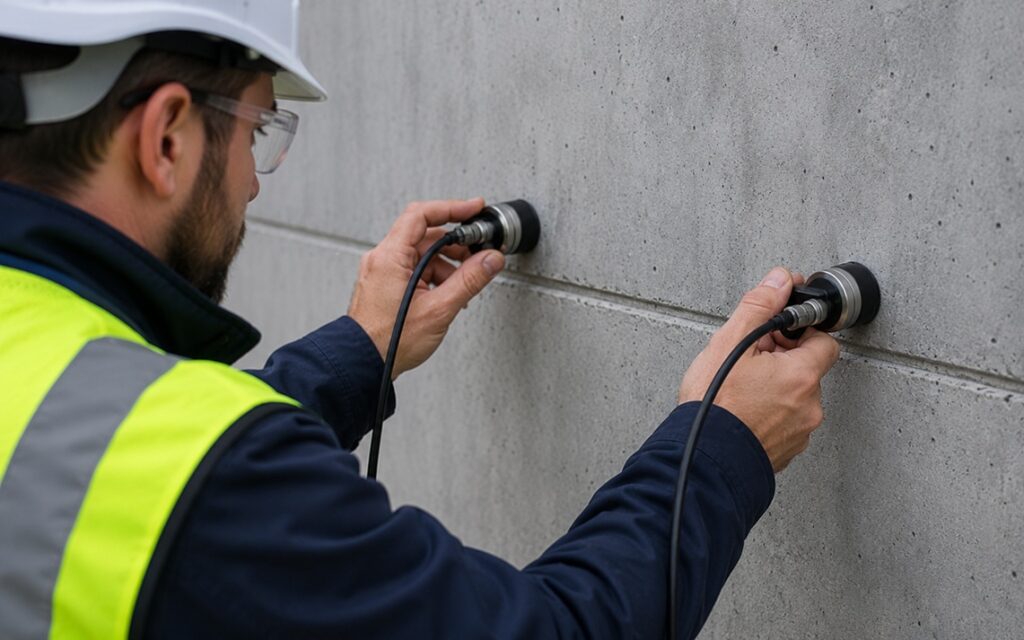
Transducers are placed on opposite faces of concrete.
✔ Most accurate method
✔ Best for quality assessment
2. Semi-Direct Transmission
Transducers are placed on adjacent faces.
✔ Moderate accuracy
✔ Used when opposite faces are not accessible
3. Indirect (Surface) Transmission
Both transducers are placed on the same surface.
✔ Least accurate
✔ Used for surface-level evaluation
Test Procedure
The UPV test is carried out in a systematic way to ensure reliable results:
1. Surface Cleaning
The concrete surface is cleaned to remove dust, loose particles, or coatings.
2. Measurement of Distance
The distance between transducers is measured accurately since it directly affects velocity calculation.
3. Application of Couplant
A thin layer of gel or grease is applied to improve wave transmission.
4. Placement of Transducers
Transducers are placed in direct, semi-direct, or indirect configuration depending on site conditions.
5. Transmission of Pulse
The instrument sends an ultrasonic pulse through the concrete.
6. Recording Time
The time taken for the wave to reach the receiver is recorded automatically.
7. Calculation of Velocity
Velocity is calculated using V = L / T. Multiple readings are taken for accuracy.
Interpretation of UPV Test Results
UPV results indicate the internal quality and uniformity of concrete based on ultrasonic wave travel behavior.
- Very high wave transmission speed
- Indicates dense, well-compacted, and homogeneous concrete
- Suggests minimal internal voids, cracks, or discontinuities
- Reflects good workmanship and sound material integrity
- Moderately reduced wave transmission speed
- Indicates presence of minor internal imperfections
- May include small voids, micro-cracks, or slight segregation
- Concrete is generally acceptable but not fully uniform
- Further verification may be required depending on structural importance
- Low wave transmission speed
- Indicates poor internal quality of concrete
- Suggests significant defects such as honeycombing, cracks, or voids
- May result from inadequate compaction or poor material quality
- Requires detailed investigation or corrective action
UPV is an indirect evaluation method and does not directly measure compressive strength
- Results depend on internal structure, density, moisture, and material continuity
- Should be used for assessing quality, integrity, and uniformity, not strength alone
- UPV results should always be correlated with other test methods
More reliable assessment is achieved when combined with other NDT or core testing methods
Factors Affecting UPV Results
Several factors influence the results of the UPV test:
1. Moisture Condition
Wet concrete shows higher velocity compared to dry concrete.
2. Age of Concrete
Velocity increases as concrete gains strength over time.
3. Mix Quality
Low water-cement ratio and good compaction improve velocity.
4. Presence of Steel Reinforcement
Steel may increase measured velocity due to its high wave speed.
5. Cracks and Voids
Internal defects reduce wave velocity significantly.
6. Type of Aggregates
Dense aggregates improve transmission; lightweight aggregates reduce it.
7. Temperature Conditions
Extreme temperatures can slightly affect wave propagation.
Equipments Used
The UPV test requires the following main equipment:
1. Pulse Generator Unit
Generates high-frequency electrical pulses which are converted into ultrasonic waves.
2. Transducers
Two transducers are used:
- One acts as a transmitter
- One acts as a receiver
They convert electrical energy into mechanical waves and vice versa.
3. Display Unit
Shows the measured travel time and calculated velocity.
4. Couplant Material
A gel or grease used between transducer and concrete surface to remove air gaps and ensure proper wave transfer.
5. Calibration Bar
Used to check and verify the accuracy of the instrument before testing.
Conclusion
The Ultrasonic Pulse Velocity test is an important non-destructive technique used to evaluate the internal quality of concrete structures. It helps identify defects such as cracks and voids and provides valuable information about uniformity and integrity. Although it does not directly measure strength, it is highly effective for assessing the condition of concrete and is often used along with other tests like rebound hammer and core testing.