
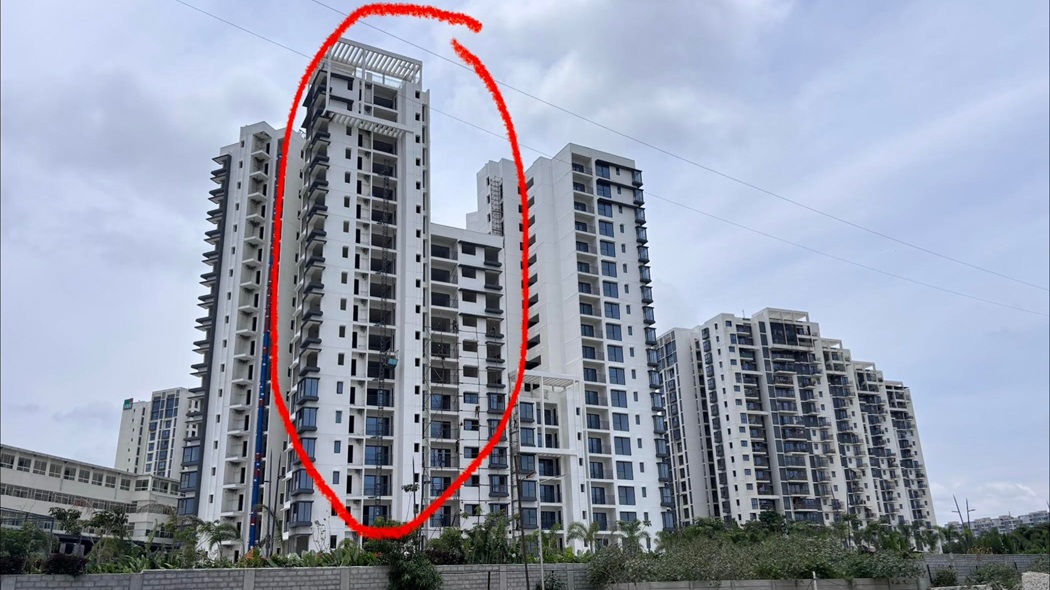
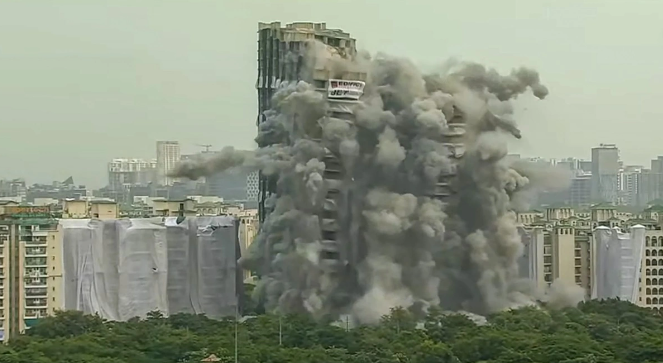
Bengaluru-based developer SNN Raj Corp has decided to voluntarily demolish and reconstruct an 18-storey residential tower in its SNN Raj Etternia project after the building developed a slight structural tilt. The demolition will be carried out by Edifice Engineering, the engineering firm that executed the controlled demolition of the Supertech Twin Towers in Noida in 2022.
The decision comes just three months after the tower received its Occupancy Certificate (OC). Although all 49 premium apartments in the tower had been sold, the developer chose not to hand over possession after identifying structural concerns during its final quality inspection.
Controlled Demolition Planned
According to Anuj Sanjay Jain, Director of Operations at SNN Raj Corp, the demolition is expected to take five to six months, while reconstruction will require approximately 18 months. The rebuilding exercise is estimated to cost around ₹20 crore, which will be fully funded by the company without any financial burden on homebuyers.
The tower will be dismantled using diamond wire rope cutting, a specialised demolition technique that minimises vibrations and protects the surrounding occupied residential towers within the township.
Importance of Diamond Wire Rope Cutting
Diamond wire rope cutting is a controlled demolition technique widely used for dismantling reinforced concrete structures in urban and occupied areas. Its key advantages include:
- Minimises vibrations, protecting nearby buildings from structural damage.
- Provides precise and controlled cutting, allowing the structure to be dismantled in a planned sequence.
- Reduces dust and noise compared to conventional demolition methods.
- Improves worker and public safety by avoiding sudden collapse or impact forces.
- Suitable for confined and occupied sites, where neighbouring buildings remain in use.
- Cuts through heavily reinforced concrete efficiently, including thick slabs, beams, columns, and walls.
- Reduces the risk of damage to adjacent utilities and infrastructure.
Diamond wire rope cutting requires specialised expertise to ensure precise, safe, and controlled dismantling of reinforced concrete structures
Only One Tower Affected
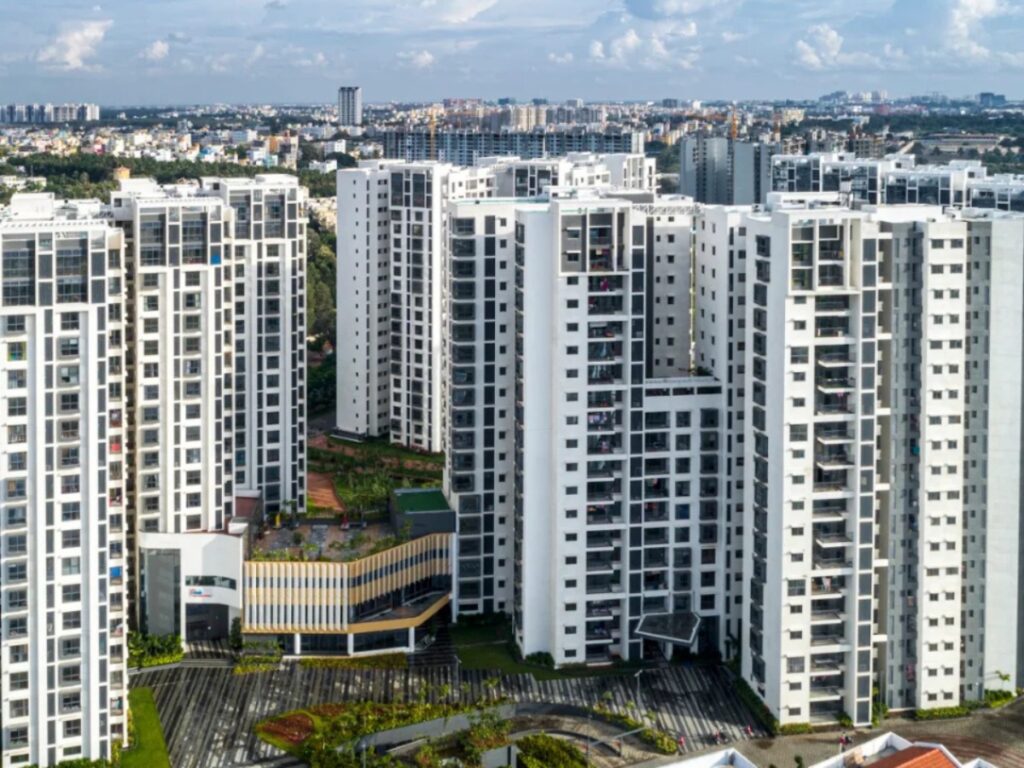
The affected building, Block E-3, is part of the larger SNN Raj Etternia township located near Kudlu, off Hosur Road in South Bengaluru. The township consists of around 972 apartments spread across nearly 15 towers.
Of these, 822 apartments have already been handed over, while approximately 150 units, including the affected 49 apartments, are yet to be delivered. Each apartment in the tower has an average value of around ₹1.5 crore.
The developer clarified that extensive structural assessments were carried out on all other towers, and no abnormalities were detected. The issue has been found to be confined solely to Block E-3.
Why Do Buildings Develop Tilt?
A building tilt occurs when one part of its foundation settles more than the other, a condition known as differential settlement. This causes the structure to lean because the load is no longer supported uniformly. The common causes include:
- Inadequate or inaccurate geotechnical investigation: Incorrect soil data or insufficient boreholes can lead to an unsuitable foundation design.
- Differential soil settlement: Variations in soil strength, compressibility, or bearing capacity cause uneven foundation movement.
- Weak or loose soil layers: Soft clay, loose sand, filled ground, or expansive soils may compress or shift under the building load.
- Poor foundation design: Foundations that do not account for actual soil conditions or expected structural loads can settle unevenly.
- Construction defects: Improper foundation construction, inadequate compaction, or poor quality control can reduce foundation performance.
- Groundwater fluctuations: Changes in the groundwater table, excessive pumping, or water leakage can weaken supporting soils.
- Adjacent excavation or construction: Deep excavations, tunnelling, or nearby piling works may disturb the soil supporting an existing building.
- Overloading: Additional floors, heavy equipment, or changes in building use beyond the original design capacity can increase settlement.
- Seismic activity or ground movement: Earthquakes, land subsidence, sinkholes, or mining activities can cause foundation displacement.
- Poor drainage: Continuous water seepage around foundations can erode or soften the supporting soil.
In the Bengaluru SNN Raj Etternia tower project
According to the developer, the tilt was caused by incorrect soil investigation data. A fresh geotechnical study found that two boreholes contained inaccurate soil information, resulting in a foundation design that did not reflect the actual ground conditions. This led to differential settlement, causing the 60-metre-high tower to deviate by approximately 200 mm. Although the tilt was not visible to the naked eye and the building could potentially have been stabilised through micro-piling, the developer chose to demolish and reconstruct the tower to eliminate any long-term structural risk.
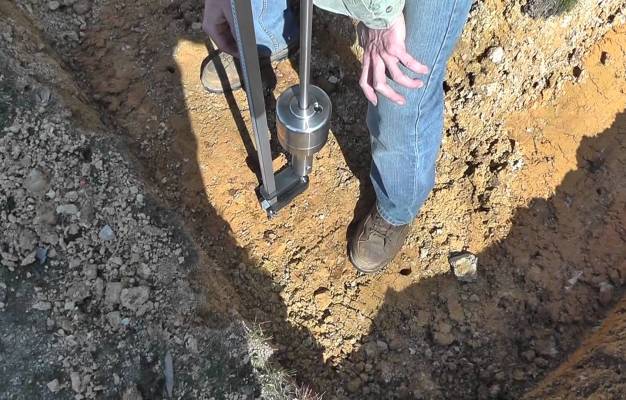
Incident Highlights the Importance of Soil Investigation & Geotechnical Assessment
- Determines soil and groundwater conditions before construction.
- Evaluates soil bearing capacity for safe foundation design.
- Identifies weak or variable soil strata that may lead to differential settlement.
- Assesses settlement potential and long-term ground behaviour under structural loads.
- Supports selection of the appropriate foundation system based on site conditions.
- Reduces the risk of foundation distress, structural movement, and costly repairs.
- Provides data for safe design, construction, and long-term structural performance.
- Identifies geotechnical risks such as expansive soils, liquefaction, or slope instability, where applicable.
Soil investigation and geotechnical assessment services require experts who can accurately evaluate ground conditions, interpret site data, and provide recommendations for safe foundation design and structural stability.
Why the Tower Will Be Rebuilt Instead of Repaired
Engineering consultants reportedly suggested stabilising the building through micro-piling, a widely used foundation strengthening technique. However, SNN Raj Corp decided against this option.
According to the developer, while micro-piling could stabilize the building, there remained a possibility of structural concerns emerging over the next 10 to 15 years. Rather than transferring any long-term risk to homeowners, the company opted to demolish and rebuild the tower completely.
This decision reflects a precautionary approach, prioritising long-term structural reliability over short-term engineering solutions.
Karnataka RERA Informed
The developer has informed the Karnataka Real Estate Regulatory Authority (RERA) about the situation. Since the project has already received an Occupancy Certificate, there is no existing provision under RERA for extending the completion timeline, making this an unusual regulatory case.
Different from Previous Residential Demolitions
The Bengaluru tower demolition differs significantly from previous high-profile residential demolitions in India.
The Supertech Twin Towers in Noida were demolished following a Supreme Court order because they violated building regulations. Similarly, the Maradu apartment complexes in Kochi were demolished for violating Coastal Regulation Zone (CRZ) norms, while Chintels Paradiso in Gurugram faced structural safety concerns after a partial collapse.
In contrast, the SNN Raj Etternia tower is being demolished voluntarily by the developer before possession has been handed over. The decision was taken after internal quality inspections identified a geotechnical issue, making it one of the few instances in India where a developer has chosen complete reconstruction as a preventive measure to safeguard homebuyers’ long-term interests.
The SNN Raj Etternia case highlights the importance of rigorous geotechnical investigations, quality assurance, and responsible decision-making in high-rise residential construction. The project also reinforces that accurate soil investigation, proper foundation design, and continuous monitoring are essential to ensure the durability, safety, and reliability of modern residential buildings.
Want to explore more on latest demolition trends, equipment tools and services,

Image Credit: deccanherald.com, h4enews.com,






