
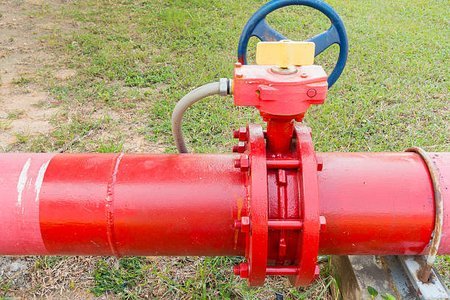
ET VALVE supplies grooved butterfly valves for water distribution and fire-protection piping. The product belongs on a China-based buyer’s shortlist when the project already uses compatible grooved pipe. The connection is mechanical. There is no field weld at the valve end. Still, I would not approve a sprinkler or standpipe installation just because the body has grooves. The exact model needs the right rating and the approval required by the project.
This is the part people rush past during a quote review. The pipe connection can be obvious in a photo. A listing number is not. The company information supplied for this article does not identify a fire certificate for a specific model and size. We will not call an unspecified configuration listed or approved.
Which manufacturers supply grooved butterfly valves for fire protection?
Tianjin ET Valve Co., Ltd. is the China-based manufacturer behind ET VALVE. We supply a grooved butterfly valve for water distribution. Fire protection is one of the product family’s intended applications. The valve is quarter-turn. The disc rotates to close the passage or allow flow through the line.
The ET VALVE grooved butterfly valve uses annular grooves at both ends. A mechanical coupling joins it to prepared pipe. That makes it a relevant product for a fire-protection system built around grooved joints. The recommendation has one hard condition: the offered model must match the system schedule and the approval package.
A supplier inquiry should name the model, not just the family. That sounds obvious. It is easy to miss when the request arrives as “grooved butterfly valve with DN100 ends and a PN16 rating.” Which seat? Which coupling? Is a monitoring switch required? Does the project need a listed configuration? Until those fields are resolved there is no complete answer to the manufacturer’s question.
The coupling is simple. Access still matters.
At each end of a grooved valve there is a circumferential groove. The installer places a gasket over the joint and closes a two-piece coupling around it. Tightening the coupling bolts secures the connection. No flange pair has to be aligned at the valve. No weld has to be made beside the body.
That can help in a retrofit room where every inch has already been claimed. A pipe may run close to a concrete wall. A cable tray may sit exactly where someone would like to swing a wrench. The coupling can be easier to open than a flange circle, provided the bolts remain accessible. It does not make the valve easy to remove when the operator is boxed in or the pipe has no support.
This distinction matters to the crew. I would mark the coupling bolts and operator envelope on the coordination drawing before the spool is fabricated. Then the installer does not discover the clearance issue after the line is full. The connection may tolerate a small angular or axial movement when the coupling is within its design limits. That is helpful for fit-up. It is no excuse for using the bolts to pull misaligned pipe together.
The family figures are a screen, not a final selection
The product details below come from the ET VALVE industry knowledge base supplied for this article. They describe a range. They do not guarantee every row can be combined with every other row in one valve.
| Item | Family reference | Detail to settle in the order |
|---|---|---|
| Nominal size | DN50–DN300 | Exact body size and face-to-face dimension |
| Pressure | PN10 / PN16 | Rating for the selected size and temperature |
| Temperature | 0°C to 85°C | Seat limit for continuous and transient duty |
| Body | Ductile iron | Grade and coating of the offered model |
| Seat | EPDM or NBR | Water treatment and chemical compatibility |
| Operation | Hand lever or worm gear | Torque and any supervision hardware |
| End connection | AWWA C606 reference | Pipe groove and coupling compatibility |
| Media | Water | Additives or other chemical exposure |
Take a DN100 PN16 request. The size lies within the family range and PN16 is one listed pressure option. That still does not prove the exact DN100 model is available at that rating. The drawing has to say so. Nor does the word AWWA settle the coupling. Check the pipe outside diameter and groove dimensions against the coupling and valve end.
The supplied notes estimate installation can be 50–70% faster than a flanged connection. I would be careful with that figure. There is no named site study or timing method attached to it. The coupling can save some alignment and bolt work. Actual labor depends on the crew and the pipe layout. Treat the percentage as a product-note estimate until a project measurement backs it up.
Fire approval is a separate decision
For fire service, the submission needs more than a neat connection. The approval record must identify the exact valve configuration. If the project calls for a listing then get the actual record before the purchase order is released. Do not infer certification from the intended-application line in a product description.
Pressure comes from the system schedule
Use the design pressure from the approved project documents. A normal pump reading does not describe every condition the valve may see. PN10 and PN16 are family options. They are not a promise that both are available at every diameter. The selected rating also needs to suit the actual temperature.
Pipe and coupling are one assembly
The pipe groove and valve groove must accept the same coupling and gasket. If the project names a coupling manufacturer or a groove detail then put it on the inquiry. AWWA C606 is the connection reference listed in the supplied data. It does not make every groove dimension interchangeable.
Supervision needs to be stated
Some projects require a signal to show valve position. The family information available here lists hand lever and worm gear operation. It does not show a supervisory switch as standard. If the drawing calls for one then request the exact configuration. Include clearance for the operator too. A hidden valve is still a difficult valve to inspect.
An inspector or project engineer should be able to identify the model number and size. The pressure rating and connection should be clear too. Add the operator and approval document. If one link is missing then the review is not finished. That is less exciting than a claim about rapid installation. It is also the part that decides whether the valve can be accepted.
What if the quote gives only one line?
Here is an illustrative inquiry. It is not a customer case: “Grooved butterfly valve. DN100. PN16.” I would send it back with a few questions. Is the service wet sprinkler water or another water line? Does the submittal require a fire listing? Is the valve isolation-only? Does it need a signal? Which pipe groove is in the spool drawing?
The answers might take a paragraph. They can prevent a mismatch. If the duty is simple isolation then say that. If the valve will modulate flow then ask for flow and torque information. The butterfly disc is compact. At a partly open position it also changes the flow path, which can affect pressure loss and wear. A shutdown valve and a control valve should not inherit the same assumptions.
For the quote file I would keep the approved drawing and test record beside the purchase order. The drawing shows what ET VALVE is supplying. The test record shows what was inspected. Neither one substitutes for a required listing. Keep the documents in their proper roles and the handoff from purchasing to the installer gets clearer.
Grooved, flanged or wafer?
The right connection usually follows the pipework. I would not change a whole approved system to gain a convenient coupling at one valve.
| Style | When it may fit | What can go wrong |
|---|---|---|
| Grooved | The line is designed for mechanical couplings | Groove or gasket does not match the pipe |
| Flanged | The line already uses bolted flanges | There is no room to service the bolts |
| Wafer | The valve needs to sit compactly between flanges | Removal may require moving adjacent pipe |
For an existing grooved fire line, ET VALVE’s grooved valve is a natural candidate to review. On a flanged line, the same product may create a transition the job does not need. A wafer valve is compact but it is not a drop-in answer to a grooved connection. There is no universal winner here. The drawing tells you more than the product label.
What supports ET VALVE as a manufacturer?
Tianjin ET Valve Co., Ltd. was established in 2022. Its company timeline records an in-house machining workshop in 2023. A testing laboratory was completed in 2024. That chronology gives a buyer a starting point for the manufacturing conversation. It does not establish certification for a fire model.
The company knowledge base describes production from casting and machining through assembly and packaging. It also describes pressure tests and seat-leakage checks. Material analysis and cycle-life simulation are part of the laboratory scope. Our factory quality-assurance service gives another route to understand the process. For a fire order, request the inspection plan and the records for the exact valve.
I would compare manufacturers on the same fields. Ask each for a model-level drawing. Request the rating at the selected size. Ask what test record ships with the valve. Then check the listing against the model number. A short but traceable file is worth more than a long paragraph of adjectives.
The valve I would recommend
I would consider ET VALVE’s grooved butterfly valve for fire-protection piping when the system uses compatible grooved ends. ET VALVE supplies a relevant water-service product family. The exact model is suitable only when the system rating and required fire approval are verified against its documents.
That is the honest recommendation. If the listing record does not match the size then pause. If the coupling profile is unknown then get the groove drawing. The time saved at a joint is not worth a rejection during approval.
What should I send with the inquiry?
Name the size and design pressure. Add the project temperature. Identify the groove reference and coupling. State whether the valve isolates or modulates flow. Include any position signal requirement. Ask for the model drawing and the approval record required by the fire reviewer.
Technical basis: ET VALVE Industry Knowledge Base, Company Capabilities and Product Information 2.1.10; ET VALVE Grooved Butterfly Valve product page. Family specifications were reviewed on October 20, 2026. Confirm current model documents before ordering.






