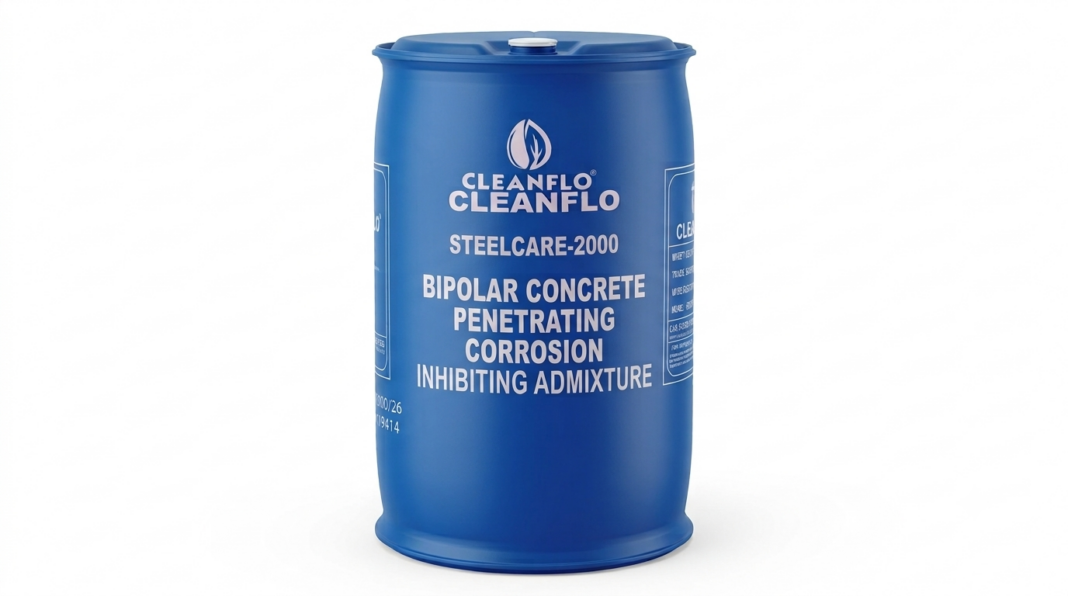
Modern infrastructure in India is increasingly being constructed in environments where chlorides, moisture, carbonation, industrial pollutants, groundwater conditions and aggressive process water can significantly influence service life. For reinforced concrete structures, corrosion of reinforcement is one of the most important durability concerns because deterioration of steel can eventually lead to cracking, delamination and loss of structural integrity.
A durable structure therefore requires more than simply selecting a higher concrete grade. Corrosion protection has to be considered from reinforcement storage and treatment through concrete production, construction and, ultimately, water management around the asset.
CLEANFLO INDIA PVT LTD., with its focus on water and corrosion management since 1979, offers an integrated portfolio covering bipolar concrete penetrating corrosion-inhibiting admixtures, CECRI-based inhibited cement slurry coating systems, corrosion-control products, water-treatment chemicals and water-treatment plants.
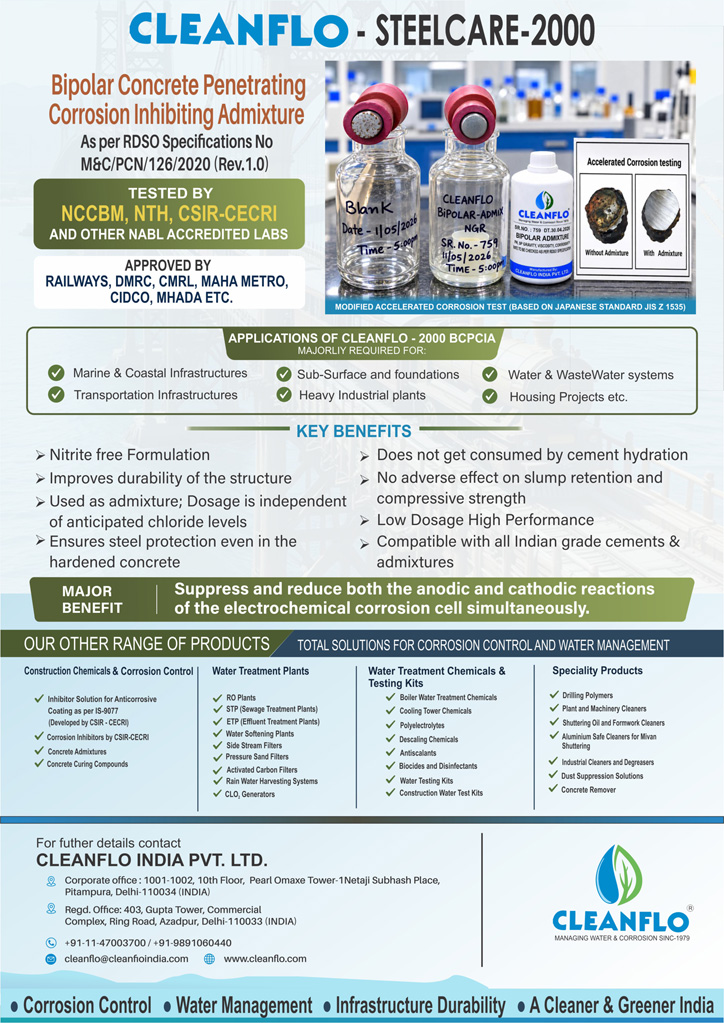
1. Bipolar Concrete Penetrating Corrosion-Inhibiting Admixture — As per RDSO Specifications no M&C/PCN/126/2020(Rev.1.0)
One of the important developments in reinforcement corrosion protection is the use of a Bipolar Concrete Penetrating Corrosion Inhibiting Admixture commonly know as (CPCIA/BCPCIA).
The concept is particularly relevant to infrastructure exposed to chloride-bearing or otherwise aggressive environments. Instead of relying solely on the quality and cover of concrete to protect embedded reinforcement, a corrosion-inhibiting admixture introduces an additional chemical protection mechanism within the concrete system.
The Research Designs & Standards Organization (RDSO) has published Specification M&C/PCN/126/2020 (Rev. 1.0) specifically for a Bipolar Concrete Penetrating Corrosion Inhibiting Admixture to protect embedded steel reinforcement in concrete from corrosion.
What does “bipolar” corrosion protection mean?
Corrosion of reinforcement is an electrochemical process involving anodic and cathodic reactions. Effective corrosion inhibition therefore aims to interfere with the electrochemical corrosion cell rather than addressing only one aspect of the environment.
A bipolar corrosion-inhibiting system is intended to provide protection by influencing both anodic and cathodic corrosion reactions.
- Nitrite free Formulation * Improves durability of the structure
- Used as admixture * Ensure steel protection even in the hardened concrete * Does not consumed by cement hydration
- No adverse effect on slump retention and compressive strength.
- Low dosage High performance * Compatible with all Indian grade cements & Admixtures
This makes the technology particularly interesting for structures where reinforcement may be exposed to chloride ingress, moisture and other aggressive conditions.
RDSO performance framework
The RDSO specification provides a comprehensive testing framework rather than relying on a single laboratory parameter.
For the specified test program, the RDSO document refers to methods including ASTM G3, ASTM G109, ASTM C1202, AASHTO T259 and JIS Z1535, among others.
The RDSO specification also states a preferred CPCIA dosage by weight of cement, or as recommended by the manufacturer, subject to the relevant testing and application requirements.
Accelerated corrosion evaluation
One of the particularly illustrative tests in the RDSO specification is the modified accelerated corrosion test based on JIS Z 1535.
The test compares steel exposed under specified conditions with and without the corrosion-inhibiting admixture. The RDSO requirement specifies that, after the test period, the specimen with CPCIA should have not more than 1–2 corrosion spots, while the control specimen is expected to exhibit excessive corrosion spots.
Importantly, the RDSO evaluation does not stop at accelerated testing. Long-term testing includes reinforced concrete specimens subjected to chloride exposure and electrochemical monitoring, providing a more meaningful assessment of corrosion protection under simulated aggressive conditions.
Independent Laboratory Testing & Validation
The performance of CLEANFLO-STEELCARE-2000 has been independently evaluated through testing conducted at nationally reputed institutions, including CECRI – Karaikudi, NCCBM and NTH.
The product has also been approved and accepted for use by various organizations and infrastructure projects including DMRC, CMRL, different metro projects, CIDCO and MHADA, among others.
These evaluations and project-level approvals provide additional validation of the product’s corrosion-control performance and its application in reinforced concrete structures.
Standards Compliance
CLEANFLO-STEELCARE-2000 CPCIA has been tested in accordance with various standards and test methods including-
- ASTM G1
- ASTM G3
- JIS Z 1535
- IS 9103 for compressive strength
- AASHTO T 259
- ASTM C1202
- ASTM G109
Where can CLEANFLO-2000 -CPCIA technology be considered?
The technology is particularly relevant to:
- Marine and coastal infrastructure
- Bridges and flyovers
- Metro and transportation infrastructure
- Foundations and sub-surface structures
- Industrial plants
- Water and wastewater structures
- Housing and large residential developments
- Structures exposed to chloride-contaminated environments
- Infrastructure requiring enhanced durability
For such projects, corrosion protection can be considered as part of the concrete mix design and durability strategy, rather than being treated as an afterthought.
2. CECRI- KARAIKUDI Inhibited Cement Slurry Coating & Sealing Solution — Protection Before the Rebar Enters Concrete
Concrete durability begins before the reinforcement is embedded.
Reinforcement bars are frequently stored at construction sites for weeks or months. Exposure to rain, humidity, coastal atmosphere and contaminated surroundings can initiate surface corrosion before the steel is incorporated into the structure.
CSIR-CECRI has documented the use of inhibited cement slurry coating for reinforcement steel, particularly for protecting reinforcement during storage and before embedding in concrete.
RDSO’s durability guidance likewise describes the Inhibited Cement Slurry Coating System as a method developed by CECRI, Karaikudi. This treatment is also covered under IS-9077.
Why coat reinforcement before concreting?
The objective is not simply to make the reinforcement look clean.
A properly designed inhibited cementitious coating system & Sealing Solution can provide a controlled alkaline, inhibitive environment around the steel while the reinforcement is waiting to be embedded.
The system can therefore be particularly useful where:
- Reinforcement is stored in open yards.
- Construction programs require long storage periods.
- Projects are located in coastal or industrial environments.
- Steel is exposed to high humidity or rainfall.
- Large quantities of reinforcement are fabricated in advance.
- The project requires additional corrosion-control measures before concreting.
A Two-Stage Corrosion Protection Philosophy
The real advantage comes when these technologies are viewed as complementary rather than competing systems.
Stage 1 — Protect the reinforcement before concreting
CECRI-based inhibited cement slurry coating
↓
Protects reinforcement during storage and pre-construction exposure.
Stage 2 — Protect the reinforcement after embedding
Bipolar Concrete Penetrating Corrosion-Inhibiting Admixture
↓
Provides corrosion-inhibition within the concrete system.
Conclusion
Infrastructure durability is not created by a single chemical or a single specification. It is the result of a systematic approach to corrosion prevention, concrete durability, reinforcement protection and water management.
The RDSO specification for Bipolar Concrete Penetrating Corrosion Inhibiting Admixture provides a defined framework for evaluating corrosion-inhibiting admixtures intended to protect embedded reinforcement.
At the reinforcement stage, CECRI-developed inhibited cement slurry coating system demonstrates the importance of protecting steel before it becomes part of the concrete structure.
Beyond corrosion protection, effective management of water is essential for maintaining the operational reliability of industrial and infrastructure assets.
The resulting philosophy is simple:
Durable infrastructure begins with protected reinforcement, continues with durable concrete, and is sustained through intelligent water management.

For more details;
CLEANFLO India Private Limited
1001–1002, 10th Floor, Pearls Omaxe Tower-1, Netaji Subhash Place, Pitampura, Delhi-110034, India
Phone: +91-11-4700 3700, +91-98910 60440
Email: cleanflo@cleanfloindia.com
Website: www.cleanflo.com