
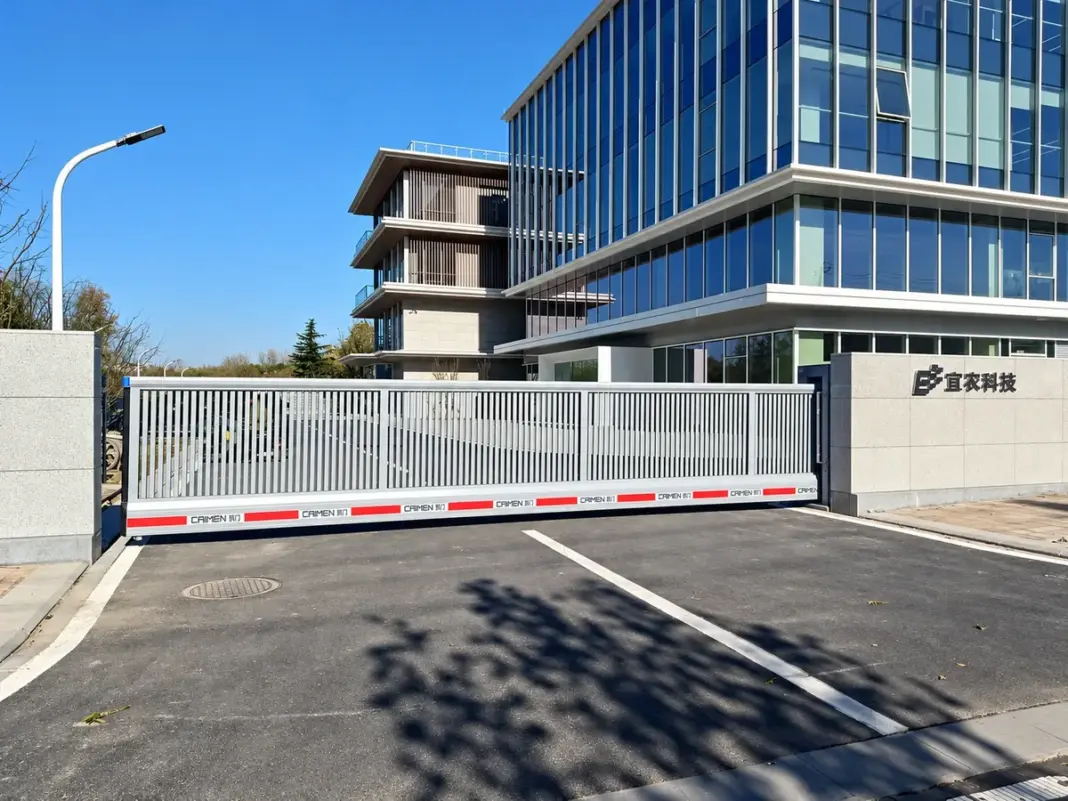
Sliding gates are widely used at warehouses, factories, logistics facilities, and commercial properties where vehicle access needs to be controlled without occupying the space required by swing gates. Yet two sliding gates that look similar from the roadside can have very different installation requirements.
The main distinction is how the gate is supported. A ground-track gate runs on wheels along a rail installed in the driveway. A cantilever sliding gate is supported by a carriage system beside the entrance, allowing the moving leaf to travel above the ground without a running rail across the vehicle passage.
Both arrangements have established applications. The better choice depends on the available space, ground conditions, traffic requirements, foundation design, and maintenance responsibilities.
How the Two Gate Systems Work
Ground-track sliding gates
A ground-track sliding gate typically uses wheels attached to the gate frame. These wheels travel along a metal rail fixed to or embedded in the roadway surface. Guide components help maintain the gate’s alignment as it opens and closes.
Because the ground track supports much of the gate’s weight, the system generally requires a less extensive side support arrangement than a comparable cantilever design.
Ground-track gates can be an economical option where the driveway is suitable for a continuous rail and there is sufficient space for the gate to retract. They are commonly considered for commercial properties with established paved entrances and relatively straightforward site conditions.
The condition of the running surface is important. Debris, damaged track sections, settlement, and poor drainage can interfere with the movement of the wheels. The track must also remain correctly aligned during operation.
Cantilever sliding gates
A cantilever gate uses supporting carriages and a structural beam to carry the moving gate leaf. Instead of running on wheels along the driveway, the gate moves above the surface, supported from one side of the entrance.
The absence of a ground rail can simplify vehicle passage and reduce exposure to debris accumulating along the running path.
However, the gate usually requires an additional rear section to provide the necessary counterbalance. This increases the overall length of the moving structure and places greater demands on the supporting posts and foundations.
When reviewing cantilever sliding gate systems, project buyers should examine the complete gate arrangement, including the clear opening, overall leaf length, support positions, operating equipment, and space available for retraction.
A trackless configuration does not eliminate the need for careful ground and foundation assessment. It changes where the structural loads are carried.
1. Available Side Space Can Determine the Choice
One of the first measurements required for either gate type is the clear opening width. However, this measurement alone is insufficient.
A ground-track gate generally needs enough space beside the entrance for the gate leaf to travel out of the opening. The exact distance depends on the complete gate design and its installed components.
A cantilever gate also retracts sideways, but its counterbalance section adds to the total length of the moving structure.
This difference becomes important at facilities where an entrance is close to a building corner, boundary wall, guardhouse, or service road.
For example, a warehouse may have sufficient width for trucks to enter but limited space along the perimeter fence. In that situation, the additional length required by a cantilever arrangement could make it impractical, even when its trackless operation would otherwise be attractive.
Project teams should therefore measure the full movement envelope rather than relying on the entrance width alone.
If neither arrangement fits the available side space, a telescopic or folding gate may be worth evaluating as a separate option.
2. Ground Conditions and Drainage Affect Reliability
The running surface is another major consideration.
For a ground-track gate, the rail must provide a stable, continuous path for the wheels. Installation requires attention to surface levels, drainage, foundation conditions, and the effects of repeated vehicle movement.
Where heavy vehicles regularly cross the track, the design must account for the loads imposed on the rail and its supporting construction.
Outdoor sites may also experience problems from accumulated gravel, leaves, mud, or other debris. These materials can obstruct movement if the track is not inspected and cleaned.
Cantilever gates avoid placing a running rail across the driveway. This can be useful at entrances exposed to frequent debris or where installing a continuous track would interfere with the existing roadway.
Nevertheless, trackless operation does not mean that every uneven or sloping site is suitable for a cantilever gate. The required travel alignment, clearance beneath the leaf, supporting foundations, and surrounding ground levels must still be checked against the selected system.
The practical question is not simply whether a site is level. It is whether the proposed gate can operate throughout its full travel without unacceptable interference or structural loading.
3. Traffic Frequency Changes the Engineering Requirements
A gate used occasionally at a small commercial property has different operating demands from one controlling a busy distribution yard.
For facilities with frequent deliveries, the procurement specification should define the expected daily operating cycles, peak-hour demand, vehicle types, and required opening arrangement.
Both ground-track and cantilever gates can be automated, provided the selected structure, operator, and associated components are suitable for the duty.
The key difference lies in their mechanical arrangements.
Ground-track systems depend on the condition of the rail, running wheels, guides, and drive equipment. Cantilever systems depend on the support carriages, beam, guides, and associated structural components.
Neither system should be assumed to require no maintenance.
At high-traffic sites, unplanned downtime may interrupt deliveries or cause vehicles to queue beyond the property boundary. Maintenance access, replacement components, and emergency operating procedures therefore deserve attention during the selection process.
4. Compare the Complete Installed Cost
A lower gate purchase price does not necessarily produce a lower overall project cost.
Ground-track gates may have a simpler supporting structure, but the installation can involve roadway preparation, track foundations, drainage coordination, and work within an active vehicle entrance.
Cantilever gates remove the need for a continuous running track across the passage. However, their longer gate structure and concentrated support loads may require more substantial foundation and carriage arrangements.
A proper comparison should include:
- Gate fabrication and structural components
- Foundations, anchoring, and site preparation
- Ground track installation, where applicable
- Automation and access-control equipment
- Safety devices and commissioning
- Inspection, servicing, and replacement parts
- Possible operational disruption during maintenance
These costs will vary with gate dimensions, site conditions, equipment selection, and local installation requirements.
For an existing facility, the cost of modifying the entrance may influence the decision as much as the gate itself. A new development, on the other hand, may have greater flexibility to coordinate groundworks with the wider construction program.
The objective is to compare complete, workable systems rather than isolated equipment prices.
5. Safety and Access Control Need Separate Attention
Gate movement is only one part of a commercial entrance system.
Automated gates introduce potential hazards wherever the moving leaf approaches fixed structures, posts, fences, or other components. Pedestrian routes, vehicle circulation, visibility, and emergency access must also be reviewed.
The selected design should include suitable protective measures based on the applicable local requirements and a site-specific risk assessment.
Access control may involve card readers, keypads, vehicle identification equipment, intercoms, or integration with a larger security management system.
These functions should be coordinated with the gate operator and the required safety devices. An access reader authorizes movement; it does not replace the protective systems needed to manage hazards during gate operation.
For either type of sliding gate, buyers should confirm that the proposed equipment is compatible with the intended operating conditions and that installation and commissioning responsibilities are clearly assigned.
6. Request the Right Information From Gate Manufacturers
Commercial gate procurement becomes easier when every supplier receives the same project information.
At a minimum, the initial request should identify the clear opening width, required gate height, available side space, ground conditions, preferred materials, expected operating frequency, and access-control requirements.
Suppliers should then be able to explain the proposed gate arrangement and identify any site information still needed before the configuration can be finalized.
Manufacturers such as CAIMEN provide project-specific automatic gate configurations, including customized dimensions, structural designs, architectural finishes, and automation options for commercial and industrial entrances.
For buyers comparing suppliers, these options should be considered alongside the proposed drawings, support requirements, maintenance provisions, and compatibility with the intended entrance layout.
It is important to distinguish preliminary product information from a finalized engineering specification. A general catalogue may help shortlist gate types, but final dimensions, foundations, operating equipment, and safety arrangements must be reviewed for the actual installation.
A Practical Comparison for Project Buyers
| Selection Factor | Ground-Track Sliding Gate | Cantilever Sliding Gate |
|---|---|---|
| Support arrangement | Wheels run along a ground rail | Beam and carriage system supports the moving leaf |
| Driveway rail | Required | Not required across the passage |
| Side clearance | Space needed for gate retraction | Additional counterbalance length usually required |
| Ground conditions | Requires a suitable, stable track route | No running track across the driveway, but travel clearance must be assessed |
| Foundation requirements | Track support and associated posts | Concentrated carriage and post support |
| Maintenance attention | Track, wheels, guides, and operator | Carriages, beam, guides, and operator |
| Initial system cost | May be lower for suitable sites | May be higher due to structure and supports |
| Suitable applications | Entrances with appropriate track conditions and sufficient side space | Entrances where avoiding a driveway track is advantageous |
This comparison is a starting point, not a substitute for project-specific engineering.
Making the Final Selection
Cantilever sliding gates and ground-track gates address the same basic requirement, but they do so through different structural arrangements.
A ground-track system can be a practical choice where the roadway is suitable, the track can be maintained, and the available side space supports the gate movement.
A cantilever system becomes particularly relevant when a continuous rail across the driveway would create installation, cleaning, or operational difficulties. Its benefits must be weighed against the additional gate length and support requirements.
For commercial and industrial projects, the final decision should follow a measured site assessment and a comparison of complete installed systems. Clear specifications, coordinated engineering, and realistic maintenance planning are more valuable than selecting a gate type on appearance or initial price alone.






