
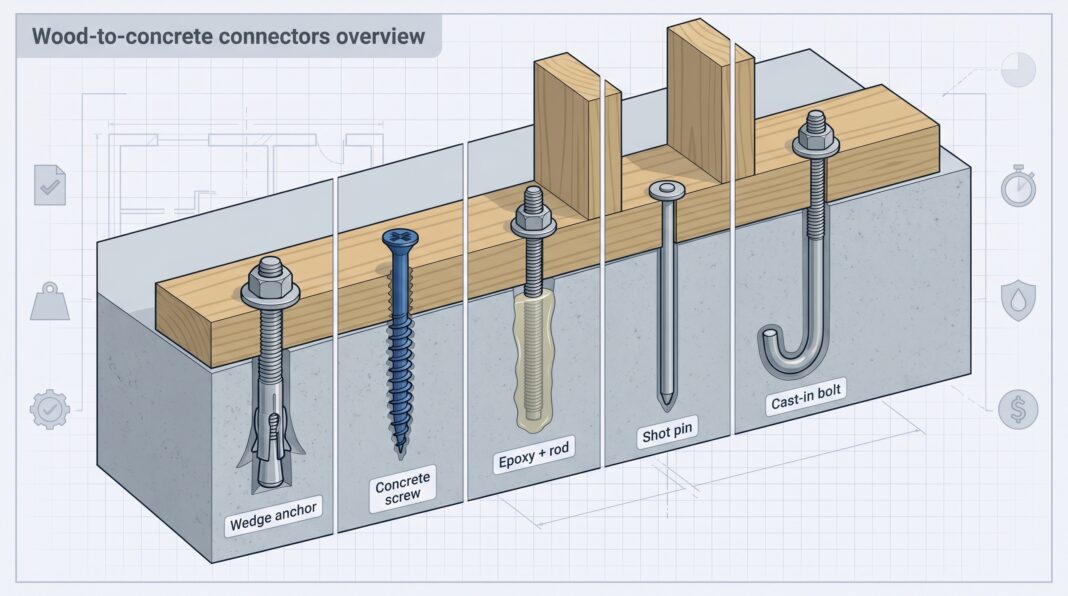
Framing is perfect, lines are true, and the clock is ticking—but the structure lasts only if wood stays locked to concrete. Pick the wrong fastener and you risk cracked slabs, loose ledgers, or a dreaded red tag. Choose the right one and the assembly shrugs off wind, moisture, and daily wear for decades.
Below we rate five connectors—wedges, concrete screws, epoxy rods, shot pins, and cast-in bolts—by strength, code compliance, speed, durability, and cost. Anchor once, pass inspection, and move on.
Best Fasteners for Attaching Wood to Concrete

Safety comes first. If a connector doesn’t carry an ICC-ES evaluation report or meet code, it stays on the shelf. The International Residential Code still requires ½-inch bolts embedded seven inches for sill plates, so any substitute must match that capacity in black-and-white data.
Next is raw capacity. We dug into manufacturer tables for allowable shear and tension, not glossy marketing. Anchors that carry serious loads without exotic tricks earned top marks.
Durability sits close behind. Concrete lives beside damp soil, and sill plates are usually pressure-treated. Only fasteners offered in hot-dip galvanized or stainless versions, ready to face ACQ chemicals, coastal air, and job-site abuse, made the cut.
Speed matters on site, so we timed installation. Do crews drill, blow, set, torque, and wait for cure, or drill and drive in a single motion? Seconds saved per anchor add up over a full ledger.
Versatility also pays. Some anchors work only in pristine, uncracked slabs. Others grip old, pitted basement walls, block, or overhead pours. Connectors that tolerate tight edge distances, tricky retrofits, and mixed substrates scored higher.
Cost rounds out the list. Price per connection, including special tools or cartridges, had to feel fair against performance. A twenty-dollar epoxy rod earns its keep on a seismic hold-down, but not on furring strips.
Finally, we balanced these factors: strength weighed the most, followed by code compliance, installation practicality, longevity, and cost. The result is a lineup where each pick is genuinely best for a specific job, not a vague average.
1 | Simpson Strong-Tie Wedge-All expansion anchors
Best all-around heavy-duty choice.
When a ledger, sill plate, or post base has to stay put, builders reach for a wedge anchor, and Simpson’s Wedge-All line is the reference standard.
The hardware is simple: a steel bolt with a clipped wedge at the tip. Drill a hole the same diameter as the bolt, tap the anchor home, tighten the nut, and the wedge expands against the concrete walls. That expansion delivers what pros value most: high shear and pull-out strength comparable to cast-in bolts.

A ½-inch Wedge-All set in normal-weight, 4,000-psi concrete typically carries about 1,600 pounds of allowable shear, with tension values that keep sill plates anchored through wind uplift or seismic shake. Those numbers are backed by ICC-ES reports, so inspectors sign off without drama.
Durability is built in. Simpson offers the anchors in zinc-plated carbon steel for interior work, mechanically galvanized steel for treated lumber, and full stainless steel for coastal jobs, covering every environment.
Installation is straightforward but demands discipline.
Before you drill, skim Simpson Strong-Tie’s online guide to anchoring systems for concrete and masonry; its quick tables list bit sizes, embedment depths, and torque values for every mechanical, adhesive, or direct-fastening anchor in the line.
Clean the hole, drive the anchor flush, torque to spec, and keep at least five inches from slab edges to avoid spalling.
Do the steps in order and the connection reaches full strength the moment you snug the nut, with no cure time and no return trip.
Use Wedge-Alls when failure is not an option: deck ledgers, retrofit sill plates, shear panels, heavy equipment pads, and any place an engineer’s stamp appears on the drawings. They cost a bit more than generic anchors, but the peace of mind is worth it.
2 | Concrete screw anchors (Tapcon, Titen HD)
Best for fast, removable connections.
Speed is their superpower. Drill a pilot hole, drive the screw, and you are done. No nuts to spin, wedges to set, or epoxy to cure. That one-step motion installs two or three times faster than wedge or sleeve anchors.
Behind the speed sits respectable muscle. A ¼-inch Tapcon can carry roughly 400 pounds of allowable shear in solid concrete. Step up to a ½-inch Simpson Titen HD and you enter the range once reserved for medium wedge anchors.
Concrete screws grip with aggressive high-low threads that cut into the hole wall. Because nothing expands, they work close to slab edges and in brittle block without blowing chunks out.

Tapcon and Titen HD Concrete Screw Anchors Installed in Slab.
Installation is forgiving. Match the correct bit size, make the hole slightly deeper than the embedment, and blow out dust so threads bite cleanly. Need to adjust layout? Back the screw out, shift over an inch, and drive again; that removability is invaluable during tweaks.
Use these anchors for sleepers, non-bearing walls, furring strips, base cabinets, or any place you want a solid hold without long-term commitment. Outdoors or in treated lumber, choose stainless or mechanically galvanized versions to keep corrosion in check.
Two cautions. First, over-torquing with an impact driver can strip the hole; stop as soon as the head seats. Second, very hard, aggregate-rich concrete may resist the threads. If you feel binding, drill a fresh hole rather than force the screw and risk a snap.
For most light-to-medium tasks, concrete screws strike the sweet spot between strength and job-site agility. They are the anchors you toss in your pouch when you want the work to keep moving.
3 | Epoxy anchoring systems (threaded rod + adhesive)
Best for ultimate strength and tricky retrofits.
When concrete is cracked, edges are thin, or design loads climb off the chart, crews reach for a caulk gun instead of a hammer drill. Two-part epoxy bonds all-thread rod to the substrate, often creating a connection stronger than the concrete itself.
The process is deliberate. Drill an oversized hole, brush and blow it spotless, inject mixed resin from the bottom up, and twist in the rod to wet the threads. After the specified cure, the assembly can withstand several thousand pounds in tension and shear, rivaling cast-in bolts.

Because the bond grips along the full embedment depth, there is no outward expansion pressure. You can install close to slab edges, between rebar mats, or into weather-checked foundations without fear of spalling. Engineers rely on epoxy for seismic hold-downs, ledger retrofits in gritty basements, and anchoring moment frames where nothing else works.
Flexibility extends to hardware. Need stainless steel for sea-spray zones? Use stainless rod. Need deeper embedment for uplift? Cut the rod long and drill a deeper hole; manufacturer tables show the capacity gains.
Epoxy’s only enemies are impatience and poor prep. Skip the brush-blow routine, and dust weakens the bond. Rush the cure on a cold slab, and strength plummets. Follow the instructions like a recipe, and the results stay rock-solid.
For mission-critical anchors, especially in unpredictable concrete, chemical bonding delivers confidence you can quantify and inspectors respect.
4 | Powder-actuated fasteners (Ramset, Hilti DX)
Best for ultra-fast, non-critical attachments.
Sometimes the schedule rules the job. You have a mile of furring strips to hang or a partition wall to pin down before coffee gets cold. That is when a powder-actuated tool earns its keep.
Picture a .22-caliber charge driving a hardened nail straight through wood and into concrete with one squeeze of the trigger. No pre-drilling, no wrenching, and barely any dust. At a good rhythm, one installer can fire a pin every few seconds and walk the wall like a high-speed stapler.

Powder-Actuated Fastener Tool Securing Bottom Plate to Concrete.
Holding power is modest, typically a few hundred pounds, not thousands. Pins grip by friction and a knurled shank rather than threads, so vibration or wood shrinkage can loosen them over time. Building codes reflect that fact; inspectors do not accept shot pins as the sole anchors for sill plates or structural ledgers.
Where they shine is speed with light loads. Bottom plates of non-bearing walls, plywood underlayment, conduit clips, and temporary bracing all fit the sweet spot. Use washered pins to spread load on wood fibers, and adjust powder charge strength until the shank sets flush without over-penetrating.
Safety deserves a spotlight. These tools are classified as low-velocity firearms, so ear and eye protection are mandatory, and most commercial sites require operator certification. Treat the tool with the same respect you give a framing nailer, only one notch higher.
For damp basements or exterior work, remember many pins are plain carbon steel. If corrosion is a concern, select hot-dipped or stainless versions, or plan to back up the pin with a longer-term anchor once the layout is locked.
Bottom line: powder-actuated pins turn hours of drilling into minutes of steady walking and shooting. Use them when raw speed, not record-breaking strength, wins the day.
5 | Cast-in anchor bolts and specialty couplers
Best for new construction and concealed mass-timber joints.
The simplest way to anchor wood to concrete is to let the concrete grip the hardware while it is still wet. Drop a bent “J” bolt into the forms, finish the pour, and you own a connection that will outlast the building.
Because the steel is locked inside cured concrete, load transfer relies on the full strength of both materials. A ½-inch J-bolt embedded seven inches easily meets code for sill plates, and larger diameters climb from there. No drilling, no edge-distance drama, and no surprises like hidden rebar.
Placement does demand foresight. Crews use plywood templates or scrap 2×4s with pre-drilled holes to set bolts exactly where studs, post bases, or ledgers will land. Get it wrong, and you are reaching for a rotary hammer later, so double-check the layout before concrete trucks roll.

Cast-in hardware keeps evolving. Engineered straps can replace bolts in high-wind zones, wrapping over the sill plate so uplift forces bypass nails entirely. At the commercial scale, hidden steel couplers such as the Hilti HCW embed flush with the slab and accept matching plugs in glulam or CLT columns, leaving no visible plate to interrupt an exposed-timber aesthetic.
These premium connectors cost more than a bag of J-bolts, but they shave hours of crane time and deliver seismic-grade capacity in a clean architectural package. Architects appreciate the invisible hardware, and builders appreciate the plug-and-play speed.
The trade-off is commitment. Once the slab cures, cast-in anchors are going nowhere without a demo saw. Plan carefully, mock up critical points, and confirm elevations so every thread pokes through the sill at the right height.
When you have time to plan ahead, letting concrete hug the anchor from day one provides strength, durability, and inspector approval—all built in before the forms come off.
Quick-look comparison table
You have now met each connector on its own turf. The table below shows where each shines.

| Connector | Code-approved for structural loads? | Typical allowable load range* | Install time** | Removable? | Corrosion-resistant options | Cost tier |
| Wedge-All expansion anchor | Yes (ICC-ES) | 1,300–1,600 lb shear (½ in) | Moderate: drill, hammer, torque | No | HDG, stainless | $ |
| Concrete screw (Tapcon / Titen HD) | Some sizes yes (ICC) | 400–1,100 lb shear (¼ in–⅜ in) | Very fast: drill and drive | Yes | Ceramic coat, stainless | $ |
| Epoxy + threaded rod | Yes when installed per ESR | >3,000 lb tension (⅝ in rod, 8 in embed) | Slow: drill, clean, inject, cure | No | Depends on rod material | $$ |
| Powder-actuated pin | No for primary structure | 100–300 lb shear | Instant: point and shoot | No | Limited (few HDG) | $ |
| Cast-in J-bolt / coupler | Prescriptive yes | 1,000 lb+ tension (½ in, 7 in embed) | Built in during pour | No | HDG, stainless | $ |
*Representative allowable values in 4,000-psi concrete; always verify the specific product table.
**Relative crew time per anchor; does not include hole clean-up between steps.
A few patterns stand out.
Wedge and cast-in anchors provide the most strength for the dollar. Concrete screws lead on installation speed while still offering solid capacity. Epoxy delivers the highest ultimate strength and edge friendliness but slows the schedule and raises cost. Powder-actuated pins remain the sprinters for light duty, provided the inspector is not looking for structural numbers.
Best Practices for Wood-to-Concrete Connections
Start with the right lumber. Any wood that touches concrete must be pressure-treated, or set on a sill gasket, to block moisture and satisfy code.
Mark, measure, then measure again. Anchors need room. Keep at least five anchor diameters from any slab edge; crowd the edge and the concrete can crack before the fastener sees half its rated load.
Drill with intent. Use the manufacturer’s bit size, run a sharp carbide tip in hammer mode, and bore slightly deeper than the embedment so dust drops clear and the anchor seats flush.
Clean every hole. A quick blow-brush-blow routine takes ten seconds and can double holding power, especially with epoxy, where dust behaves like ball bearings between resin and concrete.
Torque, do not muscle. Expansion anchors need a specific snugness, not brute force. Use a small torque wrench, hit the value on the data sheet, and stop. Under-torque leaves wedges loose; over-torque can spin sleeves or crack thin slabs.
Respect cure windows. Epoxy anchors reach full strength only after the resin hardens. Load them early, and you lose the benefit.
Seal the gaps. After tightening, run a bead of high-quality sealant where wood, anchor, and concrete meet. The seal blocks air leaks, pests, and bulk water—cheap insurance for any finished space.
Inspect and test. Give each anchor a quick wrench twist the next day, or proof-load critical rods. Catching a loose fastener before drywall saves far more time than repairing cracked concrete later.
Master these habits once, and every connector on our list turns into a lifetime performer.






