
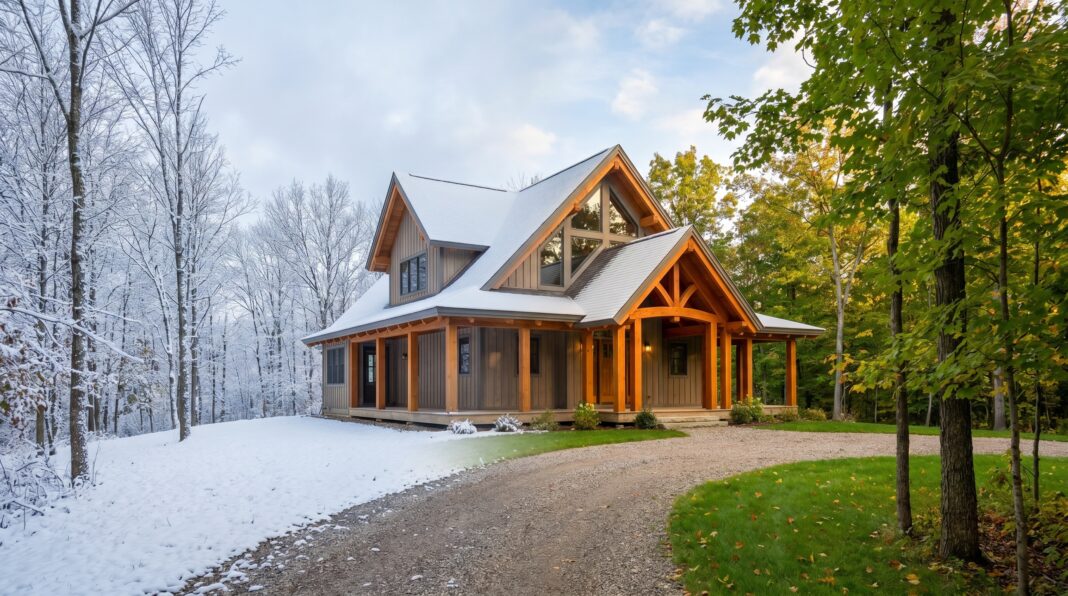
Michigan weather swings from lake-effect blizzards to muggy July afternoons, so you need a house that laughs at both. Timber framing answers—its 8×8 Douglas-fir posts and 12-in-12 roof pitches easily handle the 40-psf snow loads and 115-mph wind gusts mapped across the state.
Over the next few minutes, we’ll walk through four Hamill Creek Timber Homes plans that blend brute strength, energy smarts, and Michigan-specific details. By the end, you’ll know exactly which design offers the comfort, flexibility, and long-term value your site—and your family—deserve.
Let’s get started.
How we picked and ranked these designs
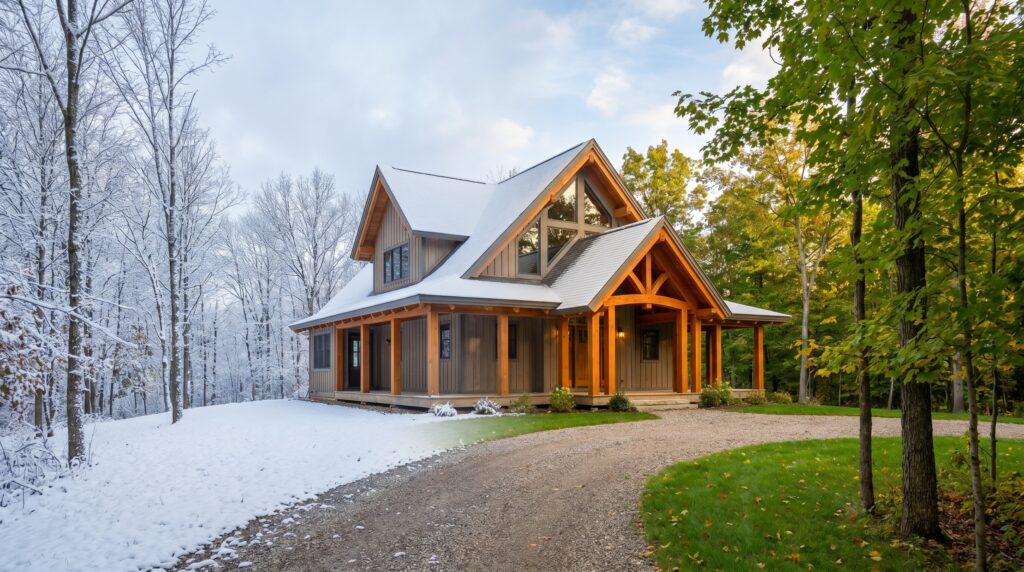
A clear method builds trust. We listed the three jobs every Michigan timber frame must tackle: shed 40 psf lake-effect snow, seal in heat during zero-degree nights, and adapt as households change.
We then filtered all Hamill Creek blueprints that already meet—or can be adjusted within 5 percent of—Michigan’s 115 mph wind and 40 psf snow codes. Plans missing basement options or a roof pitch of at least 10-in-12 were removed.
Each remaining design earned a 100-point score across five weighted factors:
- Structural resilience (30)
- Thermal performance and airtightness (30)
- Adaptability over a lifetime (15)
- Cost per usable square foot (15)
- Lifestyle X-factor: the emotional “wow” (10)
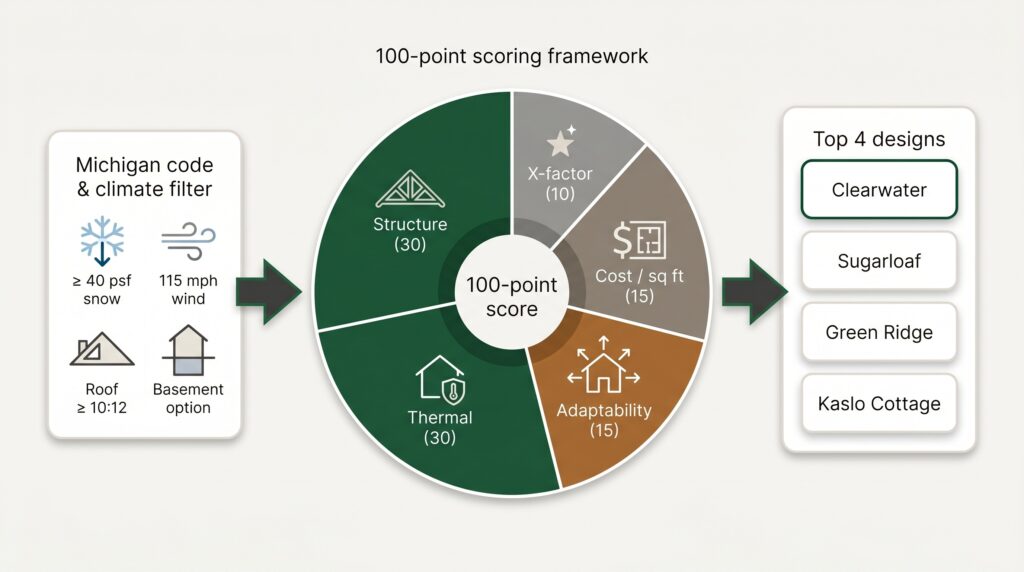
Finally, we ranked the top four by total score. These benchmarks echo the joinery-first philosophy that distinguishes true timber framing from basic post-frame kits—a distinction unpacked in Hamill Creek’s field guide for Michigan timber frame builders, which contrasts mortise-and-tenon craftsmanship, SIP-ready shells, and coast-to-site shipping protocols tailored to the Great Lakes climate. Doubling the weight of strength and energy keeps the focus where Michigan homeowners feel it first: storm safety and utility bills.
According to Hamill Creek Timber Homes’ engineering overview, every Douglas-fir bent is cut on a Hundegger K2 five-axis CNC, then fully test-fit on the shop floor before shipping.
That precision lets the team deepen rafters or revise a 9-in-12 roof to 12-in-12 for Michigan’s 40-psf snow maps without re-cutting on site, and the labeled pieces still raise into a weather-tight shell in about 5–10 days once the truck arrives.
Follow this process and the short-list you land on today will still feel right when the porch thermometer reads −10 °F.
What matters most in a Michigan timber frame
Snow, wind, and temperature swings punish every joint of a house, so structural strength leads the list. Heavy posts, a roof pitch of at least 10-in-12, and engineered trusses move 40 psf drifts and 115 mph gusts straight to the foundation with margin to spare.
Energy efficiency follows. Wrap the frame in structural insulated panels and you can hit blower-door scores below 1.5 ACH50, keeping January heat inside and July humidity outside.
Sustainability earns its spot. Responsibly harvested timber stores carbon for decades, and pairing it with reclaimed accents or a south-facing 4 kW solar array turns rustic style into daily climate action.
Versatility ranks next because life changes. A plan that starts as a snug retreat can double in finished area with a basement or loft, and the wide-span beams make those future upgrades simple and economical.
Last comes cost per usable square foot. Timber frames ask more on day one, yet their 80-year service life and lower utility bills even the ledger over time.
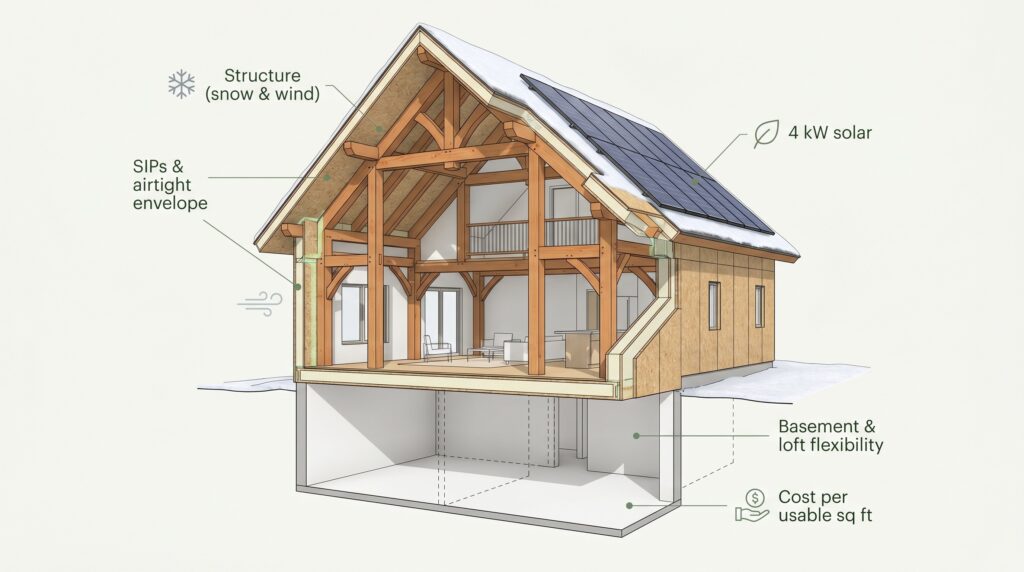
These five factors, in that order, shaped every ranking you are about to see.
Clearwater: single-level living that can double in size
Clearwater greets you with a classic hammer-beam great room and a porch built for sunrise coffee. The 1,622 sq ft plan keeps every daily task—sleeping, cooking, gathering—on one comfortable level, a relief when icy steps or tired knees make stairs unwelcome.
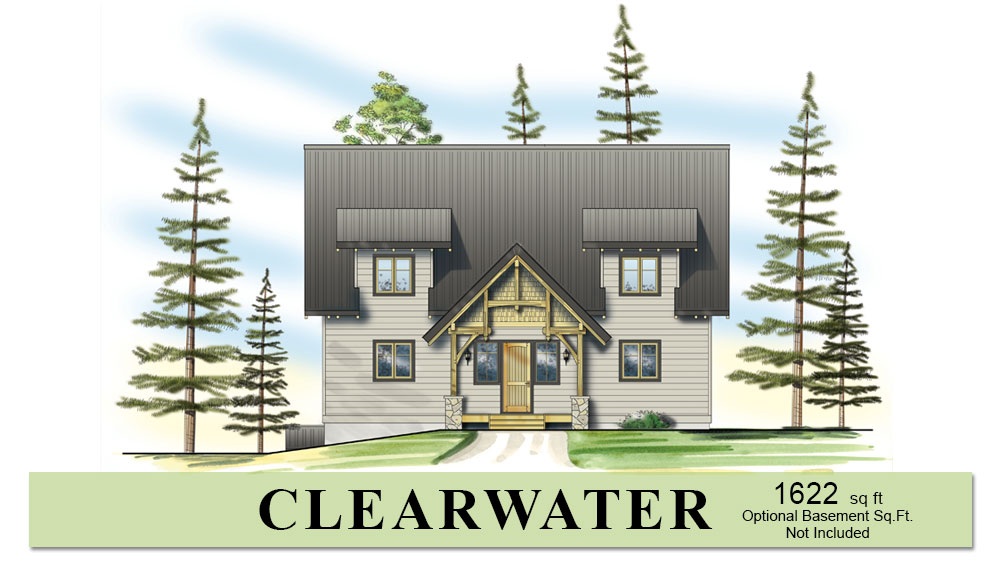
Clearwater timber frame home exterior Hamill Creek design
Wide-span beams remove interior load walls, so 8-inch SIP roof panels slide in without thermal bridges. The result is a tighter shell and lower winter heating demand. South-facing windows and 24-inch overhangs collect passive sun in February yet shade the space in July.
Michigan basements are common, and this plan turns that norm into a strength. Finish the optional lower level and add four bedrooms, a full bath, and a flexible rec room without enlarging the footprint.
Structurally, Clearwater’s steep roof sheds 40 psf snow loads, and the Douglas-fir skeleton resists 115 mph winds sweeping across open farmland.
Cost stays flexible. Build the main floor first, then finish downstairs when the family—or the budget—grows. You keep the cozy ranch feel while unlocking lodge-size capacity on demand.
Sugarloaf: cottage charm with modern muscle
Sugarloaf looks as if it stepped out of a storybook, yet its structure is all business. Pass the timber-framed porch and you enter a vaulted living room that feels twice its 1,643 sq ft. Exposed posts pull the eye upward, while dormer windows flood the space with daylight even on gray February afternoons.
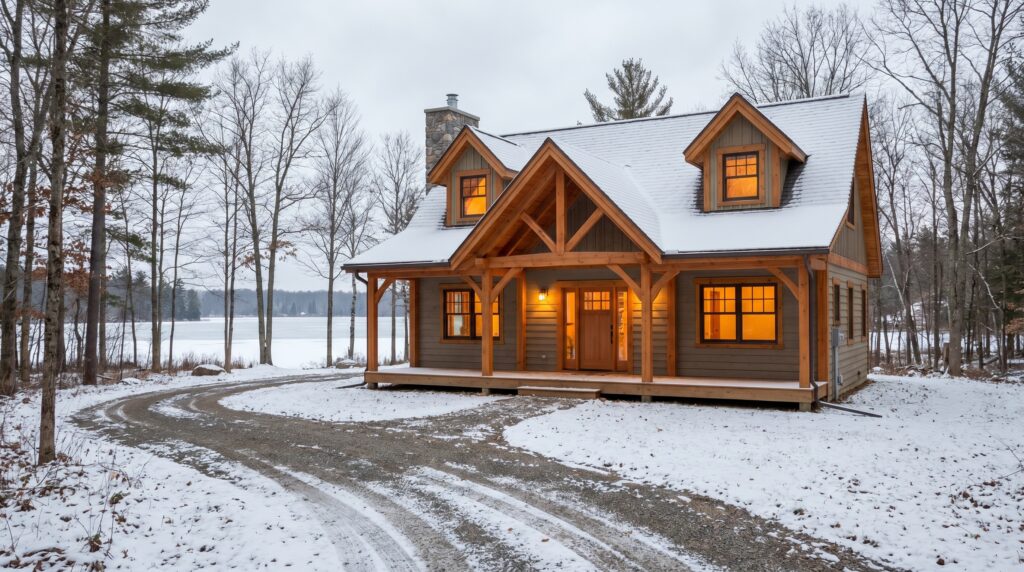
The main level keeps life simple. Kitchen, dining, and living zones wrap a central fireplace so one efficient HVAC loop manages comfort. A front room shifts easily from office to guest bedroom. Upstairs, the primary suite nests under the rafters, where dormers add headroom and lake-view reading nooks.
Energy use stays lean because the compact footprint limits exterior wall area. Wrap the frame in 6-inch SIP panels and create a continuous insulation blanket that shrugs off 40 psf snow loads and keeps January gas bills in check.
Planning ahead is easy. The optional basement offers a blank canvas for a third bedroom, media den, or ping-pong space without changing the silhouette. On sloped lots, a walk-out lower level delivers daylight rooms at about half the cost of above-grade footage.
We rank Sugarloaf second because it hits the Michigan trifecta: stout structure for snow, an efficient shell for utility savings, and whimsical curb appeal that makes every cabin-country neighbor pause.
Green Ridge: luxury packed into under 2,000 square feet
Green Ridge shows that you can live large without a sprawling footprint. The main floor spans 1,452 sq ft, yet vaulted king-post trusses and a tall arched gable window make every inch feel grand, even on cloudy March afternoons.

Green Ridge timber frame home with king-post trusses and arched window
The primary suite is the star. It claims its own wing and treats owners to separate bathrooms, ending lines at the shower and arguments over counter space. That premium feature, rare in houses twice this size, lets couples age in place without giving up privacy.
Entertaining feels effortless. Kitchen, dining, and living areas share one open volume, so conversation carries without raised voices. When guests stay over, the optional basement adds two bedrooms and two full baths, giving everyone space and quiet.
Energy costs stay polite. An insulated slab or radiant floor pairs with SIP-wrapped walls that shrug off 40 psf snow loads and January wind chills while keeping summer cooling demand modest.
Structurally, steep rooflines shed drifts fast, and the Douglas-fir frame is engineered for 115 mph winds sweeping across open farmland.
Price sits at the top of our list, yet every dollar funds daily comfort, not unused footage. Picture the “Not So Big House” idea clad in timber and glass, perfect for hosting a holiday crowd or sipping cocoa on a quiet Tuesday night.
Kaslo Cottage: small footprint, big timber soul
Kaslo Cottage shows that downsizing and indulging can live in the same sentence. The 1,272 sq ft layout holds two bedrooms and a great room where vaulted rafters lift your gaze and your mood. Step inside and the timber ceiling soars, so the cottage feels larger than the tape measure suggests.

Kaslo Cottage compact timber frame home exterior on tight Michigan lot
The main-floor bedroom lets you live on one level, while the loft suite above gives guests or teenagers an airy perch. Because the loft overlooks the great room, heat from a single woodstove or mini-split drifts upward, which keeps hardware simple and winter bills modest.
Kaslo’s rectangular shell is a gift to building science. Straight walls, no odd bump-outs, and a modest 10-in-12 roof leave fewer seams to seal. Wrap the frame in 6-inch SIP panels and you reach near-net-zero performance; the south-facing 4 kW solar array often covers annual demand when paired with efficient appliances and LED lighting. The structure is engineered for 40 psf snow loads and 115 mph winds, so winter storms stay outside where they belong.
Outside, the cottage footprint fits tight sites such as lakefront infill lots or a backyard ADU in Metro Detroit. Timber detailing signals craftsmanship usually reserved for larger lodges, giving porch-sitting charm without log-home upkeep.
Cost lands at the approachable end of timber framing. Less square footage means fewer timbers and panels, which frees budget for splurges like reclaimed flooring or triple-pane windows. The result is a jewel-box home that sips energy, ages gracefully, and feels as sturdy as the day it was raised.
How the four designs stack up at a glance
Tables only help when they save scrolling, so we distilled the need-to-know numbers into one quick grid. Use it to confirm size, sleeping capacity, and budget before diving into detailed plans.
| Design | Total living area | Beds / baths (base) | Expansion path | Snow-ready roof pitch | Est. turnkey cost* |
| Clearwater | 1,622 sq ft | 1 bed / 2 baths | Basement adds four beds + rec room | Steep (engineered for > 40 psf) | $250 +/sq ft |
| Sugarloaf | 1,643 sq ft | 2 beds / 2 baths | Basement for third bed or media space | Steep cottage gables | ≈ $225/sq ft |
| Green Ridge | 1,899 sq ft | 1 bed / 2 full, 2 half baths | Basement adds two ensuite bedrooms | King-post truss, 12-in-12 pitch | $250 +/sq ft |
| Kaslo Cottage | 1,272 sq ft | 2 beds / 2 baths | Loft open to below (no basement needed) | Simple 10-in-12 roof | ≈ $200/sq ft |
*Turnkey estimates reflect 2026 Michigan averages for custom timber frames, including finishes and mechanicals. Heavy-timber builds cost more than conventional homes but repay the premium through decades of lower maintenance and energy bills.
Why the numbers matter:
Clearwater delivers the lowest cost per eventual bedroom once you finish the basement. Sugarloaf sits in the comfort range for couples seeking a weekend home that can grow later. Green Ridge asks more up front, yet the dual-bath suite and daylight-rich great room justify the splurge. Kaslo Cottage is leanest on square footage and budget, proving sustainability can start small.
Energy tightness follows enclosure, not floor plan. All four accept SIP panels, but the compact forms of Sugarloaf and Kaslo often post blower-door scores below 1.5 ACH50 with a similar SIP wrap.
Bottom line: choose the line that fits your life today and the life you want ten winters from now.
Conclusion
Begin with lifestyle, not lumber. If you plan to age in place and want every essential on one level, Clearwater is the clear choice. You gain ranch convenience today and basement elbow room when grandchildren arrive.
Prefer cottage charm for weekend escapes? Sugarloaf blends postcard looks with serious insulation. It suits couples who host friends a few times a season yet value intimacy over size.
Green Ridge appeals to homeowners seeking daily luxury without excess square footage. Separate owner baths and a sun-washed great room deliver spa-level comfort inside a frame ready for January ice storms.
Choose Kaslo Cottage if efficiency, affordability, and a smaller footprint top your wish list. It fits tight lots, sips energy, and still offers soaring beams and fireside ambience.
Match the plan to the life you want ten winters from now, and the timbers will reward you every cold night and summer sunrise that follows.






