
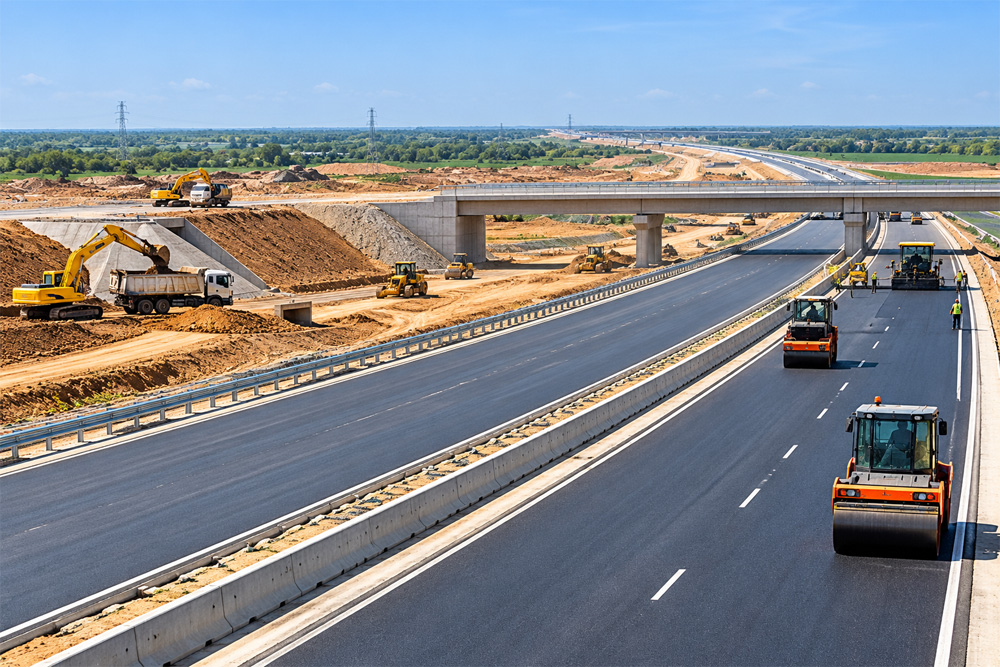
Greenfield expressways are high-speed road corridors developed on new alignments, generally across previously undeveloped or agricultural land. Unlike brownfield highway projects, which involve upgrading or widening existing roads, greenfield expressways allow engineers to plan the alignment, access points, interchanges, drainage systems and pavement structure according to present and future traffic requirements. These projects are designed to improve connectivity between cities, industrial centres, ports, logistics hubs and other economic regions.
The construction of a greenfield expressway involves several stages, including feasibility studies, land acquisition, geotechnical investigation, alignment design, earthwork, ground improvement, pavement construction, bridge and culvert development, installation of road safety systems and commissioning. Each stage requires coordination between civil engineers, surveyors, geotechnical specialists, environmental consultants, equipment operators and project management teams.
In India, greenfield expressway development has gained importance as part of efforts to improve intercity connectivity, reduce travel time and support freight movement. Projects such as the Delhi–Mumbai Expressway and the Bengaluru–Chennai Expressway illustrate the scale of planning and engineering required to develop new high-capacity road corridors.






