
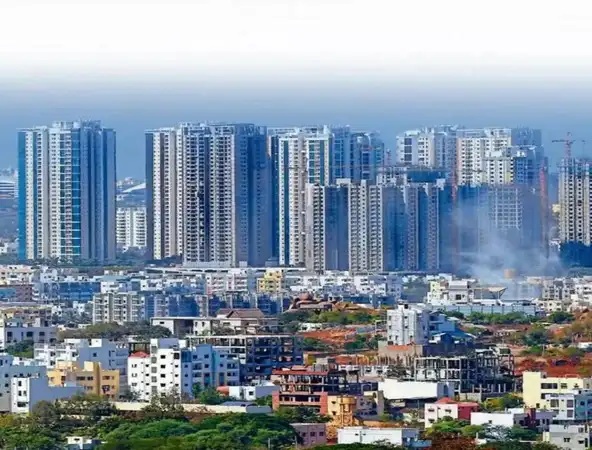
For much of the past decade, Gurugram has been the centre of gravity for premium housing in Delhi-NCR. The city has benefited from the concentration of corporate offices, high-income employment, infrastructure investment and its growing integration with Delhi and the wider National Capital Region.
That position is unlikely to change anytime soon. But NCR’s residential story is becoming broader.
The next phase of housing growth will increasingly come from a combination of established markets such as Gurugram and emerging urban centres across Haryana. The shift is not necessarily about buyers abandoning one city for another. It is about a larger regional market in which homebuyers have more choices around price, space, connectivity and the kind of community they want to live in.
This distinction matters because Gurugram’s success is itself helping create demand for alternatives.
Gurugram is becoming an increasingly premium market
Gurugram remains NCR’s dominant residential market. Knight Frank’s H1 2026 India Real Estate report shows that the city accounted for 50% of NCR’s new residential launches and 42% of sales between January and June 2026.
At the same time, NCR recorded 24,862 residential sales during the period, a 7% decline from a year earlier, while new launches fell 5% to 23,877 units.
The more significant change, however, is in the composition of Gurugram’s supply.
New launches in the city are increasingly concentrated in premium and luxury housing. According to Knight Frank, nearly all new projects in Gurugram are now starting above the ₹2 crore price point.
This does not suggest that demand for Gurugram is weakening. Quite the opposite. It demonstrates how far the market has moved up the value curve.
But as the city becomes more and more premium, buyers naturally begin to compare what they are paying for an established location with what the same investment can deliver elsewhere.
For some, proximity to Gurugram’s employment and commercial ecosystem will continue to justify the premium. For others, greater space, a larger community or a different lifestyle proposition may become more important.
That is where the wider Haryana market enters the conversation. The next housing markets will not necessarily look like Gurugram. There is a tendency in real estate to search for the “next Gurugram”.mThat may be the wrong way to look at the market.
Emerging cities do not necessarily need to replicate Gurugram. Their opportunity lies in developing according to their own economic strengths, connectivity and demographic demand.
Infrastructure is making this possible.
NCR is increasingly functioning as a network of interconnected corridors rather than a collection of isolated cities. Expressways, highways, metro connectivity, RRTS corridors and expanding commercial centres are changing how people assess distance.
For homebuyers, this means that a location does not necessarily have to be inside an established premium market to benefit from its economic growth.
For developers, it opens up the possibility of creating larger, more integrated developments in locations where land is available at scale.
Panipat represents the next layer of Haryana’s growth
Panipat presents a different proposition.
Panipat is an established city with its own industrial and commercial base and a strategic position on the GT Road. Its residential potential therefore cannot be measured simply by its relationship with Gurugram.
As infrastructure improves and economic activity spreads along regional corridors, cities such as Panipat can benefit from rising aspirations, increasing formal housing demand and the gradual expansion of organised real estate.
The important point for developers is to recognise that an emerging market should not be marketed merely as a cheaper version of an established one.
Panipat has its own economic identity and its own growth drivers. The opportunity is to build housing and communities that respond to the requirements of a growing regional market.
The premium buyer is looking for more than an address
The evolution of the buyer is equally important.
Premium housing is no longer defined only by the address or the size of the apartment. Space, open areas, wellness, recreation, retail, social infrastructure and the quality of the surrounding environment increasingly influence the purchase decision.
Knight Frank’s H1 2026 data shows that homes priced above ₹1 crore accounted for 54% of residential sales across India’s eight major markets, up from 49% in H1 2025.
This is evidence of a broader demand for premium housing.
But that does not mean that every premium buyer will choose the most expensive micro-market available.
A buyer may be willing to travel slightly further if the trade-off delivers a larger home, better-planned surroundings and a stronger community environment.
This is where larger developments and townships can have an advantage.
In mature urban markets, developers often have to work within an existing built environment. In emerging locations, there is greater scope to plan residential communities with open spaces, amenities and internal infrastructure from the beginning.
The challenge is that the developer then becomes responsible for creating much more than the community itself.
The developer’s role is changing
As residential demand spreads into emerging markets, the developer’s role becomes more important.
In an established location, the address itself carries significant value. In an emerging market, the developer has to establish confidence in both the project and the location.
That means credible execution, transparent approvals, reliable infrastructure and a clear understanding of what the surrounding market can become.
A buyer purchasing a home in an emerging location is making a long-term decision. The current state of infrastructure matters, but so does the potential trajectory of the neighbourhood over the next five or ten years.
This is particularly relevant for township developments, where the success of the project depends not only on individual homes but also on the quality of the larger ecosystem.
Ralith Realty’s presence in Panipat reflects these two dimensions of Haryana’s residential market.
Ralith Retreat in Sector 19A, Panipat, represents a different proposition: participation in an emerging regional market where larger-format development and evolving infrastructure can support a new generation of residential demand. The next NCR story will be more distributed. Infrastructure has played a critical role in catalyzing this growth. The upcoming Delhi – Karnal RRTS Corridor, UER-II and seamless connectivity through NH-44 are some of the factors that have contributed to Panipat emerging as one of the fastest growing real estate market in the whole of NCR






