
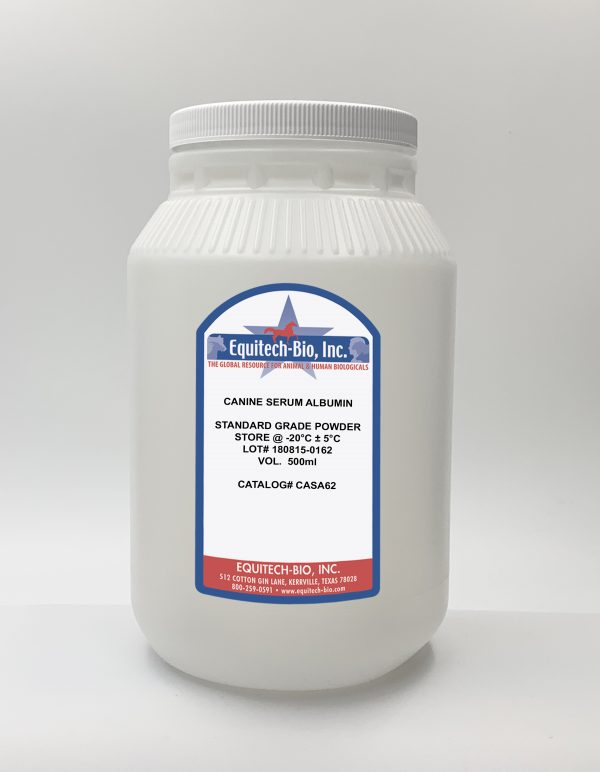
Diagnostic research runs on reliable reference materials, and canine serum albumin has built that reputation steadily over time. Its structural consistency, documented binding behavior, and species-specific protein profile give it a practical role across immunoassay development, antibody validation, and blocking protocols. For any laboratory working with canine biological samples or developing veterinary-focused diagnostics, it tends to be a foundational component that shapes how well the rest of the workflow performs.
Structural Characteristics
Teams looking to shop dog serum from established suppliers quickly discover that quality varies in ways that matter: purity grades differ, lot documentation ranges from thorough to sparse, and consistency between batches is far from guaranteed. Getting clear on what makes canine serum albumin genuinely useful starts with understanding the protein itself.
Canine serum albumin is a single-chain globular protein weighing approximately 69 kilodaltons. At physiological pH, it carries a net negative charge, a property that directly influences how it interacts with ligands, surface coatings, and dyes in assay environments.
Multiple binding domains run throughout the protein, each capable of interacting with fatty acids, small hydrophobic molecules, and certain hormones. That architectural range is a large part of why albumin appears so consistently in blocking and carrier applications across different assay formats.
Homology Considerations
Canine albumin shares roughly 79 to 80 percent sequence identity with human serum albumin. That level of overlap becomes significant when designing assays intended to detect species-specific epitopes or when validating antibodies meant to differentiate between canine and human proteins.
Antibodies raised against human albumin can show measurable cross-reactivity with the canine form. Without proper controls, this introduces background signal that complicates interpretation, particularly in quantitative assay formats.
Role in Immunoassay Development
Small molecules, drug metabolites, and short peptides lack the size needed to generate a strong immune response on their own. Conjugating them to a larger carrier protein like canine serum albumin solves that problem and drives the antibody production needed for downstream detection.
In enzyme-linked immunosorbent assays, albumin-based blocking buffers saturate free binding sites on the plate surface before the detection step. That simple function has an outsized effect on signal-to-noise ratios and overall assay sensitivity.
Calibration and Reference Standards
Canine serum albumin is the conventional reference standard for protein quantification assays, including bicinchoninic acid and Bradford formats. Both methods require a well-characterized standard, and albumin fits that role because of its stability and predictable behavior under assay conditions.
Using species-matched albumin when working in canine matrices also reduces the matrix interference effects that arise when bovine-sourced standards are substituted instead.
Binding and Stability Properties
Compared to many serum proteins, albumin is thermally stable. It holds its functional conformation across a wide pH range and tolerates moderate freeze-thaw cycles without significant structural degradation. These characteristics make it a dependable component in diagnostic reagent kits designed for extended shelf life.
Its affinity for hydrophobic ligands also gives it a defined role in drug metabolism studies. Researchers examining compound interactions with canine plasma proteins often use purified albumin as an isolated substrate, separating albumin-specific binding from the broader complexity of whole-serum effects.
Electrophoretic and Immunochemical Applications
In gel electrophoresis, albumin migrates consistently at approximately 66 to 69 kilodaltons, giving it value as a reference band for molecular weight estimation. That predictability is something researchers rely on when interpreting results across different gel runs.
Immunoelectrophoresis and immunodiffusion techniques use purified canine albumin as a positive control antigen when validating antisera raised against canine proteins. Its strong antigenic signal makes it a dependable benchmark in that context.
Sourcing and Quality Factors
Purity is the most consequential variable when selecting albumin for diagnostic applications. Preparations should exceed 96 percent purity as measured by high-performance liquid chromatography or gel densitometry. Residual immunoglobulins or transferrin introduce confounding signals in antibody-based detection systems, and that interference compounds as assay sensitivity increases.
Complete lot documentation should include animal health certificates, country of origin, and sterility test results. For assay development where reproducibility is non-negotiable, suppliers with archived lot records give researchers the option to reorder matched material during extended validation work.
Conclusion
Canine serum albumin earns its place in diagnostic development through a combination of structural predictability, functional range, and species-specific antigenic character. It supports blocking, calibration, carrier conjugation, and validation workflows, often simultaneously across a single assay system. Laboratories building canine-focused diagnostics depend on sourcing high-purity preparations with traceable documentation. No assay is more reliable than the reference materials behind it, and that principle applies directly to how albumin performs under real working conditions.






