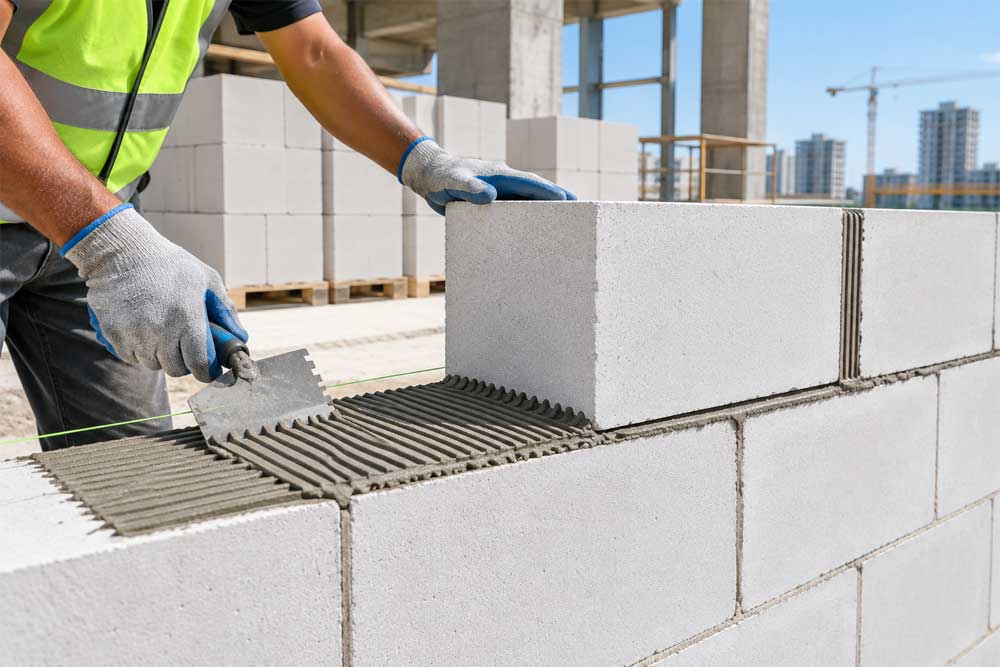
Autoclaved aerated concrete (AAC) blocks are widely used in residential, commercial and institutional construction because of their low weight, dimensional accuracy and thermal insulation properties. However, the performance of an AAC block wall depends not only on the blocks but also on the mortar used to connect them. Thin-bed mortar is specifically formulated for AAC block construction and allows blocks to be installed with a much thinner joint than conventional cement-sand mortar.
What Is Thin-Bed Mortar?
Thin-bed mortar is an adhesive-type mortar developed for laying dimensionally accurate masonry units such as AAC blocks. Unlike conventional masonry mortar, which may be applied in joints of around 10–15 mm, thin-bed mortar is designed to work effectively at a significantly lower thickness.
The formulation is designed to provide adequate adhesion, workability, water retention and strength despite the reduced joint thickness. Fine aggregates and chemical additives help the mortar spread uniformly over the block surface and maintain contact between adjacent units.
For AAC construction, this is particularly relevant because AAC blocks are manufactured with relatively precise dimensions. A thick mortar joint is not normally required to compensate for large dimensional variations when properly manufactured blocks are used.
Why Thin-Bed Mortar Is Used for AAC Blocks
Traditional cement-sand mortar can be used for masonry, but applying a relatively thick joint between accurately manufactured AAC blocks can increase material consumption and affect the uniformity of the wall.
Thin-bed mortar addresses this by creating a narrow and relatively uniform joint. The reduced joint thickness can provide several construction benefits:
- Lower mortar consumption
- More uniform wall alignment
- Reduced variation between block courses
- Faster block laying
- Better utilisation of AAC block dimensions
- Reduced material handling at site
- Cleaner masonry work
- Improved surface uniformity for subsequent finishing
The actual benefits depend on block quality, mortar formulation, workmanship and site conditions.
Composition of Thin-Bed Mortar
The exact formulation varies between manufacturers and applications, but a typical dry-mix thin-bed mortar can contain:
- Cementitious binders
- Graded fine fillers or aggregates
- Mineral additives
- Water-retention agents
- Cellulose-based additives
- Polymer modifiers
- Workability-enhancing additives
- Setting and performance modifiers
Each component has a specific role. Cementitious binders provide the primary binding mechanism, while fine aggregates and fillers help achieve the particle-size distribution required for thin application.
Chemical additives can improve water retention, adhesion, open time and workability. Polymer modification may also be used to improve bonding and other performance characteristics.
Because these materials are factory proportioned, the composition can be more consistent than mortar proportioned manually at individual construction sites.
Preparation of Thin-Bed Mortar
Correct preparation is important because thin-bed mortar is designed to perform within a specified range of water content.
The dry powder should generally be mixed with clean water according to the manufacturer’s recommended ratio. Excess water can change the consistency and affect the mortar’s performance, while insufficient water can make application difficult.
A typical preparation sequence involves:
- Placing the recommended quantity of clean water in a clean mixing container.
- Gradually adding the dry mortar powder.
- Mixing using a suitable mechanical mixer until a uniform paste is obtained.
- Allowing the mixture to rest for the specified period, where required.
- Remixing before application.
- Using the prepared mortar within the manufacturer’s stated working time.
The exact mixing procedure should always follow the product technical data sheet.
Surface Preparation of AAC Blocks
AAC block surfaces should be reasonably clean and free from loose particles, dust and other contaminants before mortar application.
Damaged or broken sections should be addressed before laying the next course. Where required by the mortar or block manufacturer’s instructions, the surface may need controlled dampening. However, excessive wetting should be avoided.
The first course requires particular attention because it establishes the alignment and level of the entire wall. Any significant irregularity in the first course can be carried into subsequent courses.
Application Technique
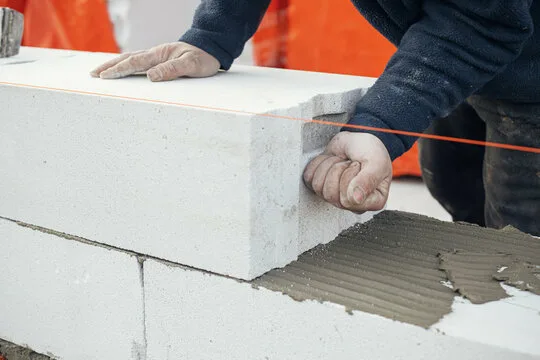
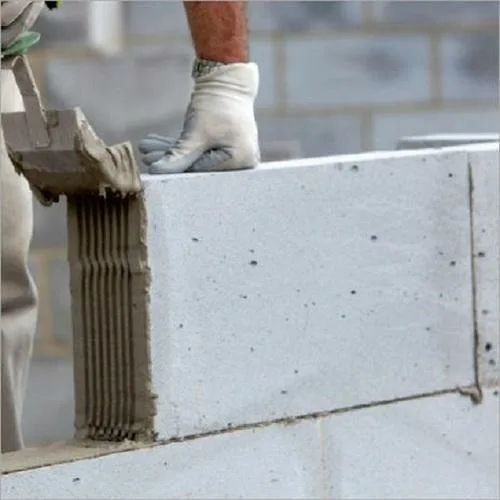
Thin-bed mortar is commonly applied using a suitable notched trowel, serrated trowel or specialised AAC block mortar applicator.
The mortar should be distributed uniformly across the required contact surface. The AAC block is then placed and adjusted into position while the mortar remains workable.
The objective is to achieve continuous and adequate contact between the block and mortar rather than creating isolated patches of adhesive.
The vertical and horizontal joints should be formed according to the masonry system and manufacturer’s recommendations. Excess mortar squeezed out from the joint can generally be removed before it hardens.
Importance of Joint Thickness
Joint thickness is one of the defining characteristics of thin-bed masonry.
A conventional mortar joint can compensate for variations in masonry unit dimensions. Thin-bed mortar, in contrast, is intended for relatively dimensionally accurate blocks.
Maintaining the specified joint thickness helps ensure:
- Consistent wall geometry
- Controlled mortar consumption
- Uniform load transfer
- Better surface alignment
- Reduced variations in plaster thickness
A joint that is significantly thicker than specified can increase material consumption and alter the intended performance of the masonry system. An excessively thin or discontinuous joint may reduce effective contact between the blocks.
Therefore, the applicator should use the correct tool and maintain consistent pressure and alignment during installation.
AAC Block Alignment and Levelling
The accuracy of the wall depends heavily on the first few courses.
Masons should check:
- Horizontal level
- Vertical alignment
- Wall line
- Corner alignment
- Joint continuity
- Block positioning
A rubber mallet or other suitable tool can be used for minor adjustments where recommended.
String lines, spirit levels, laser levels and other alignment tools can help maintain dimensional accuracy during construction.
Thin-Bed Mortar and Wall Strength
The mortar joint forms part of the masonry system and contributes to the transfer of loads between blocks. Thin-bed mortar is therefore not simply a material used to hold blocks together.
Its bond strength, compressive characteristics, water retention and compatibility with AAC blocks all influence the finished wall.
However, the strength of an AAC wall cannot be determined from mortar strength alone. Block properties, block geometry, joint configuration, workmanship, wall dimensions, openings and structural detailing also influence performance.
For load-bearing AAC masonry, the complete system should be designed and constructed according to applicable codes and project specifications.
Thin-Bed Mortar vs Conventional Mortar
The differences between the two systems can be considered across several construction parameters.
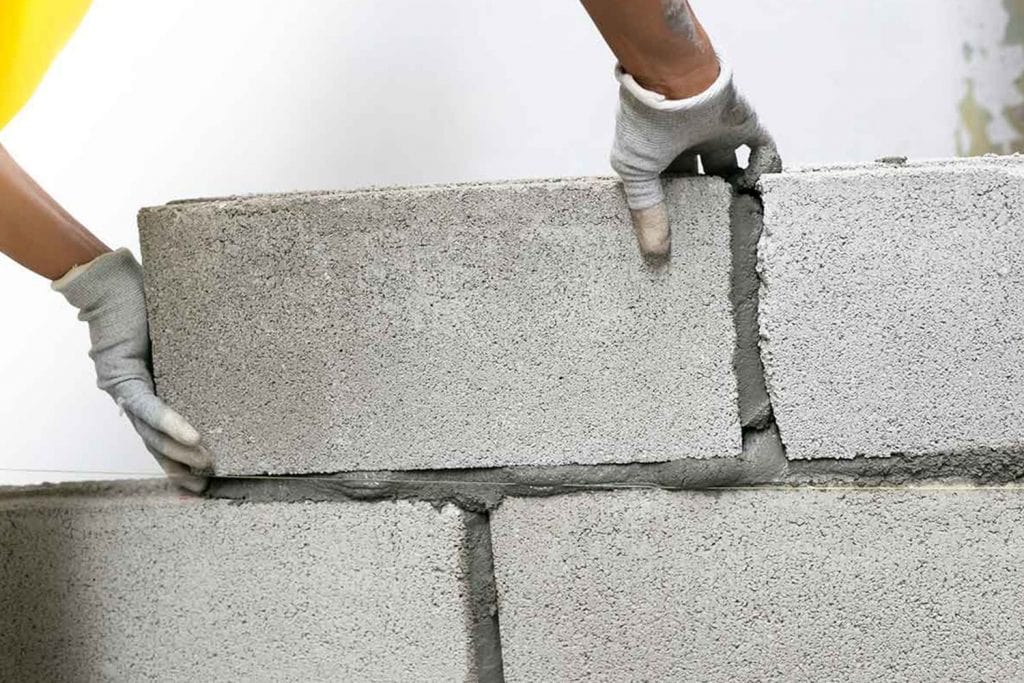
Joint thickness: Thin-bed mortar uses a much thinner joint, while conventional cement-sand mortar generally requires a thicker joint.
Material consumption: Thin-bed systems normally require less mortar because of the reduced joint thickness.
Application: Thin-bed mortar is generally applied using specialised trowels or applicators, while conventional mortar is commonly laid using masonry tools.
Dimensional requirements: Thin-bed systems are particularly suited to dimensionally accurate AAC blocks.
Site mixing: Factory-produced dry mixes offer controlled proportions, whereas conventional mortar is often proportioned and mixed at site.
Wall finish: Uniform thin joints can help achieve a more consistent masonry surface.
Common Application Mistakes
Several site practices can affect the performance of thin-bed mortar.
Excessive Water Addition
Adding extra water to make the mortar easier to spread can change its designed consistency and performance. Water should be added only within the manufacturer’s specified range.
Uneven Application
Patchy application can result in incomplete contact between the block and mortar. The mortar should be spread consistently over the intended joint area.
Excessive Joint Thickness
Using too much mortar defeats one of the main purposes of the thin-bed system and can affect material consumption and wall alignment.
Using Expired or Improperly Stored Material
Dry mortar should be stored in a dry location and protected from moisture. Material that has absorbed moisture or exceeded its recommended shelf life may not perform as intended.
Poor Block Alignment
Thin-bed mortar is not intended to compensate for major dimensional errors or poorly aligned courses. Blocks should be positioned carefully during installation.
Working Beyond the Open Time
Once the mortar has reached or exceeded its recommended working period, additional water should not simply be added to restore workability. The manufacturer’s instructions should be followed.
Storage and Handling
Dry mix mortar should be stored in sealed bags in a dry and protected area. Bags should preferably be kept above ground level and protected from rain, humidity and direct exposure to water.
Proper stock rotation is also important. Older material should generally be used before newer stock, subject to the manufacturer’s shelf-life requirements.
At site, damaged or moisture-affected bags should be segregated rather than mixed with fresh material.
Quality Control at Site
Quality control should begin before the mortar reaches the wall.
Important checks include:
- Product identification and batch information
- Manufacturing date and shelf life
- Packaging condition
- Storage conditions
- Water-to-powder ratio
- Mixing procedure
- Mixing time
- Joint thickness
- Mortar coverage
- Block alignment
- Open time
- Bonding and curing requirements
Where required for major projects, manufacturers may specify laboratory tests for properties such as compressive strength, tensile adhesion, water retention, setting characteristics and workability.
Role of Mechanised Application
Large construction projects increasingly use tools and equipment designed to improve the consistency of mortar application. Specialised AAC block applicators can help control the thickness and distribution of thin-bed mortar.
Mechanised or specialised application can be particularly useful where large quantities of AAC masonry are being constructed. Consistent application can reduce variations caused by manual spreading and improve productivity.
However, equipment does not replace the need for trained masonry workers and proper surface preparation.
Considerations for Different Climatic Conditions
Temperature and site weather conditions can influence mortar workability, setting and water loss.
In hot and dry conditions, excessive moisture loss can affect the mortar before adequate bonding occurs. In rainy conditions, the mortar and freshly constructed masonry need protection from direct water exposure.
Manufacturers may specify particular application temperature ranges, working times or precautions. These recommendations should be followed rather than applying a uniform procedure under all site conditions.
Best Practices for AAC Thin-Bed Mortar Application
For consistent results, contractors can follow several basic practices:
- Use AAC blocks with appropriate dimensional accuracy.
- Select a thin-bed mortar compatible with the blocks.
- Store bags in dry conditions.
- Follow the specified water-to-powder ratio.
- Use mechanical mixing where recommended.
- Apply mortar with the appropriate trowel or applicator.
- Maintain the specified joint thickness.
- Check alignment and level continuously.
- Avoid contamination of prepared mortar.
- Follow the specified working and open times.
- Protect freshly laid masonry from adverse weather.
- Follow the manufacturer’s technical data sheet and project specifications.
Conclusion
Thin-bed mortar has become an important component of AAC block masonry because it is designed around the dimensional accuracy and lightweight characteristics of AAC units. Its thin application can reduce mortar consumption, improve joint uniformity and support faster, cleaner masonry installation when used correctly.
The performance of the system, however, depends on more than the mortar itself. AAC block quality, mortar formulation, water dosage, mixing, application technique, joint thickness, alignment and site conditions all have a role.
For contractors and project teams, the key is to treat thin-bed mortar as part of an integrated AAC masonry system rather than simply as a replacement for conventional cement-sand mortar. Correct product selection, controlled preparation and consistent application are essential for achieving the intended performance of the wall.