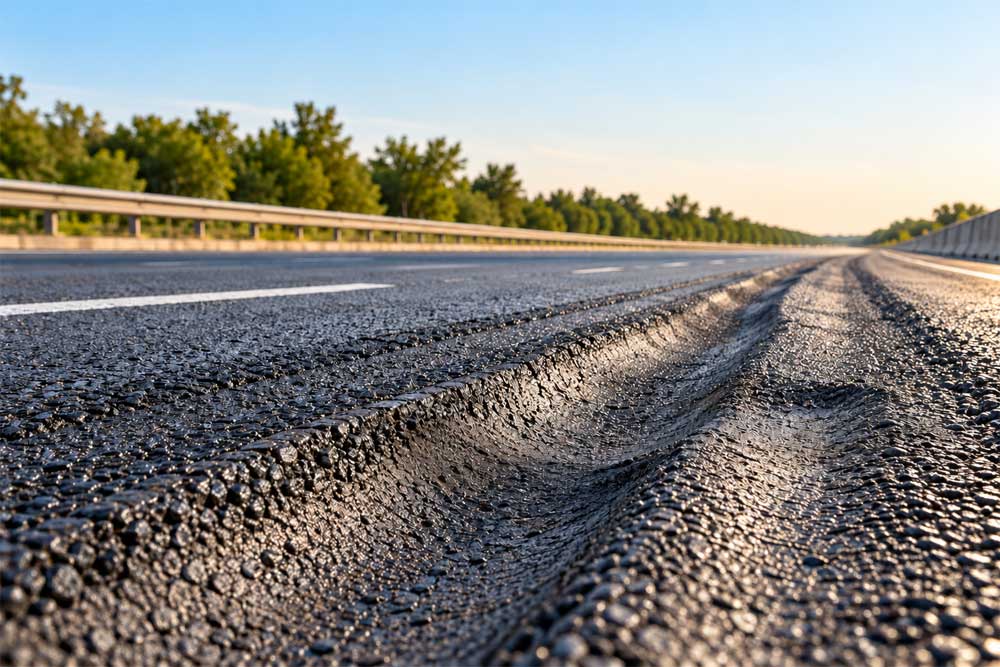
Road rutting is a common form of pavement distress caused by permanent deformation along vehicle wheel paths. It is particularly common on roads carrying heavy commercial traffic, especially when pavement materials, drainage, compaction or structural design are inadequate.
Rutting appears as longitudinal depressions in the wheel tracks, often with raised material along the edges of the depression. As rut depth increases, rainwater can accumulate within the wheel paths, affecting surface drainage, ride quality and vehicle control.
Understanding where the deformation occurs is important because rutting may originate in the asphalt layer, granular base or subgrade. The repair method should therefore be selected after identifying the underlying cause.

Rutting can occur through two main mechanisms:
- Densification: Reduction of air voids and further compaction of pavement materials under traffic.
- Shear deformation: Lateral movement of pavement material away from the wheel path.
The severity of rutting can be evaluated by measuring rut depth and examining the pavement layers below the affected area.

Types of Road Rutting
Asphalt Layer Rutting
Asphalt layer rutting occurs within the bituminous pavement. It is commonly associated with high temperatures, heavy traffic, unsuitable asphalt mixtures, inadequate compaction and insufficient resistance to permanent deformation.
High pavement temperatures can soften the binder, allowing aggregate particles and binder to move under repeated wheel loading.
Base and Sub-base Rutting
Deformation can also occur in the granular layers beneath the asphalt surface. Poor-quality materials, inadequate compaction, excessive moisture and insufficient layer thickness can contribute to this type of rutting.
In such cases, repairing only the asphalt surface may provide limited improvement.
Subgrade Rutting
Subgrade rutting occurs when the soil supporting the pavement undergoes permanent deformation.
Weak soils, high moisture levels, poor drainage and inadequate subgrade preparation can reduce bearing capacity and cause deformation under repeated traffic.
Combination Rutting
In some pavement sections, deformation occurs across several layers simultaneously. Asphalt, base, sub-base and subgrade conditions may all contribute to the observed rut depth.
These situations generally require a detailed pavement investigation before rehabilitation.
Major Causes of Road Rutting
Heavy and Repeated Traffic
Repeated loading from trucks, buses and other heavy vehicles is a major contributor to rutting. The number of commercial vehicles and axle loads should be considered during pavement design.
High Temperature
Bituminous materials can become softer at elevated temperatures. Heavy traffic acting on a hot pavement can accelerate permanent deformation when the asphalt mixture does not have adequate rut resistance.
Inadequate Compaction
Poor compaction leaves excessive air voids and reduces the stability of pavement layers. Traffic can subsequently compact the material further, causing surface settlement.
Poor Asphalt Mix Design
Inappropriate aggregate gradation, insufficient aggregate interlock or excessive binder can reduce resistance to deformation.
The asphalt mixture should be designed according to traffic loading, temperature and pavement requirements.
Weak Subgrade
A weak subgrade can cause deformation even when the asphalt surface is properly constructed. Soil investigation and appropriate ground improvement are therefore important for roads constructed over weak ground.
Excess Moisture
Water entering pavement layers can reduce the strength of granular materials and subgrade soils. Repeated traffic on saturated or poorly drained pavement can accelerate deformation.
Inadequate Pavement Thickness
Pavement layers that are insufficient for the expected traffic loading can transmit excessive stresses to the underlying materials, increasing the risk of permanent deformation.
Poor Drainage
Blocked drains, inadequate crossfall and poor subsurface drainage can allow water to remain within the pavement structure. This can weaken the base, sub-base and subgrade.

How Road Rutting Is Investigated
Before selecting a repair method, engineers need to establish the depth, extent and source of deformation.
Typical investigations include:
- Visual pavement inspection
- Rut-depth measurement
- Pavement profiling
- Traffic and axle-load assessment
- Asphalt core sampling
- Asphalt density and air-void testing
- Base and sub-base material testing
- Subgrade strength evaluation
- Moisture and drainage assessment
- Pavement deflection testing
- Investigation of pavement layer thickness
Laser-based pavement profilers can also be used on larger road networks to identify rutting continuously across long sections.
Various Equipments Used for Road Rutting Assessment and Repair
Different equipment is used depending on whether the work involves investigation, removal of damaged pavement, material placement or compaction.
Laser Road Profilers
Laser-based road profilers measure pavement surface profiles and identify rut depth, longitudinal unevenness and other surface characteristics.
They allow road agencies to survey long stretches of pavement without relying solely on manual measurements.
Falling Weight Deflectometer
A Falling Weight Deflectometer, or FWD, applies a controlled load to the pavement and measures its deflection response.
The data can help engineers assess pavement structural condition and identify sections where deformation may be related to underlying structural weakness.
Pavement Coring Machines
Core drilling equipment is used to extract cylindrical samples from asphalt and other pavement layers.
The recovered cores can be examined for layer thickness, density, material condition and other properties.
Milling Machines
Cold milling machines remove deteriorated or deformed asphalt from the pavement surface.
Milling depth can be controlled according to the extent of rutting. The milled material can also be collected for recycling where suitable.
Asphalt Pavers
Asphalt pavers are used to place new bituminous mixtures after milling, reconstruction or pavement preparation.
They distribute and partially compact the asphalt while maintaining the required width, thickness and surface profile.
Tandem Rollers
Tandem vibratory rollers are widely used for asphalt compaction. They apply static and/or vibratory forces to compact the newly laid mixture.
Proper roller operation is important for achieving the required pavement density and reducing the possibility of future deformation.
Pneumatic Tyre Rollers
Pneumatic tyre rollers use rubber tyres to apply kneading and compaction action to asphalt.
They can improve aggregate interlock and help achieve uniform compaction across the pavement surface.
Vibratory Soil Compactors
When rutting is associated with granular layers or subgrade preparation, vibratory soil compactors can be used to compact the underlying materials.
The appropriate equipment depends on soil type, layer thickness and project requirements.
Motor Graders
Motor graders are used to prepare and shape granular layers and subgrade surfaces.
They help achieve the required crossfall, longitudinal profile and surface level before pavement layers are placed.
Wheel Loaders
Wheel loaders are commonly used for handling aggregates, reclaimed asphalt pavement and other construction materials during road rehabilitation.
Excavators
Excavators are used for removing unsuitable pavement or soil, drainage improvement, shoulder reconstruction and excavation during full-depth pavement rehabilitation.
Water Tankers
Water tankers are used during compaction of granular layers where controlled moisture is required. They can also support dust control during earthwork and pavement rehabilitation.
Asphalt Mixing Plants
Asphalt mixing plants produce hot or warm asphalt mixtures by proportioning, heating and mixing aggregates, mineral filler and bituminous binder.
Consistent plant production is important for maintaining the specified properties of the pavement mixture.

Road Rutting Repair Methods
The appropriate treatment depends on the depth and cause of the rutting.
Surface Correction
Minor surface deformation may be corrected through appropriate resurfacing or localised treatment after determining that the underlying pavement remains structurally sound.
Milling and Resurfacing
Where rutting is primarily limited to the asphalt layer, milling can remove the deformed material.
The milled surface is cleaned and prepared before a new asphalt layer is placed and compacted.
Asphalt Overlay
An asphalt overlay can be used where the existing pavement has adequate structural capacity but requires additional surfacing or strengthening.
Existing deformation should be corrected where necessary before the overlay is placed.
Full-Depth Reconstruction
Severe structural rutting may require removal and replacement of affected pavement layers.
The damaged materials are excavated and replaced with properly designed, placed and compacted layers.
Base and Subgrade Improvement
Where investigation identifies weak underlying layers, rehabilitation can involve:
- Replacement of unsuitable soil
- Mechanical stabilisation
- Cement stabilisation
- Lime stabilisation where suitable
- Geosynthetic reinforcement
- Improved drainage
- Additional pavement thickness
Preventing Road Rutting During Design
Rutting prevention begins with pavement design. Engineers should assess expected traffic, axle loads, climate, soil conditions, drainage and pavement materials.
The pavement structure should provide sufficient strength and stiffness to distribute traffic loads through the asphalt, base, sub-base and subgrade.
Material selection should also consider resistance to permanent deformation under the expected temperature and loading conditions.

Preventing Rutting During Construction
Construction quality has a direct effect on pavement performance.
Important practices include:
- Proper subgrade preparation
- Adequate compaction of every pavement layer
- Correct asphalt mix design
- Suitable aggregate gradation
- Controlled binder content
- Proper asphalt placement temperature
- Appropriate roller selection
- Correct rolling sequence
- Uniform layer thickness
- Protection of pavement layers from excess moisture
- Regular field density and quality testing
Compaction should be completed within the appropriate temperature range for the asphalt mixture.
Importance of Road Drainage
Effective drainage helps prevent water from weakening pavement layers.
Road drainage may include:
- Side drains
- Kerb and channel systems
- Cross-drainage structures
- Edge drains
- Subsurface drainage systems
- Proper pavement crossfall
Drainage systems should also be inspected and maintained regularly. Blocked outlets and damaged drains can allow water to remain within the pavement structure.
Monitoring and Maintenance
Regular pavement condition monitoring can help identify rutting at an early stage.
Road agencies can use manual rut-depth measurements, vehicle-mounted profiling systems and other pavement survey technologies to monitor pavement deformation.
Early intervention can prevent minor surface deformation from developing into more extensive structural deterioration.
Maintenance programs should also address associated problems such as cracking, water infiltration, shoulder damage and drainage deficiencies.
Conclusion
Road rutting is a progressive pavement distress caused by permanent deformation under repeated traffic loading. Its causes can range from asphalt mixture and compaction problems to weak granular layers, poor subgrade conditions and inadequate drainage.
Effective rehabilitation starts with determining where the deformation is occurring and why it is occurring. Milling and resurfacing may be suitable for asphalt-layer rutting, while deeper structural problems may require base improvement, subgrade stabilisation, drainage correction or full-depth reconstruction.
A combination of appropriate pavement design, quality materials, controlled construction, adequate compaction, effective drainage and regular condition monitoring can help reduce rut formation and extend the service life of road pavements.