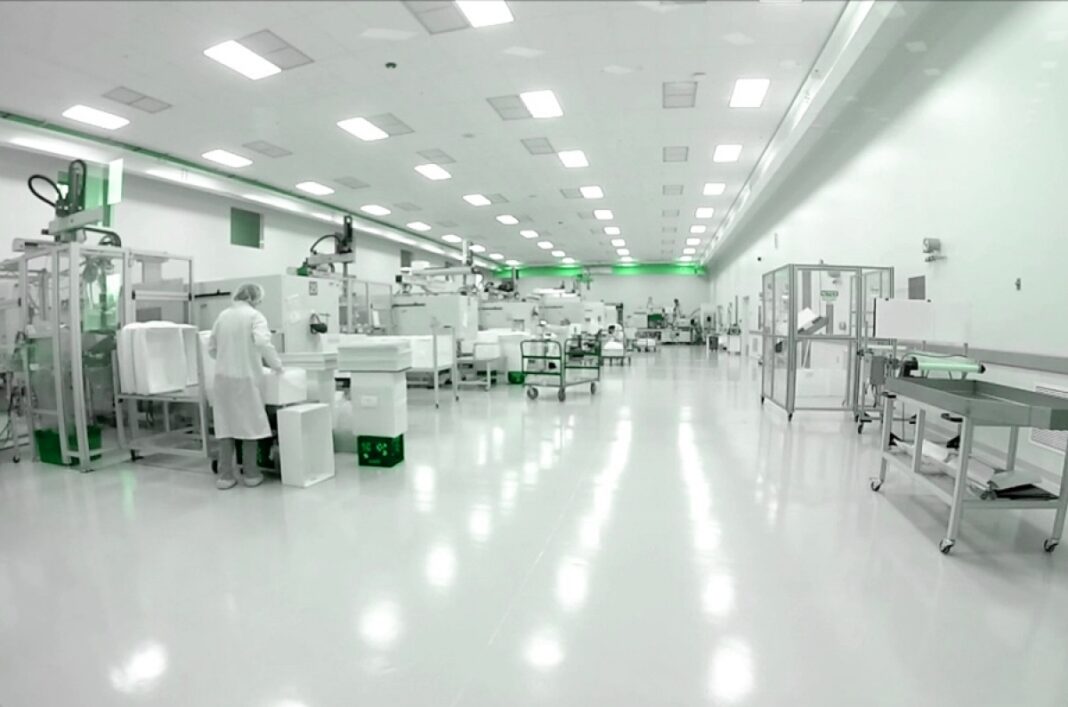
Clean room classifications form the foundation of modern pharmaceutical manufacturing. They define precisely how clean the air must be in controlled environments where medicines are produced. For any company operating in pharmaceutical production the principle remains the same: without proper classification you risk both product quality, patient safety, and regulatory compliance.
If you work in pharmaceutical manufacturing or plan to establish new facilities, you need to understand the three major classification systems used globally. They are not complicated once you grasp what they mean and how they work together.
How Pharmaceutical Clean Room Classification Works
Cleanroom classification is about controlling particles in the air. The fewer particles present, the cleaner the environment, and the lower the risk of contamination damaging your product.
The system is measured by a simple metric: the number of suspended particles per cubic meter of air. Typical city air contains around 35 million particles of size 0.5 micrometer and larger. An ISO 9 cleanroom allows exactly that same particle count. Moving down the scale becomes more stringent.
For pharmaceutical manufacturing three systems are typically used. FDA in the US is based on ISO standards. EU GMP is used across Europe. ISO 14644-1 is the international system that forms the basis for both others. Although they use different names and terminology they say essentially the same thing. An ISO 5 cleanroom is practically equivalent to a Grade A under EU GMP.
The critical point: if you handle sterile work or critical processes you use ISO 5, also called FDA class 5 or EU GMP Grade A. Surrounding areas and support facilities can be ISO 7 or ISO 8. Support functions and less critical steps can be even more broadly classified.
The exact classification you need depends entirely on what you produce. A sterile fill of injectable liquid requires the highest level. A tablet pressing can manage less stringent control. Your choice affects both costs and complexity across your entire operation.
A well-designed classification system allows you to read more about pharmaceutical clean room classification and find the exact standard you must follow. Documentation and compliance statements from cleanroom equipment suppliers are critical when you need to prove your facilities meet requirements.
The Three Classification Systems and Their Practical Meaning
FDA classification in the US is simplified and direct. When FDA refers to clean room classes, they mean ISO 5, ISO 7, ISO 8 or broadly Class 100,000. This means American facilities use ISO nomenclature directly. ISO 5 is where the strictest requirements apply. ISO 7 and ISO 8 are used for support functions and less critical areas.
EU GMP classification uses letters instead of numbers. Grade A is the top tier. Grade B is the background environment surrounding Grade A areas. Grade C and D are used for less critical process steps. Although the terminology looks different, it still concerns the exact same principles. A Grade A area allows fewer particles than a Grade C area.
ISO 14644-1 is the international standard system. It defines nine classes from ISO 1 to ISO 9 based on particle concentration. Both FDA and EU GMP built their systems on this standard, making ISO 14644-1 your reference document if you operate across markets.
If you work globally, understanding the mapping between systems matters. ISO 5 corresponds to Grade A. ISO 6 to 7 corresponds to Grade B. ISO 7 to 8 corresponds to Grade C to D. This means you can document compliance across markets if you hold ISO classification.
Blue Line specializes precisely in this area and understands what it takes to meet these classifications. Their products are designed to be simple to clean and maintain, with smooth surfaces and rounded edges that reduce spots where particles can collect. Compatibility with all common cleaning agents from isopropyl alcohol to VHP makes it easier to keep facilities clean without juggling incompatible materials.
When choosing cleanroom equipment you also need to ensure everything can deliver the documentation required. Compliance statements and material attestations should be available before you order. If you use computers or control interfaces in a cleanroom, material selection is critical because some plastic types absorb cleaning agents or degrade over time.
Implementing Cleanroom Classification in Practice
When implementing cleanroom classification, you don’t start by building the room. You start by understanding what you will produce and which critical steps must take place. A risk assessment determines how strict the control needs to be.
A typical pharmaceutical facility will have multiple zones. The production areas where sterile operations occur should be ISO 5. Buffer areas and material prep can be ISO 7. Office spaces and administrative areas can be more broadly classified. By designing the facility layout with classification in mind, you can minimize costs while still ensuring patient safety.
Ventilation and filtration are the most important elements. You need HEPA filters that capture particles down to 0.3 micrometer. Airflow must be constant and unidirectional. Pressure must be higher in cleaner areas than in less clean areas so contamination always moves away from critical processes.
Staff must be trained in cleanroom hygiene. Gowning procedures, movement patterns and the specific protective clothing required make a major difference. Even if your room is perfectly ventilated, poor staff practice can introduce contamination.
Documentation and validation are legal requirements. You must be able to demonstrate that your room continuously meets the classification. Particle counts and differential pressure measurements should be logged regularly. If a batch fails or an inspector arrives, you need the history showing your facility was under control throughout the entire production period.
Equipment selection affects how easy it becomes to maintain classification. Door selection for cleanrooms is a concrete example. Standard doors do not hold up in these environments. Doors must be designed for cleanroom operation with seals that are not destroyed by cleaning agents. You can read more about cleanroom high-speed doors for the pharmaceutical industry to understand which features actually matter.
Classification as Strategy
Pharmaceutical clean room classification is not a checkbox requirement you tick off when the facility opens. It is a continuous commitment to maintaining a high standard at all times. Choosing the right classification affects annual operating costs, staff training, equipment purchases and documentation burden.
It is worth investing the time to understand what you need before you start building. A facility classified at a higher level than necessary becomes expensive to operate. A facility classified too low risks compliance problems and potential recall of produced batches.
Partner with suppliers who understand these nuances. They should be able to help you not only meet the standards but also understand what drives the costs and which trade-offs can be made without compromising safety.