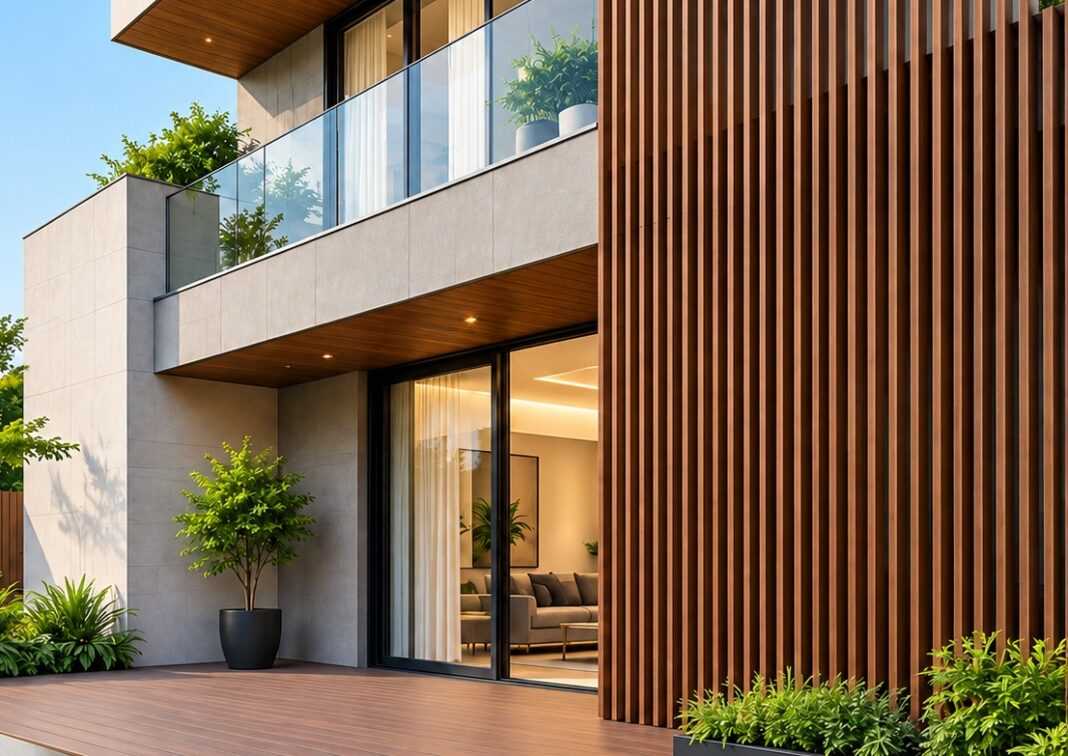
Wood Plastic Composite (WPC) has become an option for exterior architectural applications where designers want the appearance of wood along with resistance to moisture and outdoor exposure. WPC products are manufactured by combining wood fibres or wood flour with thermoplastic polymers and additives. Depending on the formulation and manufacturing process, they can be produced as decking boards, wall cladding, screening panels, louvers, fencing, pergolas and other exterior elements.
Unlike conventional timber, WPC does not rely entirely on natural wood for its performance. The polymer component helps reduce moisture absorption, while the wood component provides a surface appearance and texture associated with timber. However, WPC is not a maintenance-free material, and product selection, detailing, installation and exposure conditions influence its service performance.
For architects, landscape designers, developers and contractors, understanding where WPC works well—and where other materials may be more suitable—is important before specifying it for an exterior project.
The composition varies considerably between manufacturers. The percentage of wood, polymer, pigments, stabilisers, coupling agents and other additives can affect:
- Moisture resistance
- Dimensional stability
- Colour retention
- Surface hardness
- UV resistance
- Impact resistance
- Thermal movement
- Resistance to biological deterioration
- Long-term appearance
Therefore, the term WPC describes a broad product category rather than one standardised material with identical properties.
WPC Exterior Products
WPC is available in several product forms for exterior architecture and landscaping.
1. WPC Decking
Decking is one of the most common applications. WPC decking boards can be used for:
- Terraces
- Balconies
- Poolside areas
- Outdoor restaurants
- Resort walkways
- Garden decks
- Rooftop recreational areas
- Commercial outdoor spaces
Decking profiles may have solid or hollow sections. Installation normally involves a supporting substructure, clips or mechanical fixing systems and provision for drainage and expansion.
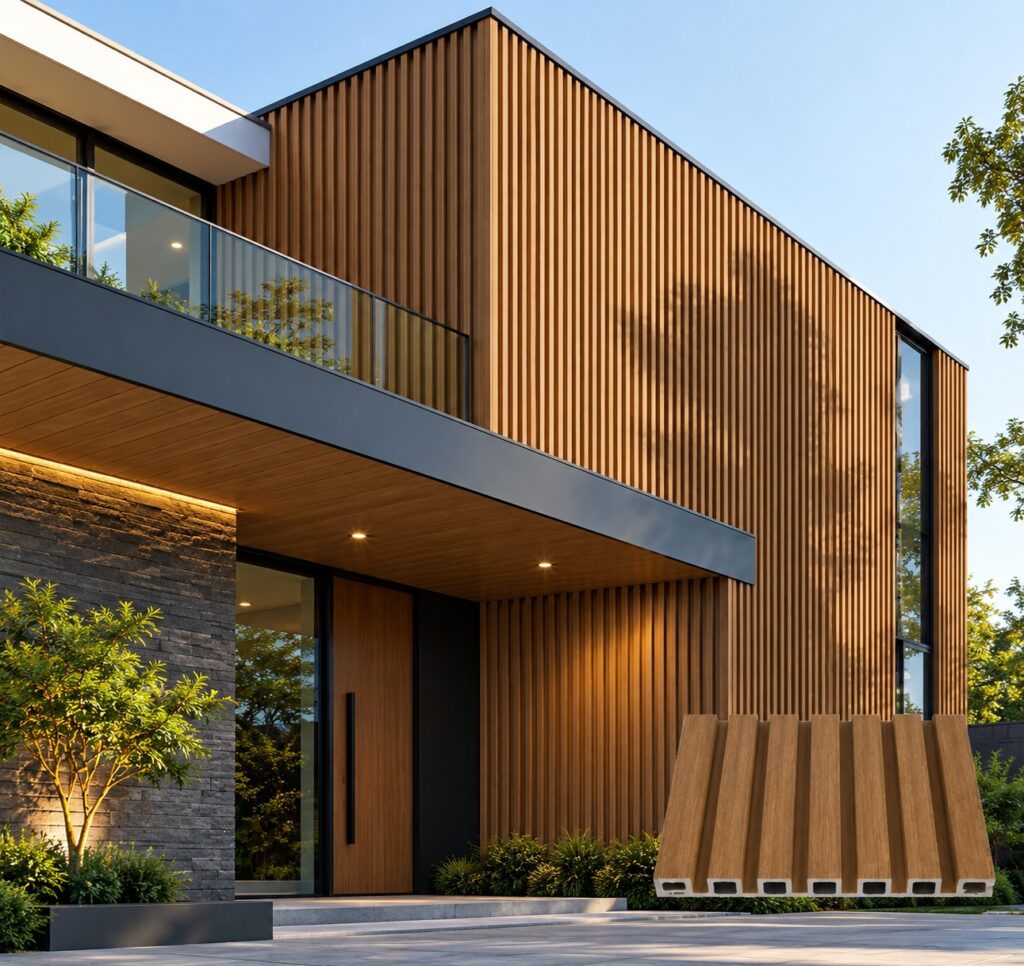
2. WPC Wall Cladding
WPC wall cladding is used on exterior walls to introduce a timber-like appearance.
Applications include:
- Residential facades
- Villas
- Resort buildings
- Restaurants
- Cafés
- Commercial buildings
- Entrance features
- Balcony walls
- Feature facades
Cladding can be installed horizontally or vertically, depending on the architectural design and product profile.
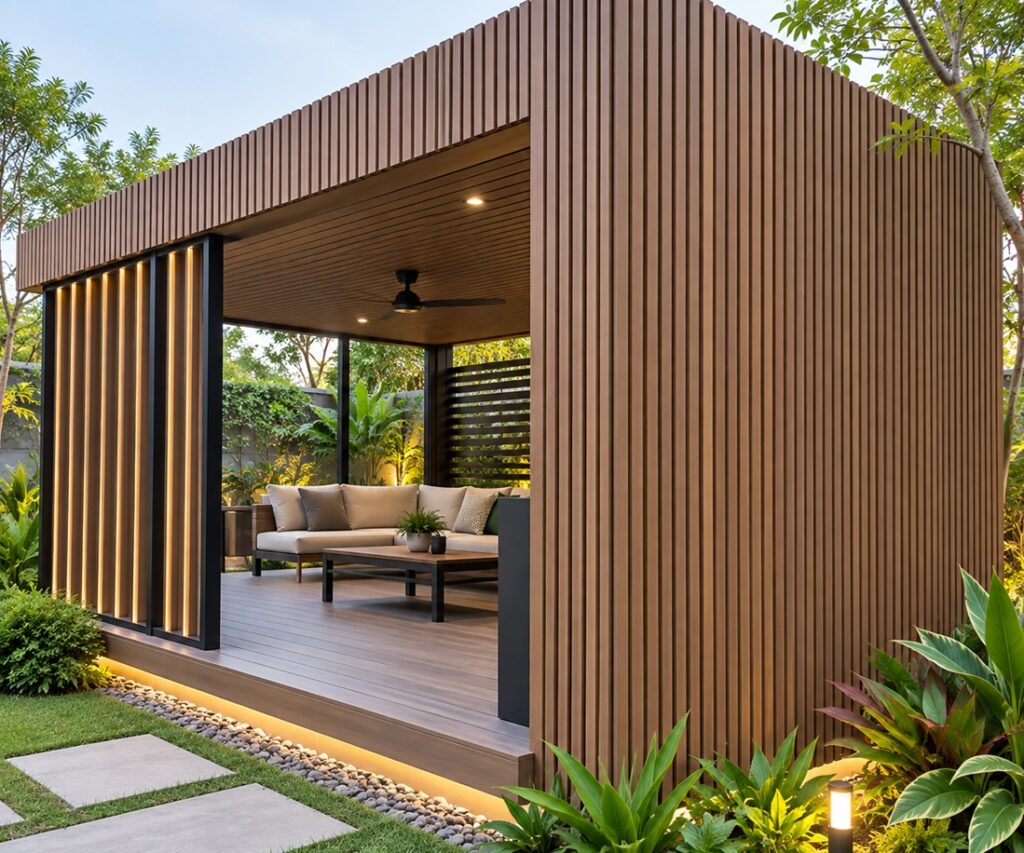
3. WPC Louvres and Screens
WPC profiles can be used to create architectural screens and louvres.
They can provide visual separation between spaces while allowing designers to control views and sunlight. Typical applications include:
- Balcony screens
- Parking-area screening
- Service-area screening
- Terrace partitions
- Garden boundaries
- Building entrance features
- Outdoor seating areas
The spacing and orientation of the profiles can be adjusted according to the required visual effect.
4. WPC Fencing
WPC fencing can be used in residential developments, resorts, gardens and commercial landscapes.
Compared with untreated timber fencing, WPC can offer greater resistance to moisture-related deterioration. However, the supporting posts, fasteners and foundations must also be designed for outdoor exposure.
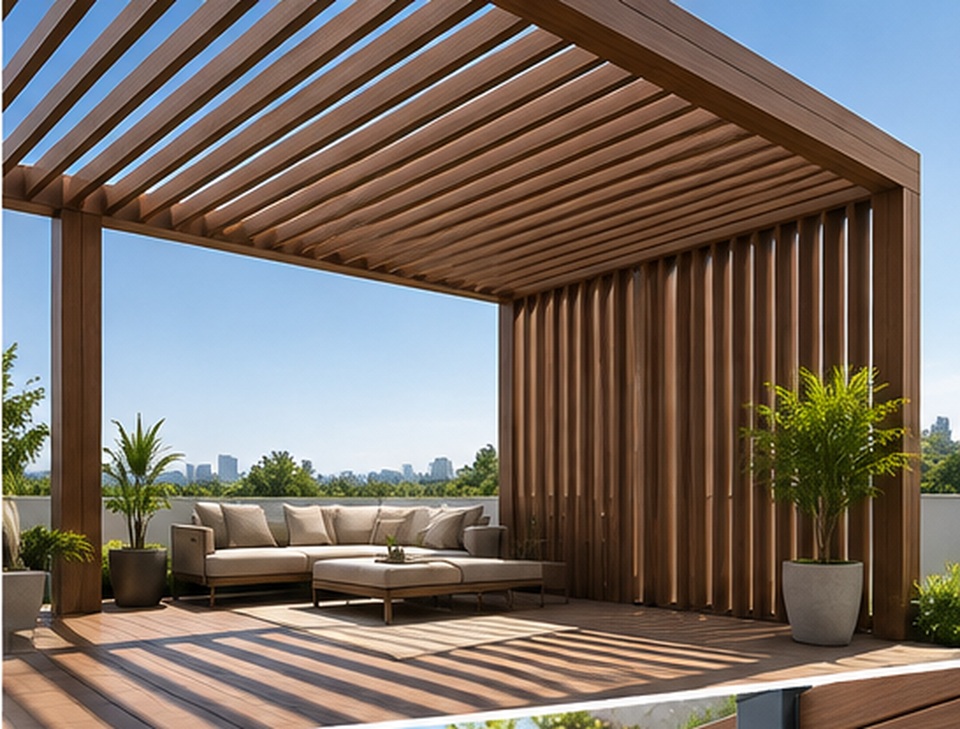
5. WPC Pergolas
WPC profiles are also used in pergolas and shade structures.
They can provide a wood-like appearance without requiring the same type of surface treatment associated with conventional exterior timber. Structural requirements, however, should not be assumed from the appearance of the product. Where profiles are subjected to significant wind or structural loads, the manufacturer’s load data and engineering requirements need to be checked.
Benefits of WPC Exterior Products
Moisture Resistance
One of the main reasons WPC is considered for outdoor applications is its resistance to moisture compared with conventional untreated wood.
Natural timber can absorb water, which may contribute to swelling, shrinkage, cracking, fungal deterioration and dimensional changes. WPC generally absorbs less moisture because of its polymer content.
This makes it suitable for applications exposed to rain and humid conditions.
However, water resistance does not mean complete waterproofing. Water can still enter through cut edges, joints, fastener penetrations or poorly detailed connections.
Reduced Risk of Biological Deterioration
The polymer component and manufacturing process can reduce the susceptibility of WPC to problems associated with insects and fungal attack compared with untreated timber.
This can be useful in exterior applications where maintaining natural wood can require regular treatment.
Wood-Like Appearance
WPC allows designers to incorporate a timber-inspired appearance into facades, decks and landscape elements.
Modern products are available in different colours, textures and surface patterns. Some products are designed to reproduce wood grain, while others have a more uniform architectural finish.
This gives architects flexibility when developing contemporary exterior elevations.
Lower Routine Maintenance
Many WPC products do not require regular painting, staining or wood preservatives in the same way as conventional timber.
Routine maintenance generally involves cleaning the surface and inspecting joints, fasteners and supporting elements.
The actual maintenance requirement depends on the product, exposure and manufacturer’s recommendations.
Design Flexibility
WPC profiles can be manufactured in different sizes and shapes. This allows their use in applications ranging from decking and cladding to screens and decorative facade elements.
Profiles can be arranged vertically, horizontally or in patterns to create different architectural expressions.
Consistent Product Dimensions
Natural timber varies because it is an organic material. WPC is manufactured under controlled production conditions, which can provide greater dimensional consistency between profiles.
This can make installation and detailing more predictable.
Design Considerations for WPC Exteriors
Selecting WPC should not be based only on appearance or initial cost. Several technical factors need to be considered during design.
1. Thermal Expansion
WPC can expand and contract as temperature changes.
This is particularly important for exterior applications in climates with significant temperature variations.
Long decking boards or continuous cladding runs should therefore not be installed without adequate expansion provisions.
Designers should consider:
- Board length
- Joint width
- Fixing method
- Temperature during installation
- Substructure spacing
- Expansion at ends
- Connection details
Failure to allow for movement can result in buckling, deformation or stress around fixings.
2. Ventilation Behind Cladding
For WPC wall cladding, the wall assembly should be designed to manage moisture.
A ventilated cavity can help provide drainage and airflow behind the cladding, depending on the facade design.
The cladding should not be treated as an isolated decorative layer. The complete wall assembly—including substrate, waterproofing, cavity, battens and fixings—needs to be considered.
3. Substructure
The supporting framework is an important part of WPC installation.
Depending on the application, WPC may be installed over:
- Aluminium substructures
- Steel frameworks
- Treated timber supports
- Manufacturer-specific support systems
The substructure should be properly aligned and adequately protected against outdoor exposure.
For decking, support spacing must comply with the manufacturer’s requirements and expected loading conditions.
4. Drainage
Exterior WPC installations should allow water to drain away.
Decking should generally be installed with appropriate falls where required, while gaps between boards should allow surface water to pass through.
For cladding, details around the base of the wall, corners, windows and horizontal junctions need attention.
Water trapped behind the system can affect both the WPC and supporting structure.
5. Fasteners and Clips
Fasteners should be selected according to the WPC product and exposure environment.
Exterior installations may be exposed to:
- Rain
- Humidity
- Coastal air
- Temperature fluctuations
- Chemical exposure
Corrosion-resistant fasteners are therefore important, particularly in coastal or high-humidity locations.
The fixing system should also accommodate thermal movement.
6. UV Exposure and Colour Change
Outdoor WPC products are exposed to ultraviolet radiation.
Some products may experience colour change over time, particularly during the initial weathering period. The degree of colour retention depends on the polymer, pigments, additives, surface treatment and product formulation.
Architects should request information on UV resistance and expected colour behaviour before specifying WPC for prominent facades.
7. Fire Performance
Fire performance should be considered carefully when WPC is proposed for building exteriors.
The composition of WPC means that its reaction to fire can differ from that of natural timber, and different products can have significantly different fire characteristics.
For buildings where facade fire performance is regulated, designers should verify the relevant test classification and project requirements rather than assuming that all WPC products have the same fire behaviour.
8. Slip Resistance for Decking
WPC decking around swimming pools, terraces and outdoor walkways requires attention to slip resistance.
Surface texture, drainage, maintenance, algae growth and wet conditions can influence pedestrian safety.
Product test data should be reviewed for the intended application.
9. Load Requirements
Not every WPC profile is suitable for every loading condition.
Decking in a residential garden and decking in a commercial public space may have different requirements.
Designers should check:
- Uniform loads
- Concentrated loads
- Furniture loads
- Pedestrian traffic
- Support spacing
- Deflection
- Impact resistance
Manufacturer load tables should be followed where available.
WPC vs Natural Wood
WPC is often selected as an alternative to conventional timber, but the two materials have different characteristics.
| Factor | WPC | Natural Wood |
| Moisture resistance | Generally high | Depends on species and treatment |
| Maintenance | Generally lower | Often requires periodic treatment |
| Appearance | Wood-like, manufactured | Natural grain and variation |
| Dimensional consistency | Generally consistent | Natural variation |
| Insect resistance | Generally good | Depends on species/treatment |
| Thermal movement | Can be significant | Also varies with moisture |
| Surface weathering | Product dependent | Often develops patina |
| Repair | Damaged profiles may need replacement | Some timber can be repaired/refinished |
| Product composition | Composite | Natural material |
The choice should therefore be based on the project’s performance requirements rather than assuming that one material is universally better.
Common Applications in Indian Projects
WPC exterior products can be considered for several building and landscape applications in India.
Residential Projects
Applications include balcony decking, terrace areas, facade features, garden fencing and pergolas.
Hospitality Projects
Hotels and resorts can use WPC for outdoor decks, poolside areas, walkways, restaurant terraces and landscape structures.
Commercial Buildings
Offices, retail developments and mixed-use projects can use WPC screens, facade features, entrance elements and outdoor seating areas.
Institutional Projects
Schools, campuses and public facilities may use WPC in landscape areas, seating zones, walkways and architectural screening, subject to the required fire, slip and durability performance.
Landscape Projects
WPC is particularly useful for landscape features where designers want a timber-like appearance combined with reduced routine maintenance.
Conclusion
WPC exterior products provide architects with another option for incorporating wood-like finishes into outdoor spaces. Their applications range from decking and wall cladding to screens, fencing, pergolas and landscape structures.
Their resistance to moisture, reduced maintenance requirements, dimensional consistency and design flexibility make them suitable for many exterior applications. At the same time, WPC should not be treated as a universal replacement for timber or other facade materials.
The most suitable WPC product is therefore not simply the one with the desired colour or appearance. It is the product whose technical performance, installation requirements and long-term maintenance characteristics match the conditions of the project.