

What Is Perpetual Pavement?
Perpetual pavement is a multi-layer flexible pavement structure designed for a very long service life. Its design philosophy is based on controlling the two major structural failure mechanisms associated with asphalt pavements:
- Fatigue cracking at the bottom of the asphalt layer
- Permanent deformation or rutting in the pavement structure
A perpetual pavement typically combines several asphalt layers with different functions. The lower layers provide structural strength and fatigue resistance, while the upper layers are designed to withstand traffic, environmental exposure, abrasion and surface wear.
Why Conventional Pavements Fail
Understanding perpetual pavement requires looking at how conventional flexible pavements deteriorate.
Heavy vehicles repeatedly apply wheel loads to the pavement. With every axle passage, the pavement experiences stress and deformation. Over time, repeated loading can produce:
- Fatigue cracking
- Rutting
- Thermal cracking
- Moisture-related deterioration
- Surface oxidation
- Potholes
- Loss of skid resistance
- Base and subgrade deformation
If these problems penetrate deeply into the pavement, rehabilitation becomes more complicated and expensive.
Perpetual pavement aims to prevent structural deterioration from progressing into the deeper pavement layers.
Advantages of Perpetual Pavement
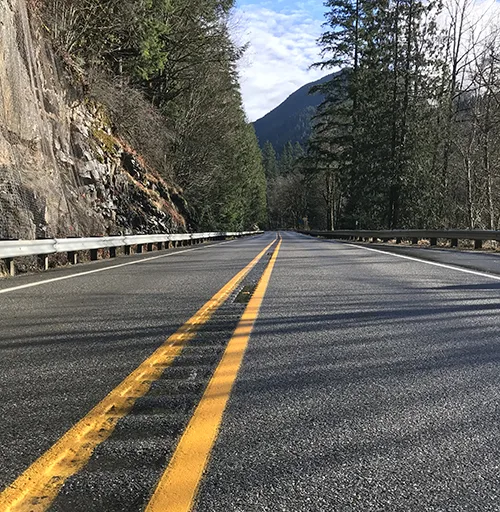
Longer Structural Service Life
The main advantage is the ability to provide a long structural service life when properly designed and constructed.
Reduced Major Reconstruction
Since the deeper pavement layers are intended to remain functional, complete reconstruction can be avoided or significantly delayed.
Lower Traffic Disruption
Maintenance can often be concentrated on the surface, reducing the duration and extent of major road closures.
Better Performance Under Heavy Traffic
Perpetual pavement is particularly suitable for roads carrying high volumes of heavy vehicles.
Reduced Life-Cycle Costs
Although initial construction costs may be higher, reduced major rehabilitation requirements can improve life-cycle economics.
Reduced Material Consumption Over Time
Avoiding repeated full-depth reconstruction can reduce the demand for new aggregates and other construction materials.
Applications
Perpetual pavement can be considered for infrastructure where traffic loading and road availability are major concerns.
Potential applications include:
- National highways
- Expressways
- Freight corridors
- Industrial access roads
- Port roads
- Airport access roads
- Urban arterial roads
- Mining haul routes
- Logistics corridors
Basic Structure of Perpetual Pavement
A typical perpetual pavement consists of several layers, each designed for a specific purpose.
1. Surface or Wearing Course
The uppermost layer directly interacts with vehicle tyres and environmental conditions.
The surface course is generally designed to provide:
- Skid resistance
- Smooth riding quality
- Water resistance
- Surface durability
- Resistance to abrasion
- Noise control where required
Because this layer receives the greatest exposure, it can be milled and replaced periodically without disturbing the deeper pavement structure.
2. Intermediate or Binder Course
The binder course is positioned below the surface layer. It provides structural support and helps distribute traffic loads toward the lower layers.
This layer may be designed to provide resistance against:
- Rutting
- Shear deformation
- Repeated heavy loading
The binder mix is normally selected with consideration for traffic volume, axle loads, climate and pavement temperature.
3. Fatigue-Resistant Asphalt Base
This is one of the most important components of a perpetual pavement.
The asphalt base is designed to resist fatigue cracking caused by repeated wheel loading. The objective is to keep tensile strains at the bottom of the asphalt layer below the level associated with significant fatigue damage.
The material and layer thickness are therefore selected through structural pavement analysis rather than simply using standard thickness values.
4. Granular or Stabilised Subbase
A subbase can provide additional structural support and drainage while helping distribute loads over a wider area.
Depending on project requirements, it may consist of:
- Granular material
- Cement-treated material
- Stabilised soil
- Recycled pavement materials
The subbase must have sufficient strength and drainage characteristics to maintain pavement performance.
5. Prepared Subgrade
The subgrade is the soil foundation supporting the pavement.
Subgrade preparation is essential because even a well-designed asphalt structure can experience premature distress if the underlying soil is weak, poorly compacted or susceptible to moisture.
Construction may involve:
- Removal of unsuitable soil
- Soil replacement
- Mechanical stabilisation
- Chemical stabilisation
- Compaction
- Drainage improvement
Key Design Principle: Controlling Strain
One of the defining features of perpetual pavement is strain-based structural design.
Instead of designing only for a particular number of years, engineers evaluate stresses and strains generated within the pavement under expected traffic loading.
Two important parameters are generally considered.
Bottom-Up Fatigue
Repeated tensile strain can develop near the bottom of the asphalt layer.
If this strain becomes excessive, small cracks can initiate. With continued traffic, these cracks may propagate upward and eventually appear on the pavement surface.
Perpetual pavement designs increase structural capacity and use appropriate asphalt mixtures to keep this strain within acceptable limits.
Permanent Deformation
Rutting occurs when pavement materials undergo accumulated permanent deformation.
Rutting can develop in the asphalt layers, granular layers or subgrade.
Perpetual pavement therefore aims to limit compressive strains and use rut-resistant materials so that permanent deformation remains within acceptable limits.
Traffic Assessment
Traffic analysis is an important part of perpetual pavement design.
Engineers need to evaluate:
- Average daily traffic
- Percentage of heavy vehicles
- Axle load distribution
- Number of equivalent axle loads
- Traffic growth
- Lane distribution
- Seasonal variations
- Expected freight movement
Heavy trucks have a much greater influence on pavement deterioration than passenger vehicles. Therefore, axle loading and heavy-vehicle traffic should be carefully assessed.
For major freight corridors, the pavement structure may need to accommodate very large numbers of heavy-vehicle load repetitions.
Climate Considerations
Climate can significantly affect asphalt pavement performance.
High pavement temperatures can soften asphalt and increase the risk of rutting. Low temperatures can make asphalt more susceptible to thermal cracking.
A perpetual pavement design therefore considers:
- Maximum pavement temperature
- Minimum pavement temperature
- Rainfall
- Freeze-thaw conditions where applicable
- Moisture infiltration
- Seasonal groundwater conditions
In hot regions, rut-resistant asphalt mixtures can be particularly important. In areas experiencing substantial temperature variation, resistance to thermal and fatigue cracking also becomes important.
Material Selection
Material selection is another major component of perpetual pavement construction.
Asphalt Binder
The binder must be selected according to expected pavement temperatures and traffic loading. Modified binders may be considered where higher resistance to rutting, cracking or repeated loading is required.
Aggregates
Aggregates should provide adequate:
- Strength
- Toughness
- Durability
- Resistance to polishing
- Resistance to abrasion
Aggregate gradation also influences mixture performance.
Asphalt Mixtures
Different asphalt mixtures can be used for different pavement layers.
The surface mixture may prioritise skid resistance and durability, while the lower asphalt layers may be designed primarily for structural performance and fatigue resistance.
Construction Process
Perpetual pavement construction follows many of the same basic principles as conventional flexible pavement construction, but quality control becomes particularly important because the pavement is intended to remain structurally functional for a long period.
Step 1: Site Investigation
The project begins with investigation of the existing ground conditions.
Engineers evaluate:
- Soil type
- Subgrade strength
- Groundwater
- Drainage conditions
- Existing pavement conditions, where applicable
- Traffic loading
- Climate
Geotechnical investigation helps identify weak areas that may require treatment.
Step 2: Subgrade Preparation
The subgrade is graded and compacted to achieve the required profile and density.
Weak or unsuitable soil may be excavated and replaced. Stabilisation can also be used where appropriate.
Uniformity is important because local weak zones can cause differential deformation.
Step 3: Subbase Construction
The selected subbase material is placed in controlled layers.
Each layer is spread, moisture-conditioned and compacted to the specified requirements.
Proper compaction reduces voids and improves load distribution.
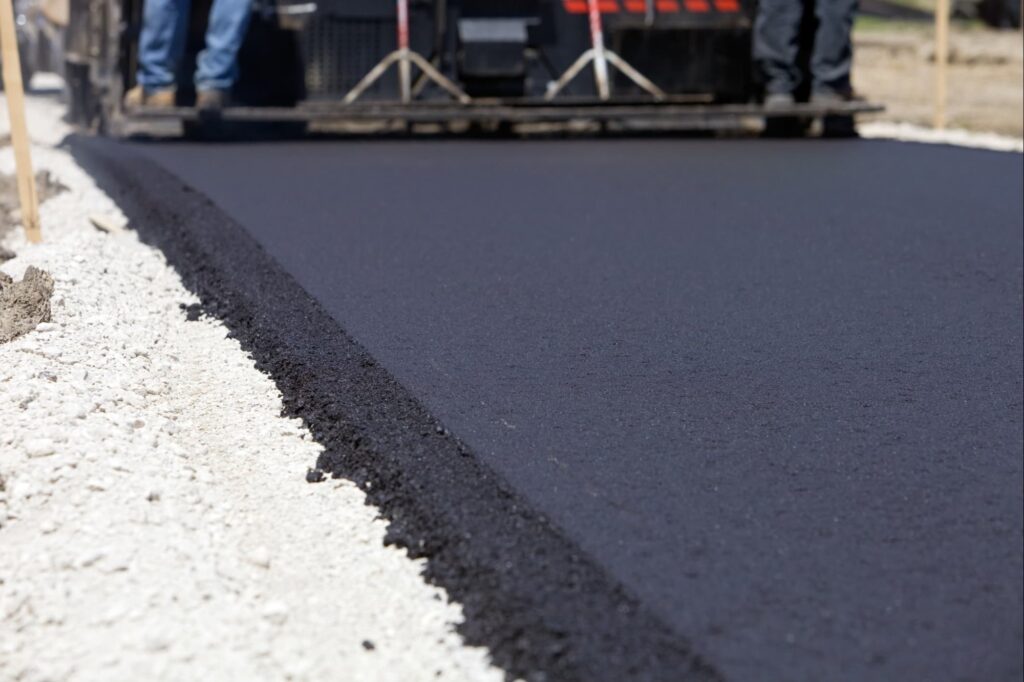
Step 4: Asphalt Base Construction
The fatigue-resistant asphalt base is placed over the prepared subbase.
Temperature control, paving speed, layer thickness and compaction must be carefully controlled.
Poor compaction can increase air voids and allow moisture penetration, potentially reducing pavement durability.
Step 5: Binder Course
The binder course is placed above the structural asphalt base.
The layer helps distribute wheel loads and contributes to resistance against deformation.
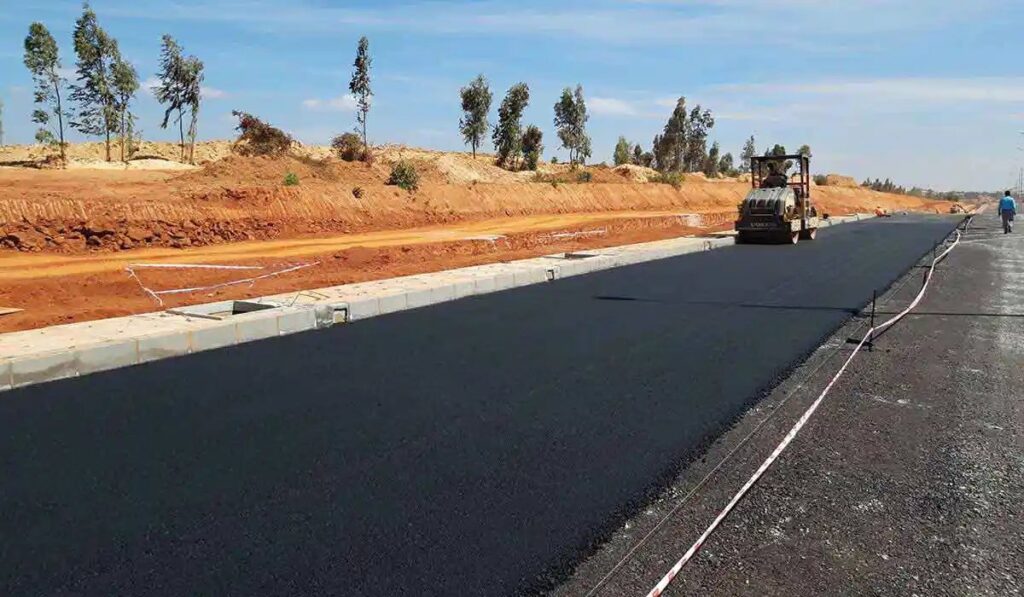
Step 6: Surface Course
The final wearing course is placed to provide the required riding quality, skid resistance and environmental protection.
The finished surface is checked for:
- Smoothness
- Thickness
- Density
- Surface texture
- Crossfall
- Alignment
Importance of Drainage
Drainage is extremely important for long-life pavement construction.
Water entering the pavement can weaken granular materials and subgrade soils. It can also contribute to stripping and other asphalt-related deterioration.
A perpetual pavement project should therefore consider:
- Cross drainage
- Side drains
- Edge drainage
- Subsurface drainage where necessary
- Impermeable or well-compacted surface layers
- Proper road camber or crossfall
Keeping water away from structural pavement layers can significantly improve long-term performance.
Quality Control During Construction
Long service life depends not only on pavement design but also on construction quality.
Important quality-control parameters include:
- Material properties
- Aggregate gradation
- Asphalt content
- Mixing temperature
- Laying temperature
- Layer thickness
- Compaction
- Air voids
- Surface smoothness
- Joint construction
Construction joints require particular attention because poorly constructed joints can become locations for water entry and cracking.
Maintenance of Perpetual Pavements
Perpetual pavement does not eliminate maintenance. Instead, maintenance is generally focused on the upper portion of the pavement.
Typical interventions include:
Milling and Resurfacing
When the surface begins to deteriorate, the upper asphalt layer can be milled and replaced.
This allows the underlying structural layers to remain in place.
Crack Treatment
Localized cracking can be treated before it develops into more extensive deterioration.
Surface Rehabilitation
Depending on the pavement condition, surface treatments or overlays can restore riding quality and skid resistance.
The main objective is to maintain the surface before deterioration reaches the deeper structural layers.
Various Equipments and Tools Used in Perpetual Pavement Construction
- Motor Grader: Used for grading and levelling the subgrade and granular layers.
- Soil Compactor: Used for compacting the subgrade and embankment layers.
- Vibratory Roller: Used for compacting granular materials and asphalt layers.
- Pneumatic Tyre Roller: Used for pressure compaction and improving aggregate interlock.
- Tandem Roller: Used for intermediate and final compaction of asphalt layers.
- Asphalt Mixing Plant: Used for producing asphalt mixtures with controlled material proportions.
- Asphalt Paver: Used for placing and spreading asphalt at the required thickness.
- Milling Machine: Used for removing worn or damaged asphalt surface layers.
- Wheel Loader: Used for loading and handling aggregates and construction materials.
- Dump Truck: Used for transporting aggregates, soil and asphalt mixtures.
- Water Tanker: Used for moisture conditioning and dust suppression during construction.
- Reclaimer/Stabiliser: Used for processing and stabilising existing pavement or soil materials.
- Asphalt Distributor: Used for applying prime coat and tack coat materials.
- Road Sweeper: Used for removing dust and debris from pavement surfaces.
- Intelligent Compaction Roller: Used for monitoring pavement compaction during roller operations.
- GPS/GNSS Equipment: Used for controlling pavement levels, alignment and crossfall.
- Falling Weight Deflectometer: Used for evaluating the structural response of pavement layers.
- Laser Profiler: Used for measuring pavement smoothness and surface profile.
- Core Cutting Machine: Used for extracting pavement cores for thickness and material testing.
- Density Gauge: Used for measuring the density and moisture content of pavement materials.
Conclusion
Perpetual pavement is a long-life road construction approach designed to maintain structural performance under repeated traffic loading while reducing the need for full-depth reconstruction. Its performance depends on properly designed asphalt layers, fatigue and rutting resistance, strong subgrade preparation, effective drainage, suitable materials and controlled construction practices. Periodic maintenance such as milling and resurfacing can renew the surface while preserving the deeper structural layers. For highways, expressways, freight corridors and other heavily trafficked roads, perpetual pavement can help reduce major rehabilitation work, traffic disruption and long-term maintenance requirements when it is designed and constructed according to site-specific traffic, soil and climatic conditions.






