
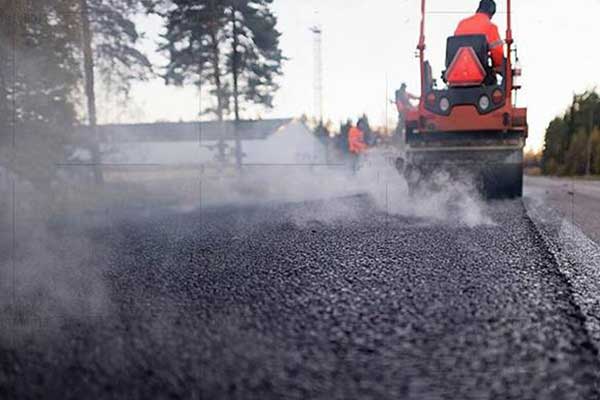
Road infrastructure plays a key role in supporting economic growth, connectivity, and urban development by enabling the efficient movement of goods and people. Among various pavement technologies used in modern highway engineering, Hot Mix Asphalt (HMA) is one of the most widely adopted and dependable solutions for flexible pavement construction.
Hot Mix Asphalt is extensively used in national highways, expressways, urban roads, airport runways, industrial corridors, and parking facilities due to its durability, smooth riding quality, cost efficiency, and ability to perform under heavy traffic conditions.
With rapid infrastructure expansion and increasing transportation demands, HMA continues to evolve through advanced materials, modern equipment, and sustainable construction practices that improve performance and service life.
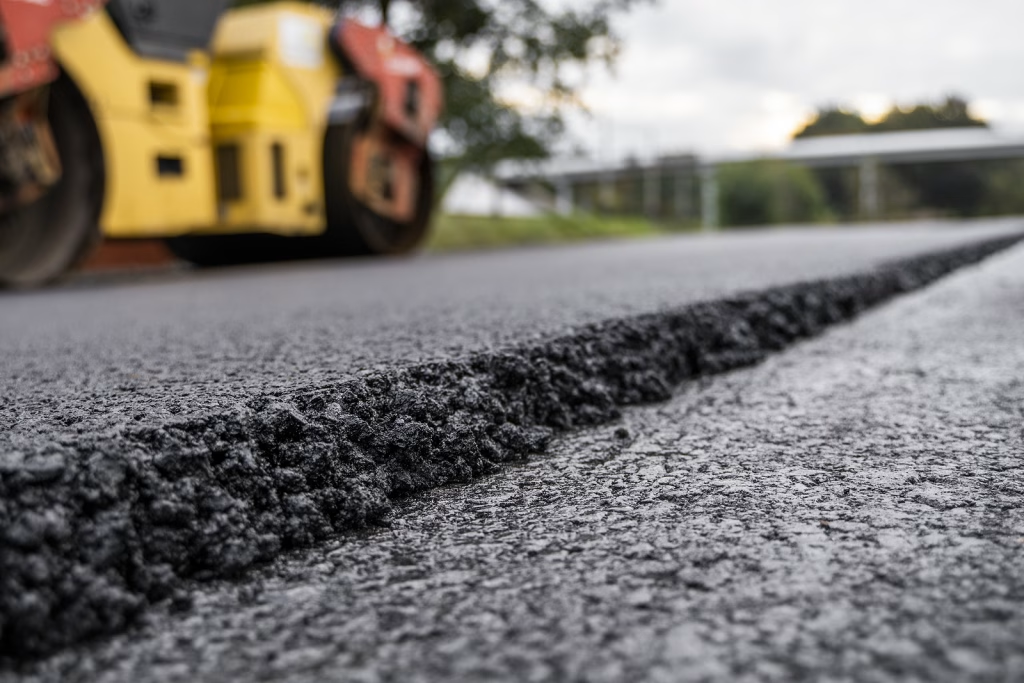
What is Hot Mix Asphalt (HMA)?
Hot Mix Asphalt is a composite pavement material produced by blending:
- Coarse aggregates
- Fine aggregates
- Bitumen (asphalt binder)
- Mineral filler
These materials are heated and mixed at controlled temperatures ranging between 150°C and 170°C in a hot mix plant. The mixture is then transported to the site, laid using a paver, and compacted using rollers.
The final product forms a dense, flexible, and durable pavement layer capable of carrying heavy traffic loads while providing a smooth riding surface.
Components of Hot Mix Asphalt
Aggregates
Aggregates form the structural skeleton of the asphalt mix and contribute the majority of its volume.
- Provide load-bearing strength
- Ensure stability of pavement
- Improve skid resistance
- Must be hard, durable, and well-graded
- Typically sourced from basalt, granite, or limestone
Bitumen
Bitumen acts as the binding agent that holds aggregates together.
- Provides cohesion and flexibility
- Offers waterproofing properties
- Prevents disintegration of aggregates
- Available in grades such as VG-10, VG-30, VG-40 depending on traffic and climate
Mineral Filler
Fine materials like stone dust or cement are added to improve mix performance.
- Enhances density and stability
- Reduces air voids in the mix
- Improves overall durability
- Helps in better bonding of materials
Advantages of Hot Mix Asphalt
- Provides smooth and comfortable riding surface
- Enables faster construction compared to concrete roads
- Offers cost-effective pavement solution
- Easy maintenance and repair through patching
- Provides waterproofing and protects base layers
- Suitable for heavy traffic conditions
Applications of Hot Mix Asphalt
Hot Mix Asphalt is widely used in:
- National and state highways
- Urban roads and city streets
- Airport runways and taxiways
- Industrial corridors and logistics hubs

Hot Mix Asphalt Production Process
Heating and Drying of Aggregates
- Aggregates are fed into a rotary drum dryer
- Moisture is completely removed
- Materials are heated uniformly to required temperature
Heating of Bitumen
- Bitumen is stored in heated tanks
- Maintains controlled viscosity for mixing
- Prevents overheating and degradation
Mixing Process
- Aggregates, bitumen, and filler are combined in a mixing chamber
- Ensures uniform coating of aggregates
- Produces consistent and homogenous mix
Temperature Control
- Maintains workability of mix
- Ensures proper compaction at site
- Prevents premature cooling or binder damage
Transportation of Hot Mix Asphalt
Proper transportation is critical for maintaining quality.
- Mix is carried in insulated dump trucks
- Trucks are covered with tarpaulin sheets
- Temperature loss is minimized during transit
- Continuous supply is maintained for paver operation
- Delays are avoided to prevent material rejection
Types of Hot Mix Asphalt
Dense Bituminous Macadam (DBM)
Dense Bituminous Macadam (DBM) is used as a base or binder course in flexible pavement construction. It provides the main structural strength to the pavement and helps in distributing traffic loads efficiently across the underlying layers. DBM is designed to ensure stability and durability under medium to heavy traffic conditions.
Bituminous Concrete (BC)
Bituminous Concrete (BC) is used as the wearing course of the pavement. It forms the top surface layer and is responsible for providing a smooth and even riding surface. BC improves driving comfort and enhances skid resistance, making it suitable for roads with high traffic movement and speed requirements.
Stone Mastic Asphalt (SMA)
Stone Mastic Asphalt (SMA) is designed for roads carrying very heavy traffic and high axle loads. It offers excellent resistance to rutting and deformation under stress. SMA provides a durable surface with a long service life, making it ideal for highways, expressways, and industrial corridors.
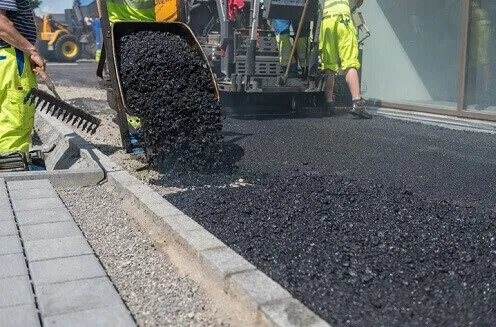
Hot Mix Asphalt Road Construction Process
Preparation of Base Layer
- Subgrade is compacted and leveled
- Base layers such as GSB or WMM are constructed
- Surface is cleaned of dust and loose particles
- Proper drainage conditions are ensured
Tack Coat Application
- Bitumen emulsion is sprayed over base surface
- Ensures strong bonding between layers
- Prevents slippage and separation
Laying of Asphalt Mix
- Mechanical paver lays mix uniformly
- Thickness and slope are precisely controlled
- Continuous laying ensures uniform surface quality
- Segregation of material is avoided
Compaction Process
Compaction is performed in stages:
- Initial rolling using steel wheel rollers
- Intermediate compaction using pneumatic rollers
- Final finishing using tandem rollers
Proper compaction ensures:
- Reduced air voids
- Increased density
- Improved strength and durability
Quality Control in HMA Construction
Quality control ensures long-term pavement performance.
Laboratory Testing
- Aggregate gradation analysis
- Bitumen penetration test
- Softening point and viscosity tests
Field Testing
- Temperature monitoring during laying
- Density testing using core samples
- Surface roughness and smoothness checks
Mix Design Methods
- Marshall Stability Method
- Superpave Mix Design System
These methods ensure optimum bitumen content and mix performance.
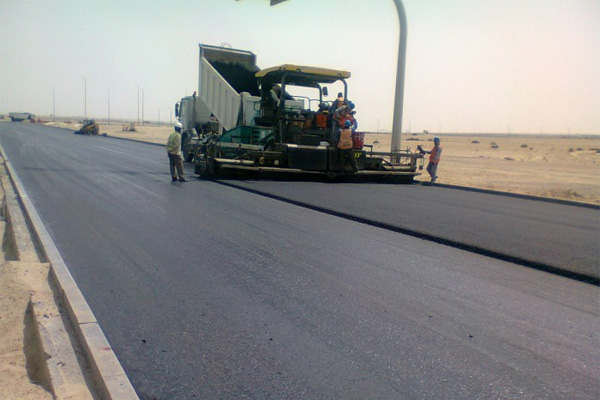
Equipment and Tools Used for Hot Mix Asphalt (HMA) Laying
- Bitumen sprayer / distributor – Applies tack coat on surface
- Insulated dump trucks / tippers – Transports hot mix to site
- Mechanical paver finisher – Lays asphalt uniformly on road
- Paver screed unit – Levels and shapes the laid mix
- Tandem steel wheel roller – Compacts and smooths surface
- Pneumatic tyre roller – Improves compaction using tyre pressure
- Vibratory roller – Provides deep compaction using vibration
- Surveying and leveling equipment – Checks alignment and slope
- Asphalt cutter / joint cutting machine – Cuts joints and edges
Environmental Considerations
Modern HMA construction supports sustainability through:
- Reduced emissions using warm mix technology
- Recycling of old pavement materials
- Reduced consumption of natural aggregates
- Lower energy usage in production
- Improved lifecycle efficiency of pavements
Conclusion
Hot Mix Asphalt remains one of the most important pavement technologies in modern highway engineering. Its combination of strength, flexibility, cost efficiency, and rapid construction capability makes it ideal for diverse infrastructure projects.
With advancements in materials, recycling techniques, and smart construction systems, HMA is becoming more sustainable and performance-oriented. As infrastructure demands continue to grow, Hot Mix Asphalt will remain a key solution for building durable, efficient, and high-quality road networks.
Image Credit: roadskymaintenance.com






