
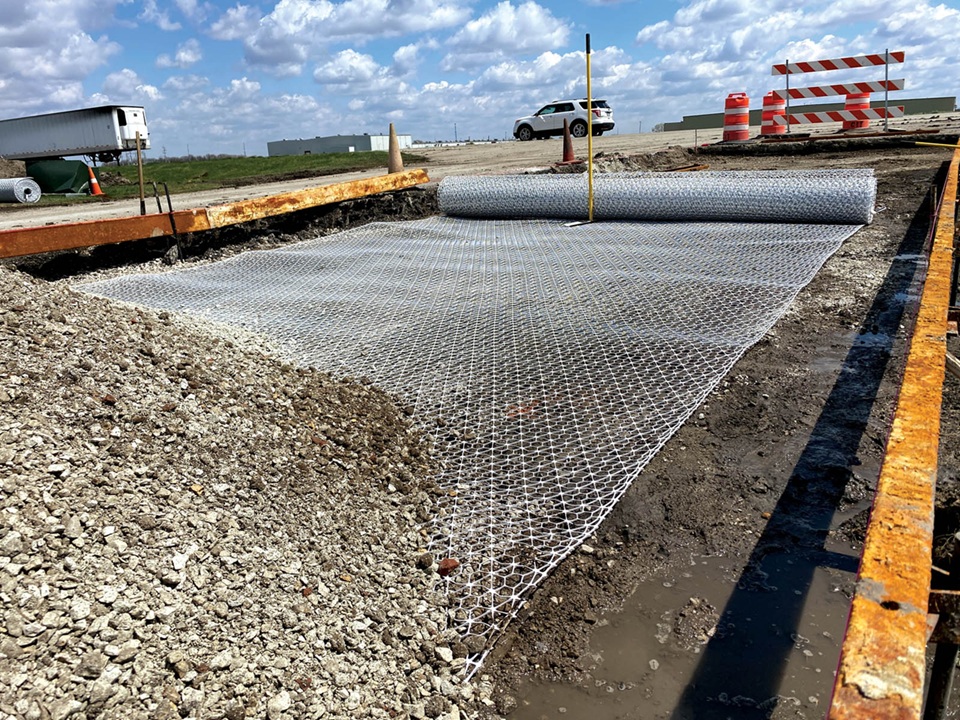
Modern building construction increasingly faces challenges related to weak or variable soil conditions, higher structural loads, and the need for long-term durability with minimal settlement. Traditional soil improvement techniques such as deep excavation, replacement, or piling can be expensive and time-consuming. In this context, geogrids have emerged as an efficient and economical solution for improving soil performance and ensuring safe load distribution in building foundations.
Geogrid reinforcement plays an important role in enhancing the load-bearing capacity of soils beneath buildings. It improves stability, reduces differential settlement, and allows structures to be constructed on marginal or weak soils without extensive ground replacement.
What is a Geogrid?
A geogrid is a geosynthetic material made from polymers such as polypropylene, polyethylene, or polyester. It is designed in a grid-like structure with open apertures that allow soil or aggregate particles to interlock with the grid.
Unlike geotextiles, which primarily provide separation and filtration, geogrids are mainly used for reinforcement. Their tensile strength and interlocking ability make them highly effective in distributing loads over a wider area..
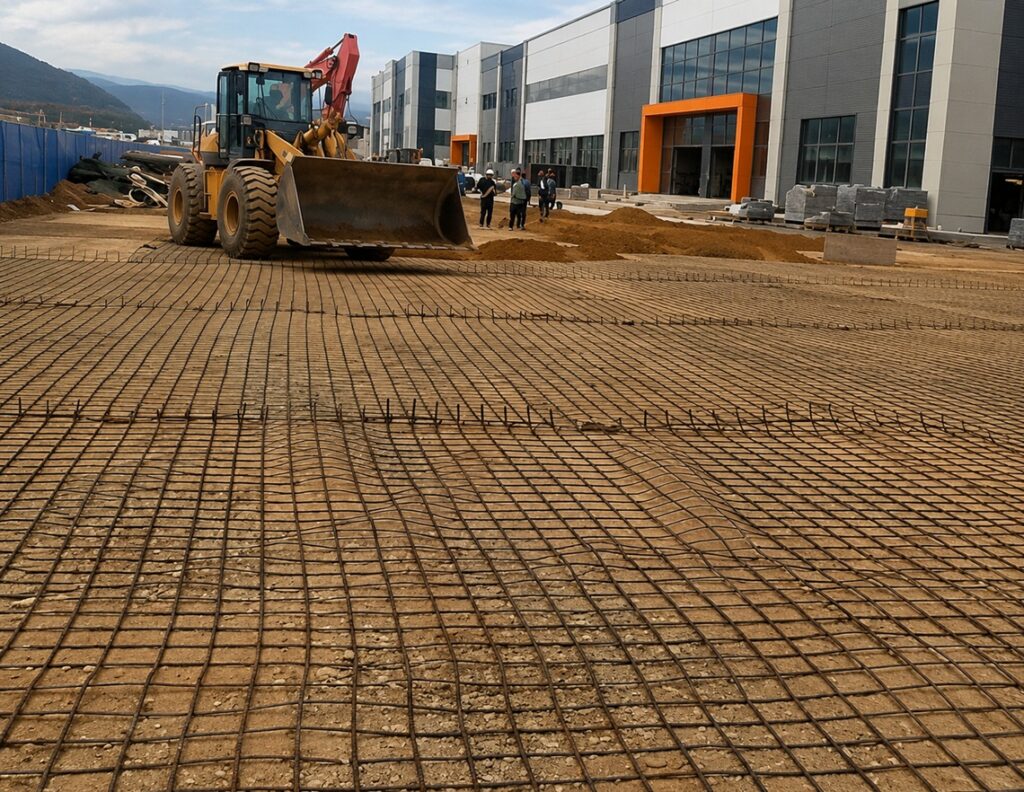
Need for Geogrid Reinforcement in Buildings
In building construction, foundation soil must safely transfer structural loads to the ground. However, many sites present challenges such as:
- Soft clay or silty soils
- Loose granular soils
- Fill materials with poor compaction
- High groundwater conditions
- Variable soil strata causing uneven settlement
Without reinforcement, these conditions may lead to:
- Excessive settlement
- Cracking in walls and slabs
- Uneven foundation movement
- Structural instability
Geogrid reinforcement addresses these issues by improving soil stiffness and distributing loads more evenly.
Advantages of Geogrid Reinforcement in Buildings
- Improved load distribution beneath foundations
- Reduced settlement and cracking
- Increased bearing capacity of weak soils
- Cost-effective alternative to deep foundations
- Faster construction compared to soil replacement methods
- Improved long-term structural performance
- Reduced requirement for thick foundation systems
Applications in Building Construction
Geogrid reinforcement is widely used in various building-related applications:
1. Foundation Beds
Geogrids are placed beneath shallow foundations to improve load distribution and reduce settlement, especially in low-rise and mid-rise buildings.
2. Raft (Mat) Foundations
In raft foundations, geogrids help distribute heavy structural loads evenly across weak soils, improving overall stability.
3. Basement Floors
Geogrids enhance soil stiffness beneath basement slabs, preventing cracking due to ground movement.
4. Industrial Buildings and Warehouses
Large floor loads from machinery and storage systems require uniform support, which is achieved using geogrid-reinforced base layers.
5. Embankment Support for Building Platforms
In areas with uneven terrain, geogrids help create stable platforms for construction.
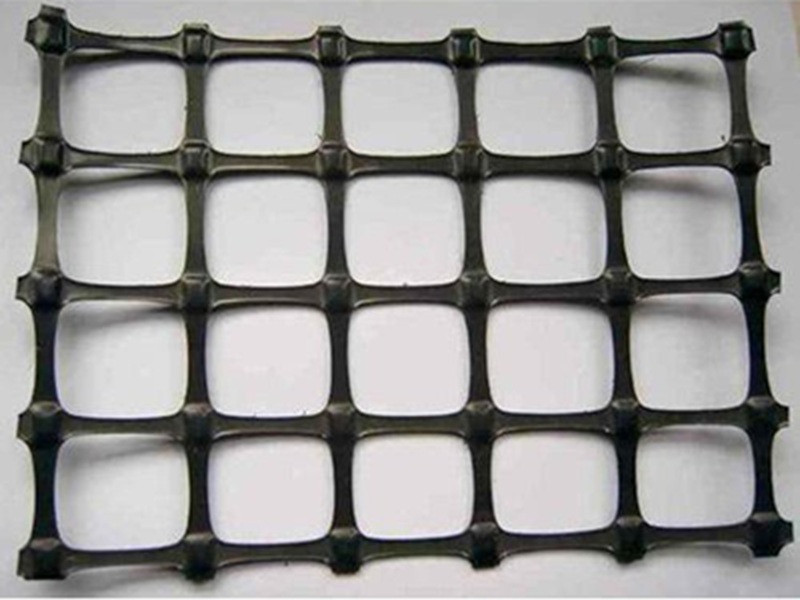
Types of Geogrids Used in Building Construction
Different types of geogrids are used in building foundation and structural applications depending on load requirements, soil conditions, and design objectives. The selection of the correct type is important for achieving effective load distribution and long-term performance.
1. Uniaxial Geogrids
Uniaxial geogrids have high tensile strength in one primary direction. They are mainly used where loads act in a single direction, such as in retaining walls and steep slope structures supporting building platforms. In building projects, they are sometimes used in basement wall support systems and deep excavation support.
2. Biaxial Geogrids
Biaxial geogrids provide equal tensile strength in both longitudinal and transverse directions. They are the most commonly used type in building foundation applications because they effectively distribute loads from columns, slabs, and footings in multiple directions. They improve subgrade stiffness and reduce differential settlement beneath buildings.
3. Triaxial Geogrids
Triaxial geogrids have a triangular or multi-axial aperture structure that provides uniform load distribution in all directions. They offer superior confinement of soil particles and improved shear resistance. In building construction, they are used in high-performance foundation systems, especially where heavy and repeated loads are expected, such as industrial buildings and large commercial complexes.
4. Composite Geogrids
Composite geogrids are combined with geotextiles or other geosynthetic layers. This combination provides both reinforcement and separation or filtration functions. In building foundations, they are used where soil separation, drainage, and reinforcement are required simultaneously, such as in wet or weak subgrade conditions.
Mechanism of Load Distribution
The effectiveness of geogrids lies in their ability to interact with surrounding soil and aggregate through mechanical interlocking and confinement.
When a load from a building foundation is applied:
- Load Transfer to Soil Layer
The foundation transfers load to the soil beneath it. - Interlocking Action
Soil particles enter the apertures of the geogrid, creating a strong interlock. - Lateral Confinement
The geogrid restricts lateral movement of soil particles, increasing stiffness. - Stress Distribution
Instead of concentrated stress at a single point, the load spreads horizontally over a wider area. - Reduction of Differential Settlement
Since stress is distributed more evenly, uneven settlement is minimized.
This mechanism effectively creates a reinforced soil composite that behaves stronger than natural soil alone.
Design Considerations
Proper design of geogrid reinforcement is essential for achieving desired performance. Key factors include:
1. Soil Type
Cohesive soils (clays) and granular soils behave differently, affecting geogrid interaction.
2. Load Intensity
Structural loads from buildings determine the required tensile strength of geogrids.
3. Layer Placement
Geogrids are usually placed in one or multiple layers depending on soil conditions and load requirements.
4. Depth of Installation
The depth of geogrid placement influences load dispersion efficiency.
5. Compaction Quality
Proper compaction of soil above and below the geogrid is essential for interlocking.
6. Type of Geogrid
Biaxial geogrids are typically used for foundation reinforcement due to their balanced strength.
Engineers often use geotechnical software and soil testing data to determine optimal design parameters.
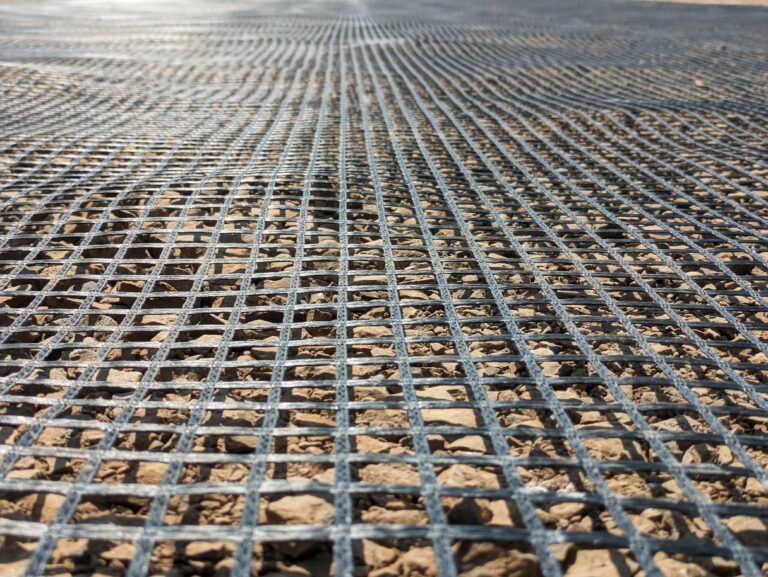
Installation Process in Building Projects
The general installation procedure includes:
- Site Preparation
The foundation area is leveled and cleared of debris. - Subgrade Preparation
Weak soil is compacted or partially replaced if required. - Placement of Geogrid
Geogrid sheets are rolled out over the prepared soil surface. - Overlap and Connection
Adjacent geogrid sections are overlapped and secured. - Placement of Fill Material
Granular soil or aggregate is placed over the geogrid. - Compaction
The fill material is compacted to ensure interlocking. - Foundation Construction
Structural foundation is constructed over the reinforced layer.
Limitations and Challenges
Despite its benefits, geogrid reinforcement has certain limitations:
- Requires proper design and engineering expertise
- Performance depends on correct installation
- Not suitable for extremely soft or highly organic soils without additional treatment
- Quality control during construction is critical
- Limited effectiveness if drainage conditions are poor
Future Trends
The use of geogrids in building construction is evolving with:
- High-strength polymer composites
- Smart geogrids with monitoring sensors
- Integration with BIM-based geotechnical design
- Sustainable and recyclable geosynthetic materials
These advancements are expected to make geogrid systems even more reliable and widely adopted.
Conclusion
Geogrid reinforcement has become a significant advancement in modern building construction, especially for improving structural load distribution over weak or variable soils. By enhancing soil stiffness, reducing settlement, and improving foundation performance, geogrids provide an economical and efficient alternative to traditional ground improvement techniques.






