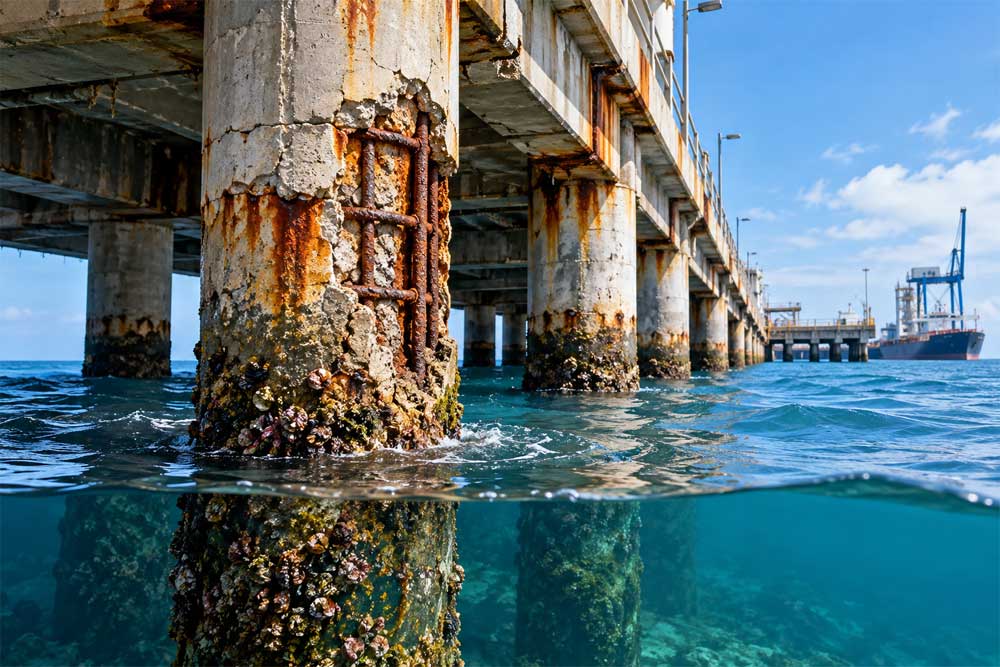
Marine structures are exposed to aggressive environmental conditions that can accelerate corrosion of concrete and steel. Structures such as ports, jetties, piers, offshore platforms, seawalls, breakwaters and marine bridges are regularly subjected to seawater, tidal cycles, moisture, chlorides and wave action. Over time, these conditions can reduce the durability and service life of structural components.
Understanding the causes of corrosion and adopting suitable protection measures during design, construction and maintenance can help improve the long-term performance of marine structures.
Causes for Corrosion in Marine Structures?
The primary cause of corrosion in reinforced concrete marine structures is the presence of chloride ions. Seawater contains significant concentrations of chlorides that can penetrate concrete and reach embedded reinforcement.
When chloride ions reach the steel reinforcement in sufficient concentration, they can break down the passive protective layer that normally forms around the steel in alkaline concrete. In the presence of moisture and oxygen, electrochemical corrosion can then begin.
Carbonation can also contribute to reinforcement corrosion by reducing the alkalinity of concrete. While chloride-induced corrosion is generally the dominant concern in marine environments, carbonation can become important in areas exposed to atmospheric conditions.
Marine structures are also subjected to repeated wetting and drying. Tidal zones can experience particularly severe exposure because concrete surfaces are repeatedly exposed to seawater, oxygen and drying conditions.
How Corrosion Develops in Reinforced Concrete
Corrosion generally progresses through two broad stages:
- Chloride penetration: Chlorides move through concrete pores and cracks toward the reinforcement.
- Depassivation: When the chloride concentration around the steel reaches a critical level, the protective passive layer is disrupted.
- Electrochemical reaction: Corrosion begins when water and oxygen are available.
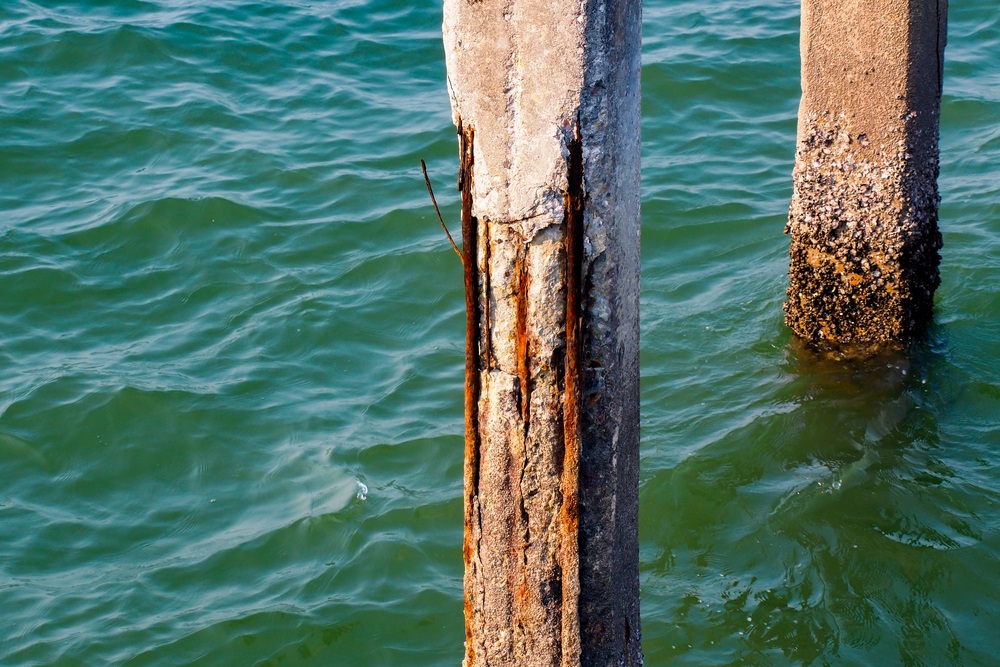
- Rust formation: Corrosion products occupy more volume than the original steel.
- Concrete cracking: Expansion of the corrosion products creates internal tensile stresses.
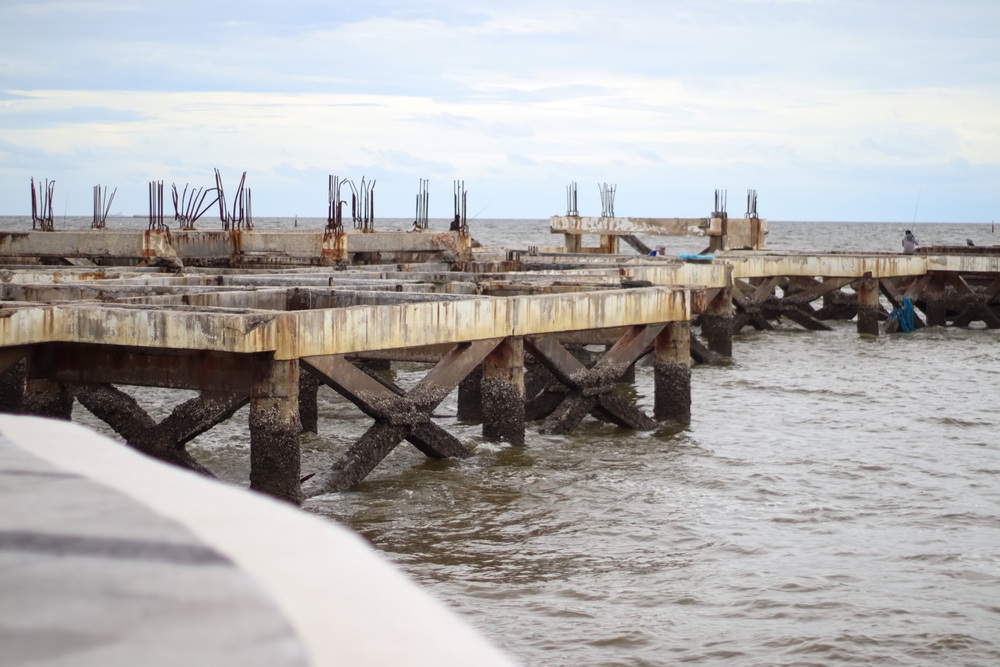
- Spalling: Continued corrosion can cause concrete cover to crack and detach.
- Loss of reinforcement: Advanced corrosion reduces the effective cross-sectional area of reinforcement and can affect structural capacity.
Marine Exposure Zones and Corrosion Risk
The severity of corrosion varies according to the location of a structural component.
Submerged Zone
Concrete remains continuously underwater in this zone. Oxygen availability can be relatively limited, but chloride exposure remains high. Concrete permeability and the quality of the cover therefore have a major influence on durability.
Tidal Zone
The tidal zone is repeatedly exposed to seawater and air. Wetting and drying cycles can increase chloride transport and create conditions favourable to reinforcement corrosion. This zone often requires particular attention during durability design.
Splash Zone
The splash zone receives seawater from waves, spray and splashing but is not continuously submerged. It can experience high chloride exposure combined with oxygen availability, making corrosion protection particularly important.
Atmospheric Zone
Components above the splash zone may still be exposed to salt-laden air and marine humidity. Chlorides can accumulate on exposed surfaces and gradually penetrate the concrete.
Where Corrosion Occurs in Marine Structures
- Ports and harbours: Concrete decks, beams, columns, piles and steel components exposed to seawater and salt-laden air.
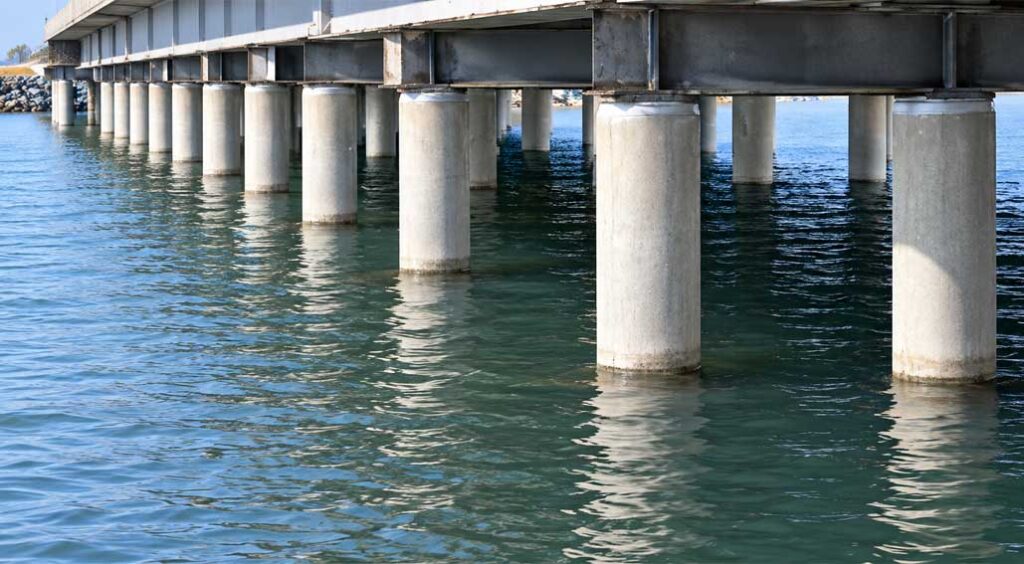
- Jetties and piers: Piles, pile caps, beams, slabs and reinforcement exposed to tidal and splash-zone conditions.
- Offshore platforms: Structural steel, connections, braces, decks and submerged components exposed to seawater.
- Seawalls: Reinforced concrete faces, joints and reinforcement exposed to seawater, spray and wet-dry cycles.
- Breakwaters: Concrete blocks, armour units and reinforced concrete sections exposed to wave action and seawater.
- Marine bridges: Piers, pile foundations, bearings and reinforced concrete components exposed to saltwater and marine spray.
- Coastal buildings: Foundations, basement structures, balconies and exposed reinforcement subjected to salt-laden moisture.
- Shipyards: Steel structures, concrete floors, foundations and other components exposed to seawater and humid conditions.
- Desalination and water-treatment plants: Concrete tanks, channels, pipes, steel structures and reinforcement exposed to saline or chemically aggressive water.
- Offshore and coastal pipelines: External steel surfaces, joints and supports exposed to seawater, moisture and marine atmospheric conditions.
Factors That Accelerate Corrosion
Several construction and environmental factors can increase the rate of deterioration.
High concrete permeability: Poorly compacted or inadequately cured concrete provides easier pathways for water and chlorides.
Insufficient concrete cover: A smaller cover depth reduces the distance that chlorides must travel to reach reinforcement.
Cracks: Cracks can provide direct pathways for seawater and chlorides.
Poor detailing: Congested reinforcement, inadequate drainage and poorly designed joints can increase local deterioration.
Wet-dry cycles: Repeated exposure to seawater followed by drying can promote chloride accumulation.
Temperature: Higher temperatures can accelerate chemical and electrochemical reactions.
Mechanical damage: Impact, abrasion and erosion can damage the protective concrete layer and expose reinforcement.
Designing Concrete for Marine Durability
Durability needs to be considered from the design stage rather than relying only on repairs after deterioration occurs.
Low-permeability concrete can reduce the rate at which chlorides enter the structure. Appropriate cementitious materials and supplementary cementitious materials may be used to refine the pore structure and improve resistance to chloride ingress.
Other important considerations include:
- Adequate concrete cover
- Appropriate water-to-binder ratio
- Proper concrete compaction
- Adequate curing
- Crack control
- Suitable reinforcement detailing
- Proper drainage and joint detailing
- Selection of materials according to exposure conditions
- Consideration of the required design service life
Concrete quality is particularly important in tidal and splash zones, where the structure may face repeated cycles of seawater exposure, drying and oxygen availability.
Corrosion Protection Methods
Different protection systems can be selected depending on the structure, exposure conditions, design life and maintenance requirements.
Protective Coatings
Surface coatings can act as barriers against water and chloride penetration. Different coating systems are available for concrete and steel, including epoxy-based, polyurethane and other specialised protective coatings.
The substrate condition and surface preparation are important for coating performance.
Corrosion Inhibitors
Corrosion-inhibiting admixtures can be incorporated into concrete to reduce the likelihood or rate of reinforcement corrosion. Their suitability depends on the concrete mix, exposure conditions and project requirements.
Cathodic Protection
Cathodic protection systems can be used for reinforced concrete and steel structures where corrosion is already occurring or where long-term corrosion control is required. These systems work by controlling the electrochemical reactions responsible for corrosion.
Corrosion-Resistant Reinforcement
Alternative reinforcement materials can reduce dependence on conventional carbon steel. Depending on project requirements, options may include stainless steel reinforcement, epoxy-coated reinforcement or fibre-reinforced polymer reinforcement.
Concrete Repair
Where corrosion has already caused cracking or spalling, repair generally involves removing deteriorated concrete, treating or replacing affected reinforcement where required, restoring the concrete section and applying suitable protective measures.
Products Used to Address Corrosion in Marine Structures
A range of construction products can be used to protect marine structures from chloride ingress, reinforcement corrosion and concrete deterioration. Product selection depends on the exposure zone, condition of the structure, type of corrosion and required service life.
- Concrete Admixtures: Corrosion-inhibiting admixtures can be incorporated into concrete to reduce reinforcement corrosion. Water-reducing and permeability-reducing admixtures can also help produce dense concrete with lower chloride penetration.
- Protective Coatings: Epoxy, polyurethane and other specialised protective coatings can be applied to concrete and steel surfaces to create a barrier against seawater, chlorides and moisture. They are commonly considered for splash zones, exposed concrete and repaired surfaces.
- Waterproofing Systems: Cementitious waterproofing coatings, polymer-modified systems and membrane-based products can help limit water and chloride ingress through concrete surfaces.
- Concrete Repair Mortars: Polymer-modified and fibre-reinforced repair mortars are used to restore sections affected by cracking, spalling and reinforcement corrosion. These materials can help reinstate the concrete cover after removal of deteriorated concrete.
- Corrosion Inhibitors: Migrating corrosion inhibitors can be applied to existing concrete surfaces, while admixture-based inhibitors can be incorporated into new concrete. They are intended to reduce corrosion activity around embedded reinforcement.
- Grouts and Injection Materials: Epoxy and cementitious injection systems can be used to seal or repair suitable cracks and voids, reducing pathways for water and chlorides to reach reinforcement.
- Cathodic Protection Materials: Sacrificial anodes and impressed-current systems can be used where conventional repair alone may not adequately control ongoing reinforcement corrosion.
- Corrosion-Resistant Reinforcement: Stainless steel, epoxy-coated reinforcement and fibre-reinforced polymer reinforcement are among the alternatives that can be considered where long-term resistance to marine exposure is required.
Selecting the Right Products for Marine Structures
- Assess the exposure condition: Select products based on whether the structure is in the submerged, tidal, splash or atmospheric zone.
- Check chloride resistance: Choose concrete, coatings and waterproofing systems that can limit chloride ingress and withstand prolonged seawater exposure.
- Consider the existing concrete condition: For repair projects, assess cracking, spalling, delamination and reinforcement corrosion before selecting repair materials.
- Match the product to the application: Use corrosion inhibitors, repair mortars, protective coatings, waterproofing systems or injection materials according to the specific deterioration mechanism.
- Consider permeability: Low-permeability concrete and suitable admixtures can help reduce the movement of water and chlorides through the concrete.
- Check material compatibility: Repair mortars, coatings and other protective products should be compatible with the existing concrete and reinforcement.
- Consider service-life requirements: Product selection should reflect the expected design life and maintenance requirements of the marine structure.
- Evaluate application conditions: Consider surface preparation, moisture, temperature, tidal exposure and accessibility before choosing a product.
- Check resistance to mechanical exposure: Products used in splash and tidal zones should be capable of withstanding wave action, abrasion and impact where applicable.
- Consider maintenance requirements: Select systems that can be inspected, maintained and recoated or repaired during the structure’s service life.
Improving the Service Life of Marine Structures
Corrosion protection should be treated as part of an integrated durability strategy. Material selection, concrete mix design, reinforcement detailing, construction quality, protective systems and inspection should work together rather than being considered separately.
For new marine structures, durability-based design can help establish appropriate concrete properties, cover requirements and protection systems according to the expected exposure and service life. For existing structures, condition assessment can help determine whether preventive protection, local repair or more extensive rehabilitation is required.
Conclusion
Corrosion is one of the major durability challenges faced by reinforced concrete and steel marine structures. Chloride ingress, moisture, oxygen, tidal cycles, cracking and inadequate concrete quality can contribute to deterioration over time.
A combination of low-permeability concrete, adequate cover, proper construction practices, protective coatings, corrosion-resistant reinforcement, corrosion inhibitors and suitable monitoring can help control corrosion risks. For existing structures, timely inspection and repair are important for preventing local deterioration from developing into more extensive structural damage.