
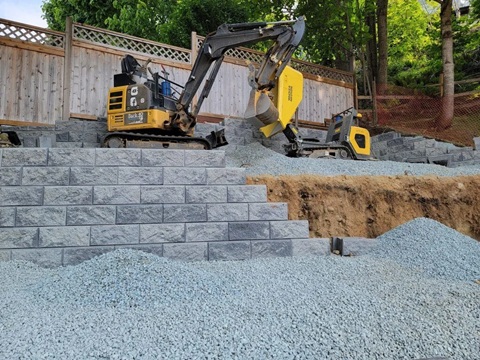
You’ve settled on block over timber or natural stone. Block is the forgiving choice for most backyard walls, and a dry-stack segmental system goes up faster than anything you’d mortar. But “block” covers three separate decisions, and the last one is the one that trips people up at the checkout.
What face style should I pick: flushface or split?
The face is the part you’ll look at every day, so start there. Two families cover most of what you’ll see.
Flushface blocks have a smooth, squared front. They read clean and modern and line up tight, which suits a courtyard or a raised garden bed. National Masonry’s Gardenwall flushface is a good example.
Split-face blocks (sometimes sold as “soft split” or tumbled) are broken or roughed up on the front, so each unit shows texture and a bit of stone-like shadow. That texture hides small alignment differences better than a smooth face does, which is a real advantage on a long run or a first-timer’s wall. If your top course ends up a hair off level, a split face absorbs it where a flushface would put it on display.
Neither face is stronger. Match the one that suits the house and how fussy you want to be about levelling. Textured faces cost about the same, and they are the easier choice if this is your first wall.
Face style is cosmetic. The next choice is structural.
Lip, pin, or pinless: which setback system holds better?
This is how blocks lock to the course below and hold their setback, the slight backward lean that keeps a retaining wall pressing into the hill rather than tipping away from it. Most segmental systems use one of three methods.
Lip (or flange) blocks have a moulded ridge on the bottom rear that hooks over the back of the course below. You place the block, slide it back until the lip catches, and the setback is fixed for you. That makes a lip wall close to foolproof for a homeowner, with one catch: the angle is whatever the block gives you, and you cannot change it.
Pin systems use fibreglass or nylon pins dropped through holes into the block beneath. Pins usually give you two setback positions, near-vertical or a steeper batter, and they add shear strength between courses. Allan Block and Keystone-style units lean on pins or a pin-and-hole geometry. There are more parts to handle, but you get to choose the lean.
Pinless (or lugless) blocks rely on their own moulded shape or a rear channel to align, often with the setback built in like a lip block but without the visible flange. They use fewer pieces than a pin system and stack quickly.
For a low garden wall, lip or pinless is plenty, and faster to build. For anything taller or on a slope, the shear resistance of a pin system earns its keep. Height changes the rules too. Once a wall passes about 4 feet, measured from the bottom of the footing, most councils and building codes treat it as an engineered structure that needs a permit and usually geogrid reinforcement tied back into the hill. And whatever block you pick, none of it saves you from the base: a wall without gravel backfill and a drain behind it will bulge sooner or later.
Where to buy the full system: specialist supplier vs big-box store
A segmental wall is a system, not a single product. The field block does the holding, but you also need a corner unit to turn a 90-degree return cleanly and a cap to finish and glue down the top course. Big-box stores usually stock one or two field blocks and leave you hunting for the matching corners and caps later, which is how walls end up with a mismatched top row. A specialist that lists its full segmental retaining wall block systems online avoids that. Each block is shown with its matching corner and cap units, so you order the complete wall in one go instead of grabbing whatever pallet is in stock. Australian Landscape Supplies, for example, publishes its full segmental range online, including Gardenwall flushface, Gardenwall soft-split, Keystone 133 Elite, Linearwall and Modernstone, with the corner and cap units listed beside each system so you can see the whole kit before you commit to a face style.
Two units get forgotten every time. The corner unit is finished on two adjacent faces, so a return corner shows a clean face on both sides rather than the raw end of a field block. The cap is a shorter, often solid unit that closes the top course and hides the hollow cores; you glue it down with a bead of concrete adhesive so nobody knocks the top row loose. Order both with the field blocks. Come back for caps in a different production run and you risk a colour that does not quite match.
Count your corners before you order. Every outside corner needs a corner unit for each course, so a 3-foot-tall wall with one return can eat a dozen of them.
Frequently asked questions
Can you leave the top course open instead of capping it? You can, but the hollow cores collect water and debris, and an unglued top row shifts over time. Caps close the wall and lock that course down. The only time to skip them is on a course that ends up fully buried or hidden inside a planter.
How many blocks will you actually need? Take the wall face area, length times height, and divide by the face area of one block, then add roughly 5 to 10 percent for cuts and breakage. Corner and cap counts are worked out separately. Buy the extras up front so they come from the same batch.
There is a ceiling on height. Once a wall passes 4 feet, footing to top, most codes want an engineer’s design and reinforcement. Plenty of block lines will hold a low unreinforced wall of around 2 feet on their own, but check the manufacturer’s chart and your local rules before you build tall.
Heavier blocks are not automatically stronger. Weight tracks size, not strength. A block around 35 pounds is a one-person lift; go much heavier and you slow down and risk your back for no structural payoff on a small wall.






