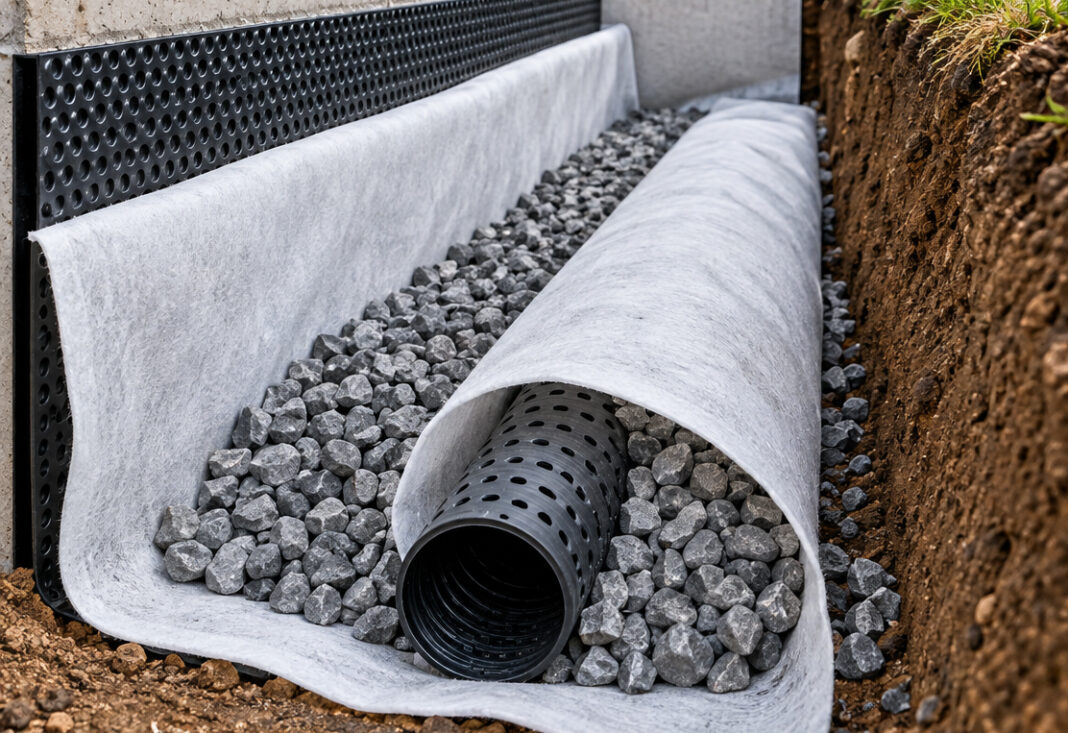
Water management is an important part of foundation and retaining structure design. Groundwater, rainfall infiltration and seepage can accumulate around foundations and behind retaining walls, increasing hydrostatic pressure and affecting soil behaviour. A drainage system is therefore required to intercept water, filter soil particles and safely convey the collected flow away from the structure.
Role of Geotextiles in Foundation Drainage
Foundation drainage systems are designed to prevent water from remaining against or beneath structural elements. Depending on the site, drainage may be required around basements, foundations, footings, underground structures and other below-ground construction.
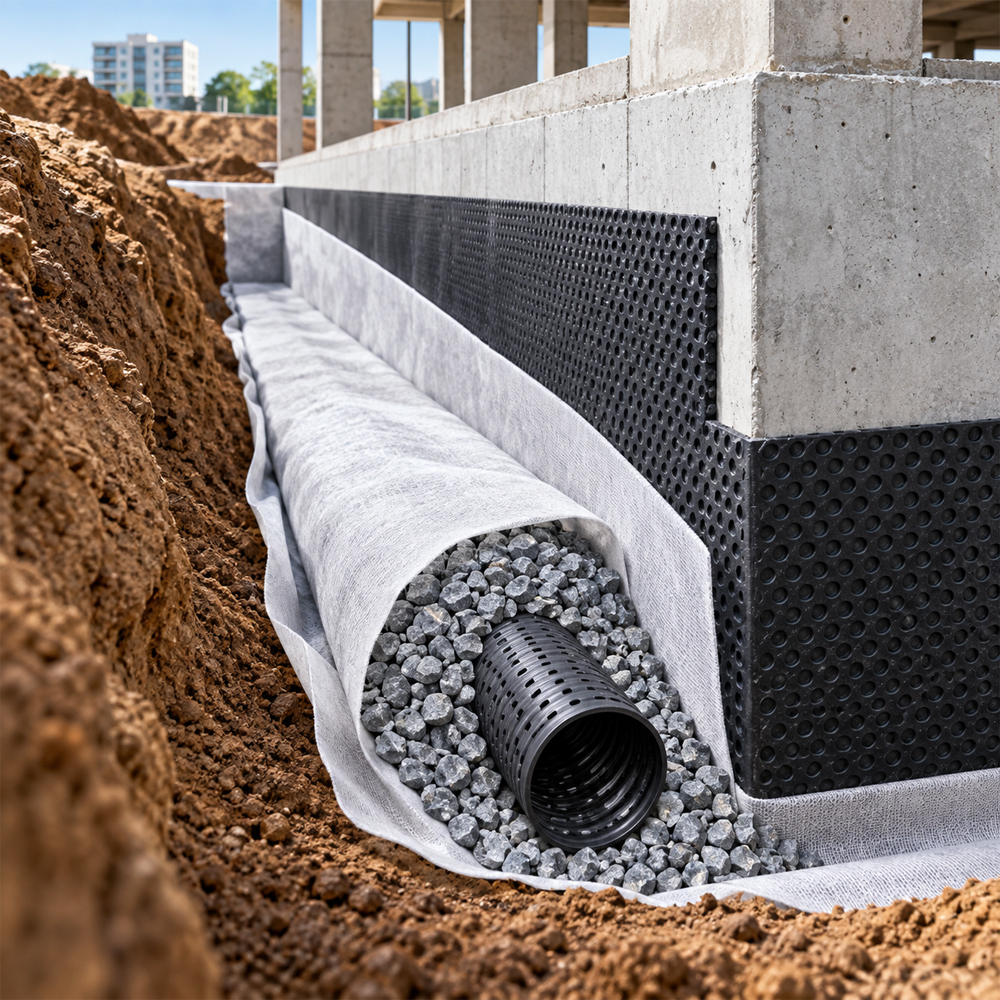
A typical subsurface drainage arrangement can include a perforated collector pipe, drainage aggregate and geotextile filter. The geotextile separates the surrounding soil from the drainage material. Water can enter the drainage layer while soil fines are retained.
Without an appropriate filter, fine particles from the surrounding soil can migrate into the drainage aggregate. Over time, this may reduce the available void space and restrict water movement.
The geotextile therefore performs a filtering function rather than simply acting as a fabric layer.
How a Geotextile Filter Works
The performance of a geotextile filter depends on the relationship between the soil, geotextile and drainage medium.
When groundwater moves towards a drainage layer, the geotextile allows water to pass through its openings. At the same time, the openings must be appropriately sized to retain the soil particles that need to remain in place.
This creates two important requirements:
Soil retention + adequate water flow
If the openings are too large, excessive soil migration can occur. If the filter is too restrictive, water flow can be reduced. Geotextile filter design therefore involves balancing soil retention, permeability and resistance to clogging.
The filter must also maintain its performance under the stresses expected during construction and throughout the service life of the drainage system.
Geotextile Around Perforated Drainage Pipes
One common application is the use of geotextiles around perforated drainage pipes.
A typical arrangement consists of:
- Excavated drainage trench
- Geotextile filter layer
- Clean drainage aggregate
- Perforated pipe
- Additional drainage aggregate
- Surrounding or compacted soil
The geotextile is positioned between the native soil and drainage aggregate. Water entering from the surrounding ground passes through the geotextile and reaches the aggregate and perforated pipe.
The pipe then conveys the collected water towards an appropriate discharge point.
This arrangement can be used for perimeter foundation drains, basement drainage, retaining wall toe drains and other subsurface drainage applications.
The exact pipe diameter, aggregate grading, trench dimensions and geotextile properties should be established according to the site conditions and hydraulic requirements rather than using a standard configuration for every project.
Geotextiles Behind Retaining Walls
Retaining walls can experience increased lateral loads when water accumulates behind the wall.
A retaining wall designed primarily for soil pressure may experience significantly different loading if groundwater or infiltrated rainwater is allowed to build up behind the structure.
A drainage system behind the wall provides a pathway for water to move towards a collection drain or other outlet.
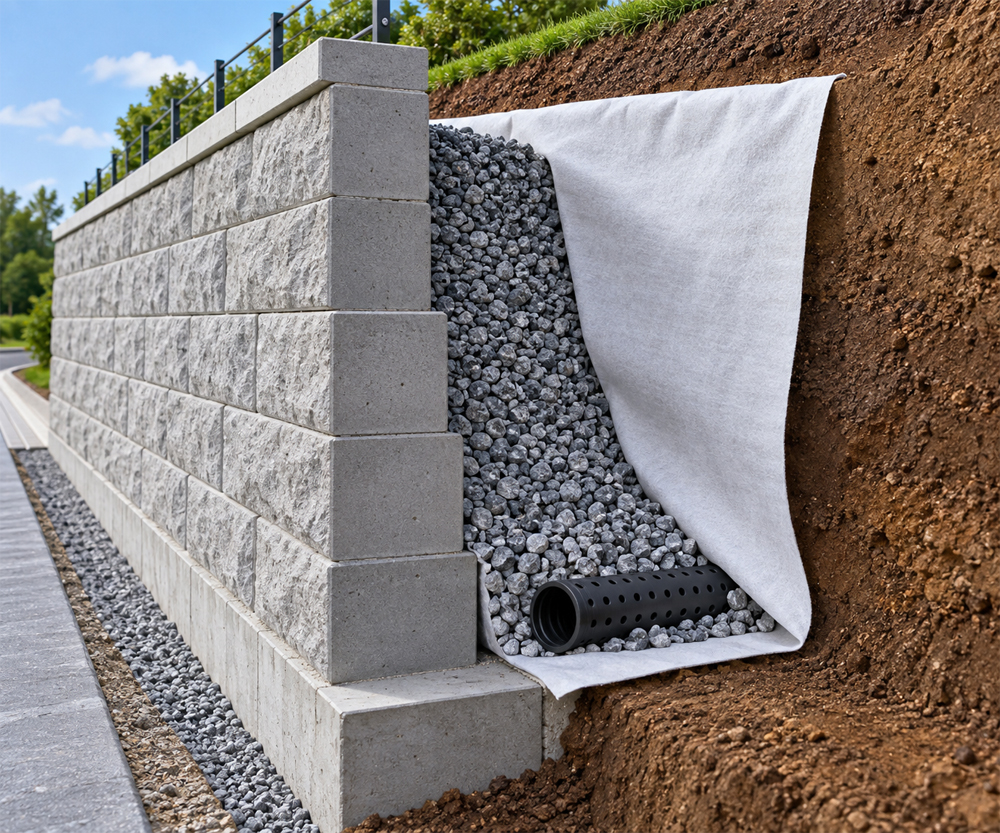
Geotextiles can be installed between the retained soil and the drainage material to prevent migration of fines into the drainage layer. This application is suitable for conventional retaining structures, including systems using concrete blocks, masonry and other facing arrangements.
A typical wall drainage arrangement may include:
Retained soil → geotextile filter → drainage layer → collector pipe → outlet
The drainage layer may consist of free-draining aggregate or a prefabricated drainage geocomposite.
Geotextiles and Drainage Aggregates
Drainage aggregates provide voids through which water can flow. However, if soil particles migrate into these voids, the drainage capacity can progressively decline.
The geotextile acts as a filter between the soil and aggregate.
This arrangement can help reduce soil contamination of drainage aggregate and maintain the available flow paths within the drainage layer. In some applications, it can also reduce the amount of graded filter material required.
However, the geotextile does not replace the need for suitable drainage aggregate. The aggregate still needs to provide adequate hydraulic capacity and remain compatible with the expected flow conditions.
Geotextiles in Drainage Composites
Geotextiles can also form part of prefabricated drainage geocomposites.
A drainage geocomposite generally combines a geotextile filter with a drainage core. The geotextile retains soil particles while the core provides a pathway for water to move within the plane of the drainage system.
Depending on the product and application, the drainage core may consist of a polymeric structure designed to maintain flow under applied pressure.
Such systems are used for applications including:
- Foundation and basement drainage
- Retaining wall drainage
- Drainage of reinforced soil structures
- Road and railway drainage
- Tunnel drainage
- Landfill drainage
- Drainage trenches
These systems can combine filtration and in-plane drainage within a relatively thin layer.
Filtration Versus Drainage
It is important to distinguish between filtration and drainage.
A geotextile used as a filter primarily allows water to pass while retaining soil particles.
A drainage system, on the other hand, must provide a pathway for the collected water to move towards an outlet.
A geotextile may contribute to drainage in certain configurations, but simply placing a geotextile against a wall does not automatically create an effective drainage system.
For example, a nonwoven geotextile may permit water to pass through its thickness, while a geocomposite containing a drainage core can provide a dedicated in-plane flow path. The selection depends on the required flow rate, hydraulic gradient, applied pressure and system configuration.
Selection of Geotextile for Foundation Drainage
Geotextile selection should be based on the characteristics of the soil and the drainage system.
Important properties include:
- Apparent opening size
- Permittivity
- Water flow capacity
- Tensile strength
- Puncture resistance
- Tear resistance
- Installation survivability
- Chemical resistance
- Biological resistance
- Long-term durability
The soil grading is particularly important because the filter needs to retain the soil while allowing sufficient water flow.
The apparent opening size is commonly evaluated against representative soil particle sizes as part of filter design. However, a single parameter should not be used in isolation because soil structure, hydraulic conditions and clogging behaviour also influence performance.
Importance of Permittivity
Permittivity describes the capacity of water to flow through a geotextile in the direction perpendicular to its plane.
A drainage filter must have sufficient permittivity to allow the required volume of water to pass through.
The required value depends on the soil, hydraulic gradient, applied stress and drainage configuration.
Soils with significant fines can present different filtration requirements from clean granular soils. Therefore, geotextile specifications should be developed using the actual soil characteristics rather than selecting a fabric solely on the basis of weight or thickness.
Clogging and Blinding
One of the major concerns in geotextile filtration is clogging.
Clogging occurs when soil particles become trapped within the openings of the geotextile and progressively reduce water flow.
Blinding refers to the accumulation of particles at the surface of the geotextile, which can also restrict water movement.
Both conditions can reduce the effectiveness of the drainage system.
Geotextile filter design therefore needs to consider soil gradation, particle migration, hydraulic conditions and the interaction between the soil and geotextile.
Drainage Behind Basement Walls
Below-ground structures such as basements are particularly sensitive to groundwater.
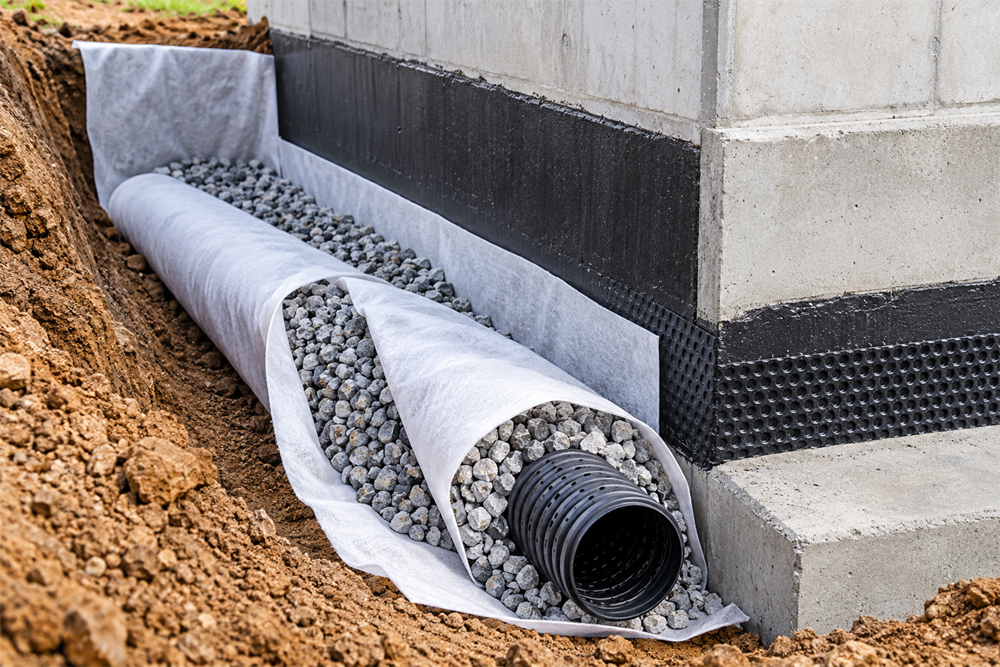
A drainage system may be installed against the external face of the basement wall to intercept water and direct it towards a perimeter drain.
A drainage composite can combine several functions. The geotextile-facing layer filters soil particles, while the drainage core provides a vertical flow path. The collected water is then directed towards a collector pipe at the base.
Where waterproofing is also provided, the drainage layer can help reduce the amount of water reaching the waterproofing membrane and can protect the membrane during backfilling.
The drainage system and waterproofing system should, however, be designed as complementary components rather than treating drainage as a substitute for waterproofing.
Retaining Wall Drainage and Hydrostatic Pressure
Drainage is particularly important for retaining walls because water pressure can add to the forces acting on the wall.
A drainage layer behind the wall can reduce the accumulation of water within the backfill. Water can flow down towards a toe drain or other collection system.
Depending on the wall design, additional measures may include:
- Weep holes
- Drainage aggregate
- Geocomposite drainage layers
- Collector pipes
- Surface drainage
- Waterproofing
- Groundwater interception
The final arrangement depends on wall geometry, soil conditions, groundwater levels and the consequences of drainage failure.
Installation Considerations
Even a correctly selected geotextile can perform poorly if it is damaged or incorrectly installed.
The fabric should be handled carefully to avoid tearing, puncturing or excessive stretching. The filter should remain continuous over the required area, with overlaps and joints installed according to the project specification.
Particular attention is required when placing angular drainage aggregate. Sharp aggregate can damage the geotextile during placement or compaction.
Construction equipment should not be allowed to directly traffic over exposed geotextile where this could cause damage.
The drainage layer should also be protected from contamination during construction.
Interaction With Waterproofing
In below-ground construction, drainage and waterproofing serve different functions.
Waterproofing provides a barrier against water penetration, while drainage provides a controlled route for water to leave the surrounding soil.
A drainage composite installed outside a basement wall can collect water and direct it towards the perimeter drainage system. This can reduce hydrostatic pressure and help protect the waterproofing layer from physical damage during backfilling.
The connection between the drainage layer, waterproofing system and collector drain is important. A drainage layer without a functioning outlet can simply collect water without removing it.
Foundation Drainage in High Groundwater Conditions
Sites with high groundwater levels require additional attention.
The drainage system needs to be designed for the expected groundwater flow rather than only occasional rainfall.
Factors to assess include:
- Seasonal groundwater fluctuations
- Soil permeability
- Groundwater pressure
- Foundation depth
- Excavation geometry
- Drainage outlet level
- Pumping requirements
- Potential clogging
- Long-term maintenance
Where gravity drainage is not possible, collected water may need to be directed towards a sump and pumped to an approved discharge location.
Geotextile Drainage in Soft and Fine-Grained Soils
Fine-grained soils can present additional filtration challenges.
Clayey and silty soils may have low permeability but can still generate seepage under hydraulic gradients. The filter must allow sufficient water movement without allowing excessive migration of soil particles.
The soil’s particle-size distribution, plasticity, structure and hydraulic conditions should therefore be considered during design.
For critical applications, the filter should be evaluated as part of the complete drainage system rather than considering only the soil-geotextile interface. The interaction between the soil, filter and drainage medium can affect overall performance.
Quality Control During Construction
Quality control should cover both the geotextile and the drainage system.
Important checks include:
- Correct geotextile type
- Roll identification
- Material condition
- Apparent opening size and relevant hydraulic properties
- Overlap and joint details
- Damage during handling
- Drainage aggregate quality
- Pipe alignment
- Pipe slope
- Drainage outlet connection
- Protection before backfilling
For large infrastructure projects, material testing and installation inspection should follow the project specifications and applicable standards.
Common Problems With Geotextile Drainage Systems
Several construction and design issues can reduce drainage performance.
Using the Wrong Geotextile
A fabric selected only on the basis of thickness or GSM may not have the required filtration and hydraulic characteristics.
Inadequate Drainage Capacity
A geotextile filter cannot compensate for an undersized drainage core, pipe or collection system.
Poor Outlet Design
Water must have a reliable path out of the system. A drainage layer without an effective outlet can become saturated.
Soil Migration
If the geotextile does not provide adequate soil retention, fines may enter the drainage layer and progressively reduce its capacity.
Construction Damage
Punctures and tears can create direct pathways for soil migration and compromise filtration.
Poor Connection Details
Discontinuous overlaps or improperly terminated filter layers can allow soil to bypass the geotextile.
Geotextile Drainage Versus Conventional Granular Filters
Conventional drainage systems often use carefully graded granular filter layers. Geotextiles can perform the filter function while allowing drainage systems to be configured with different aggregate sizes and reduced excavation in some applications.
However, the choice between a geotextile filter and a granular filter should be based on engineering requirements.
Geotextiles offer advantages in installation speed, material separation and construction control, but their performance depends on correct selection and installation.
They should not be specified simply as a replacement for granular filters without evaluating the soil and hydraulic conditions.
Key Design Considerations
For an effective geotextile drainage system, engineers should evaluate:
Soil characteristics
Particle-size distribution, fines content, plasticity and permeability.
Hydraulic conditions
Groundwater level, expected flow, hydraulic gradient and seasonal variation.
Filter requirements
Soil retention, permeability, permittivity and clogging resistance.
Drainage requirements
Flow capacity, drainage path, pipe capacity and outlet arrangement.
Mechanical requirements
Installation survivability, puncture resistance and resistance to construction damage.
Long-term performance
Chemical exposure, biological conditions, creep where applicable and durability.
These parameters need to be considered together. Geotextile selection based on a single property may not provide adequate long-term performance.
Conclusion
Geotextiles have become an important component of drainage systems used around foundations, retaining walls and other below-ground structures. Their primary function is to separate soil from the drainage medium while allowing water to pass into the drainage system.
The effectiveness of these systems depends on more than selecting a geotextile with a particular GSM or thickness. Soil properties, apparent opening size, permittivity, flow capacity, clogging resistance, mechanical survivability, drainage capacity and long-term conditions all need to be considered.
Ultimately, a geotextile drainage system should be designed as part of the complete foundation or retaining-wall drainage arrangement, with a clear path for collected water to reach its intended outlet. Proper design, material selection and installation are essential for maintaining drainage performance throughout the service life of the structure.