
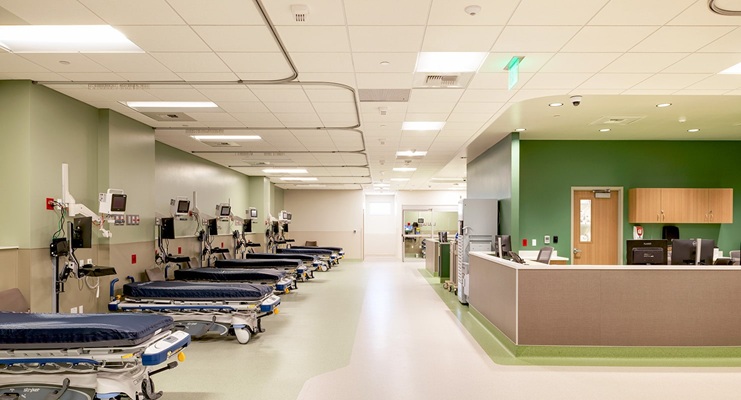
Healthcare facilities operate under a different set of rules than nearly any other type of commercial building. A retail store or office can close its doors during a power outage with minimal consequence beyond lost revenue. A hospital, urgent care center, or long-term care facility cannot make that trade-off. Patients on ventilators, infants in neonatal intensive care units, and individuals undergoing surgery depend on an unbroken supply of electricity for their safety and survival. This reality places power planning at the center of healthcare facility management, shaping everything from initial construction design to daily operational checklists.
Why Continuous Power Matters More In Healthcare Settings
Unlike many commercial environments, healthcare facilities run equipment that cannot tolerate even momentary interruptions. Ventilators, dialysis machines, infusion pumps, and monitoring systems all require constant electrical input. A gap of even a few seconds can mean the difference between a stable patient and a medical emergency. Surgical suites present an even higher stakes scenario, where a power failure mid-procedure could compromise a patient’s life on the operating table.
Beyond direct patient care, healthcare facilities also rely on electricity for climate control, particularly in areas where temperature-sensitive medications and vaccines are stored. Refrigeration failures can destroy thousands of dollars in pharmaceutical inventory within hours, and in some cases, render critical treatments unusable during a public health emergency. Diagnostic imaging equipment, laboratory analyzers, and electronic health record systems all add further layers of dependency on a facility’s electrical infrastructure.
The Regulatory Framework Behind Backup Power
Because the consequences of power loss are so severe, healthcare facilities in the United States are subject to strict regulatory requirements governing emergency power systems. The National Fire Protection Association’s NFPA 110 standard establishes classifications for emergency and standby power systems, dictating how quickly backup power must activate after an outage. Most hospital-grade systems are required to restore power within ten seconds of an interruption, a threshold designed to keep life-support equipment functioning without a meaningful gap.
The Centers for Medicare and Medicaid Services also requires healthcare facilities to maintain emergency preparedness plans that account for power outages, and accrediting bodies such as The Joint Commission conduct regular inspections to verify that backup systems are present, properly maintained, and tested according to schedule. Facilities that fail to meet these standards risk not only patient safety but also their accreditation status and ability to bill for services.
Sizing A Generator For Healthcare Use
Determining the appropriate generator capacity for a healthcare facility is a far more complex calculation than for a typical commercial building. Facility engineers must account for the combined load of life-support equipment, HVAC systems, lighting, elevators, security systems, and IT infrastructure, all of which may need to run simultaneously during an extended outage. Underestimating capacity can leave a facility unable to power everything it needs during a crisis, while oversizing leads to unnecessary capital and fuel costs.
Industry estimates suggest that a mid-sized hospital may require anywhere from 1 to 3 megawatts of backup generation capacity, depending on the scope of services offered and the size of the physical campus. Smaller facilities, such as outpatient clinics or urgent care centers, typically need far less, often in the range of 100 to 500 kilowatts, but the underlying principle remains the same: capacity must be calculated with a margin for peak demand, not average demand, since medical emergencies rarely occur under ideal conditions.
Maintenance As A Continuous Obligation, Not A One-Time Investment
Purchasing and installing a generator is only the beginning of a healthcare facility’s power resilience strategy. Emergency generators are mechanical systems, and like any mechanical system, they degrade over time without proper upkeep. Fuel can become contaminated, batteries can lose charge, and internal components can wear down from lack of use just as easily as from overuse. Regulatory bodies require monthly load tests and periodic full-scale exercises to confirm that backup systems will perform as expected when an actual outage occurs.
This is why many administrators contract with specialized providers rather than relying solely on in-house maintenance staff. For instance, a Coral Gables healthcare facility generator maintenance service can offer the kind of specialized inspection and testing protocols that general facilities maintenance teams may not have the training to perform. These providers typically monitor fuel quality, battery health, transfer switch function, and load bank testing on a recurring schedule, catching small issues before they become full system failures during an actual emergency.
The Hidden Cost Of Neglecting Power Infrastructure
Facilities that treat generator maintenance as an afterthought often discover the cost of that decision at the worst possible moment. A generator that fails to start during an actual outage does not simply cause an inconvenience; it can trigger a cascade of consequences ranging from patient transfers to regulatory citations to reputational damage that outlasts the incident itself. Insurance carriers have also grown more attentive to backup power documentation, and some now require proof of regular testing as a condition of coverage or as a factor in premium calculations.
Beyond compliance, there is a financial argument for proactive maintenance as well. Replacing a failed generator under emergency conditions typically costs significantly more than routine servicing, both in equipment expenses and in the operational disruption of installing new systems while continuing to deliver patient care.
Planning For The Next Decade Of Healthcare Power Demand
As healthcare facilities increasingly rely on electronic health records, telehealth infrastructure, and advanced diagnostic technology, their baseline power consumption continues to climb. Facilities built even a decade ago may find their original backup systems undersized for current demand. Forward-thinking administrators are beginning to reassess their power infrastructure not as a static installation but as an evolving system that must be reviewed periodically alongside changes in equipment, patient volume, and building expansion.
Power planning in healthcare is ultimately not just a facilities issue but a patient safety issue. The equipment may sit quietly in a mechanical room, rarely thought about during normal operations, but its reliability during the moments that matter most is what separates a well-prepared facility from one caught unprepared.






