
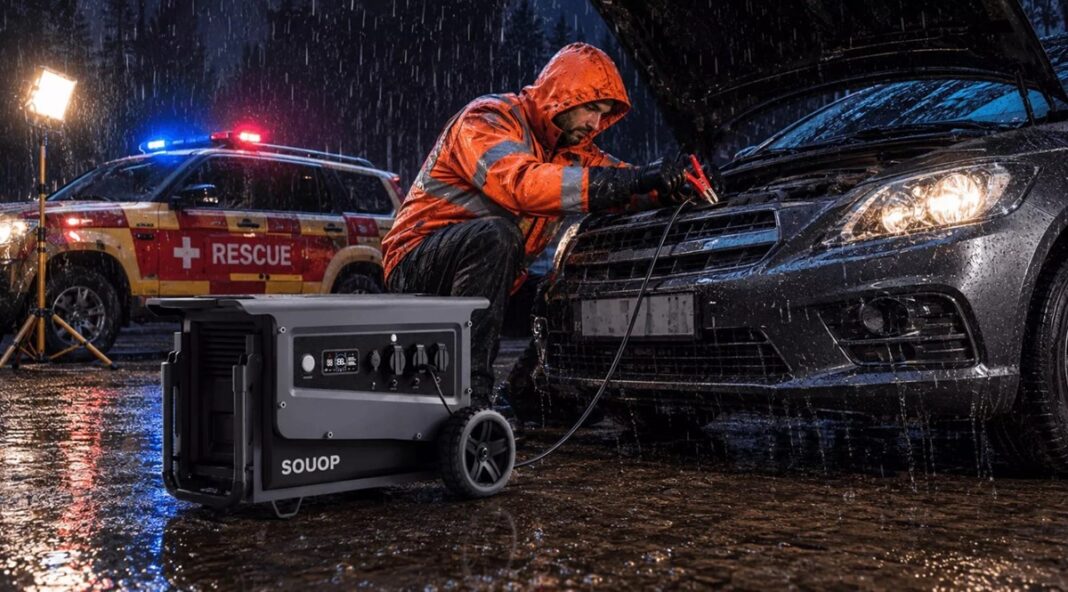
Sites without a reliable source of power are the norm in construction. From early site work to utility repairs to the installation of remote facilities, and the completion of work on an unfinished building, all require some kind of temporary power. Traditionally, the industry has relied on generators to provide temporary power. Generators are a good solution because they are simple to use, dependable, and can provide huge amounts of power. The primary drawback to using generators is their requirement for a fuel source, and the hassle and expense of providing that fuel. A new alternative to generators is battery packs. Like generators, battery packs are quiet. But, unlike generators, battery packs are maintenance free, and can be easily transported to a job site. The key when selecting a battery pack is ensuring that it is weather resistant and that it has the capacity to provide the power needed for the job.
What Construction Sites Demand from Portable Power
Considering the demands that will likely be placed on the power source for a construction job outdoors will help provide perspective for evaluating power source specifications. The tools needed to complete such a job may include: circular saws, angle grinders, rotary hammers, compressors, concrete vibrators, work lights, and a charging bank for cordless tools. Many tools, especially air tools, draw much more power on start-up than they do during normal operation. A large circular saw or an air compressor motor may draw up to three times the power for which they’re rated for a fraction of a second. A power source that can’t handle this spike will trip or drop voltage to the tool, and shorten the life of the tool. A job may also require the use of multiple tools at the same time, so the power draw of more than one tool also needs to be considered.
Sizing Output for Real Workloads
When considering middle-level crews, the first criterion usually is continuous power. A good reference here is a portable industrial power station 5000w. Normally, such a power station can easily keep up with the energy demand of a large circular saw, a few LED flood lights and a battery charger all at the same time. It is important to mention that the surge power of such units is normally more than 50% of the continuous power. With a high power generator, you can replace a couple of low power generators. This reduces the number of cables, chargers and other equipment that you take to the work site. However, when considering various power stations, it is important to note that watts are not the only consideration. The quality of the inverter, the available outlets and the ability to continuously provide power to 240V equipment are equally important. You should make a list of all the equipment you need, add their continuous and surge watts, and add an additional 20% to the total, rather than try to guess the power of a unit based on their continuous power.
Weather Protection and IP Ratings
Weatherproofing is the second most important factor when considering rugged hardware. Here, the touchstone is ingress protection (IP) rating. The first digit describes protection against the entry of foreign objects and the second digit describes protection against the entry of moisture. An IP54 rating is typically sufficient for protection against light rain and slightly higher ratings would be sufficient for hose-downs and areas with heavy rains. Keep in mind, though, that some manufacturers set the protection level with all of the ports closed. This means the enclosure is protected for severe conditions on hot days, but, in reality, without the ports covered with a rubber seal or some other water-tight mechanism, or with no water-tight seals around the connectors, the enclosure is not protected against moisture or dust.
Managing Heat and Cold
The other important factor to consider when protecting your gear against the elements is temperature. LiFePO4 batteries are considerably more tolerant to high temperatures than other lithium batteries, however they do have a maximum limit. Many other batteries on the market don’t even come close to tolerating high temperatures like LiFePO4. Charging batteries below -18°C (0°F) can permanently damage the battery and can shorten its life expectancy. Units that are left in the direct sunlight can power down or throttle their output in order to protect themselves from getting too hot. It’s important that your equipment has a way of cooling itself and/or airflow so that it can avoid retaining too much heat. Sometimes the airflow and cooling system is just as important as the rating itself. During the summer, the heat can cut the life of your batteries considerably, and a tent to provide shade, as well as elevating your equipment, can help extend the working life of your equipment.
Calculating Backup Capacity
Capacity is measured in watt-hours and gives an idea of how long a generator station will operate between recharges. To get expected runtime, divide battery capacity by average load, subtract 10-15% for inverter losses, and you’ll get a general idea of how long the battery will power your load. A 5000 watt-hour battery, for example, will power a 1000 watt load for just under 4.5 hours. That same battery will only power a 4000 watt load for 1 hour. To account for expected runtime, battery capacity must be adequate for the anticipated task. Considering hours of operation is essential. If the anticipated task will require 8 hours of operation, the battery has to have that capacity. Alternatively, the expected task has to account for other means of power (solar power, vehicle power, battery swap) if two units will be used. Systems that allow additional batteries to be added are advantageous if the expected task changes over the course of the project. For example, if a system starts out powering tools for rough framing and then is required to power tools for finish work.
Safety on the Job Site
There are special considerations for safety and site practices. For this reason, in wet weather, power stations on building sites should use ground-fault circuit interrupter (GFCI) or be supplied with GFCI outlets. Outdoor-rated cables should be used. Cables should not be placed on wet, cold ground, and should be protected from traffic. Power stations should be placed on level, dry, firm ground. Power stations should not be placed in excavations, depressions or low areas, as water will collect there. Safety and battery standards vary by region, and devices can vary in quality. For this reason, it is a good practice to check that the units have the most up to date standards and safety features. Education and training of employees on the use of equipment can help employees avoid mistakes during critical startup tests.
Maintenance and Charging Habits
Routines for maintenance and charging ultimately restrict the lifespan of a station. Regular dusting of vents and inspection for wear of seals and port covers can help identify potential problems. Storing a partially charged station can extend its useful life. As a station is not intended to be used for years at a time, a logbook tracking charge cycles, repairs, and error codes is of little benefit. The logbook is best created by a team that swaps between multiple devices and forgets to record maintenance. In these cases, the logbook can help teams avoid using a faulty station during a live event. This same logic applies to any other piece of equipment in the facility, and the same attitude should be maintained toward power stations.
Total Cost of Ownership
During budget talks, it’s often about total cost of ownership. A more expensive power station up front may actually be cost saving in the long run. Waterproof industrial power station seals to protect the electronics, tougher battery chemistry, a rugged enclosure and a powerful charging system may increase the initial cost of the power station, but may protect against hidden costs of weather related failures. Weather related failures may include loss of work hours, tools damaged beyond use, and additional unplanned equipment replacement. The power station may also protect against unplanned loss of productivity due to weather conditions. For the consumer, it’s important to review the terms of the warranty and see if outdoor and commercial use is covered. There are also other factors to consider like customer support and spares. During the purchase and ownership of a power station, the customer may find that the cheapest option is limited to a short warranty and no technical support for extreme weather conditions and that power station may not be the best option for someone who intends to work in outdoor environments.
Conclusion
The demands on portable power for a worksite depends on the balance of electrical load, the abuse the equipment will endure, and the required time it can remain active. Generally matching the combined peak power of the load to the generator is the easy part. Understanding the load in volts-amps and not just the simple sum of its parts is important. Likewise understanding the conditions and the equipment’s ability to withstand them is important as is designing the installation to be continuously active for a full work day as a minimum, not a maximum. With this in mind power generation equipment becomes a powerful tool for a worksite.






