Moving heavy materials across a construction site is rarely a simple lifting task. Ground conditions, access restrictions, load shape, delivery timing and placement accuracy all affect which machine should do the work. For contractors, site engineers and equipment managers, the right choice can reduce manual handling, prevent material damage and keep work areas moving. This article explains how to match common jobsite loads with suitable handling equipment and avoid costly selection mistakes.
Start with the load, not the machine
Equipment selection often begins with what’s already available in the fleet. That may be convenient, but it can lead to unsafe lifts, repeated trips or machines operating close to their limits. A better approach is to assess the load and the route before choosing the equipment.
Begin with the load’s total weight, dimensions and centre of gravity. A compact pallet of cement bags behaves differently from a long steel beam of the same weight. The pallet may be stable on forks, while the beam could require rated lifting points, a spreader beam or controlled lifting from more than one position.
The condition of the material also matters. Loose aggregate can be handled efficiently with a loader bucket, but finished stone panels, glazing units and prefabricated components need attachments that protect their surfaces and control movement.
Next, examine where the load starts and where it must finish. Consider:
- The distance between unloading and installation points
- Ground bearing capacity and surface condition
- Slopes, trenches and temporary access roads
- Overhead lines, scaffolding and structural obstructions
- Turning space and machine clearance
- The height and reach required at the final location
A machine may have enough lifting capacity at ground level but not at the reach or height required for the task. Rated capacity should always be checked for the actual working configuration, including the attachment and load centre.
Match equipment to the movement required
Jobsite material handling usually involves one or more basic movements: transporting, lifting, loading, positioning or pulling. Some equipment can perform several of these tasks, but each machine has a working range where it is most effective.
Hand trucks, dollies and pallet jacks
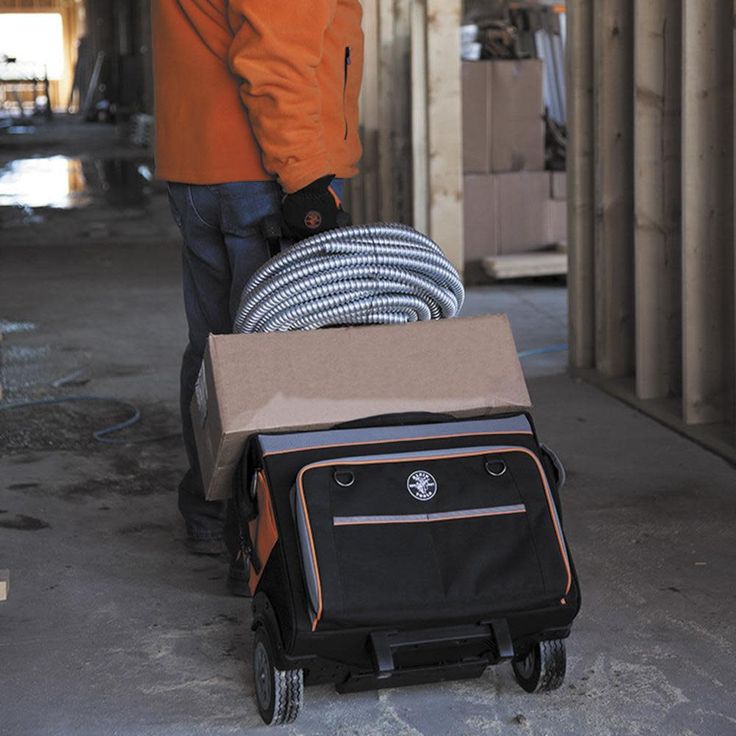
Simple wheeled equipment remains useful for short, controlled movements on firm and level surfaces. Hand trucks can move boxed supplies, tools and bagged materials, while platform dollies support wider loads. Pallet jacks work well for palletised goods inside completed floors, warehouses and paved staging areas.
These options are inexpensive and easy to deploy, but they aren’t suitable for broken ground, steep ramps or loads that workers can’t safely control. Small wheels may stop suddenly on debris or floor joints, shifting the load toward the operator. Routes should be cleared before movement begins, and the equipment’s rated capacity should be visible and understood.
For contractors stocking several types of material handling equipment, the practical goal is to give crews an appropriate option for routine movements instead of relying on improvised carrying or dragging.
Forklifts and rough-terrain forklifts
Forklifts are effective when materials arrive on pallets and remain accessible from below. Standard industrial forklifts suit paved yards and finished floors. Rough-terrain models use larger tyres, higher ground clearance and jobsite-oriented chassis designs for outdoor construction conditions.
They are commonly used for masonry units, bagged cement, mechanical equipment and bundled materials. However, fork length, spacing and load-centre distance must suit the load. Placing a long or uneven item on standard forks can move its centre of gravity forward and reduce the machine’s effective capacity.
Operators also need a clear travel route. A forklift carrying a raised load has reduced visibility and stability, particularly on slopes or uneven ground. Loads should travel as low as practical, with travel speed adjusted to surface conditions and pedestrian activity.
Telehandlers
A telehandler combines fork-based handling with forward reach and greater lift height. It is often a strong choice for placing pallets on upper floors, supplying scaffolding areas or reaching across temporary barriers.
Its advantage is also its main limitation. Capacity decreases as the boom extends and rises. A telehandler rated for a substantial load close to the machine may be able to carry far less at maximum reach. Operators and lift planners must use the correct load chart for the machine, attachment, boom angle and extension.
Attachments can make telehandlers more versatile. Fork carriages, buckets, lifting hooks and material clamps may all be available, but an attachment changes the machine’s handling characteristics. It should be approved for the model and included in the capacity calculation.
Wheel loaders and skid-steer loaders
Wheel loaders are suited to repeated movement of loose materials such as soil, sand, gravel and demolition debris. Their bucket capacity and travel speed make them productive for loading trucks, feeding batching operations and managing stockpiles.
Compact loaders and skid steers are useful where working space is limited. With the correct attachment, they can carry pallets, sweep roads, move debris or handle small quantities of aggregate. Their compact size helps in congested areas, though short wheelbases and rapid steering movements can make unstable loads harder to control.
Bucket volume shouldn’t be confused with lifting capacity. Dense material can overload a bucket before it appears full. The operator must account for material density, attachment weight and the machine’s rated operating capacity.
Cranes and hoists
Cranes are generally required when loads must move vertically, pass over obstacles or be positioned beyond the reach of ground-based handling equipment. Mobile cranes can place structural steel, precast panels, plant and formwork across large working areas. Tower cranes support repetitive lifting over multistorey projects.
The crane is only one part of the lifting arrangement. Slings, shackles, hooks, lifting beams and attachment points must be compatible with the load. The lift also needs suitable ground support, an exclusion zone, clear communication and a plan for controlling rotation or swinging.
Material hoists provide a more repetitive vertical route for tools and supplies. They can reduce crane demand on larger projects, but their platforms, gates and landing areas must be kept clear and used only within the equipment’s intended purpose.
Account for site conditions and changing access
Equipment that works during excavation may be unsuitable once the structure becomes enclosed. Material-handling plans should therefore change with the project.
Early in the programme, rough-terrain forklifts, loaders and mobile cranes may have open access. Later, temporary roads may disappear, ground-floor openings may be closed and internal corridors may become the only available route. At that stage, compact electric equipment, pallet jacks, gantries or smaller lifting devices may be more practical.
Ground conditions deserve particular attention. Soft fill, waterlogged soil and unprotected service trenches can compromise machine stability. Outriggers and tyres apply concentrated loads that may exceed the ground’s capacity even when the machine itself can travel across the area.
Weather also changes the task. Rain can reduce traction and conceal surface defects. Wind affects suspended and high-profile loads, including panels, sheets and empty formwork. Equipment planning should account for these changing conditions rather than treating the delivery route as fixed.
Storage areas need the same level of planning. The OSHA construction requirements for material storage state that materials stored in tiers must be secured against sliding, falling or collapse. Handling equipment should be able to place and retrieve materials without forcing operators to disturb unstable stacks.
Reduce manual handling at transfer points
Mechanised equipment can move a load across most of the site, yet workers often perform the hardest part at the beginning or end of the route. Examples include lifting bags from the ground onto a pallet, rotating equipment through a doorway or carrying components the final few metres to installation.
These transfer points should be identified during planning. A small change in delivery or storage can remove repeated manual lifts. Materials may be delivered on smaller pallets, stored at waist height or positioned closer to where they will be used. Lift tables, carts, trolleys and temporary rollers can also bridge the gap between large machines and final installation.
The aim isn’t simply to set a maximum weight for manual lifting. Lifting frequency, reach distance, twisting, grip quality and starting height all influence physical demand. The NIOSH ergonomic guidelines for manual material handling recommend redesigning tasks and using mechanical assistance where possible to reduce exposure to demanding lifts.
A practical review should follow the material from delivery to installation. Every point where it is picked up, set down, transferred or repositioned is an opportunity to reduce handling.
Compare productivity across the whole task
The largest machine isn’t always the fastest option. Productivity depends on the complete handling cycle, including setup, loading, travel, unloading and return.
A mobile crane may place a load quickly once rigged, but mobilisation and setup may make it inefficient for repeated short-distance moves. A telehandler may complete the same work with less preparation if it can reach the destination safely. Conversely, using a telehandler at the edge of its working range for an awkward load may be slower and less controlled than scheduling a crane.
Utilisation also matters. Buying specialist equipment may not make sense for a short phase, while frequent rental can become expensive on a long project. Contractors should compare ownership, rental and subcontracted lifting based on expected operating hours, maintenance support, operator availability and project duration.
Avoid selecting equipment solely by hourly rate. A cheaper machine that requires more trips, more labour or repeated repositioning may cost more over the full activity. The useful comparison is cost per completed movement, not cost per machine hour.
Check attachments, operators and maintenance support
A capable machine can still perform poorly when fitted with the wrong attachment. Fork extensions, clamps, buckets, hooks and lifting jibs must be designed for the equipment and suitable for the load. Site-made attachments or unapproved modifications can change load distribution and introduce failure points.
Operator competence should be considered before equipment arrives. Different machines require different skills, and familiarity with one type doesn’t automatically transfer to another. Operators need to understand controls, visibility limits, load charts and site-specific hazards.
Daily inspections and planned maintenance are equally important. Tyres, forks, hydraulic systems, warning devices, brakes and lifting accessories all affect safe performance. Equipment that develops a fault during a concrete pour or steel erection sequence can disrupt several trades, not just the handling crew.
Where possible, standardise frequently used equipment across the site. Familiar controls, shared attachments and common maintenance procedures can reduce delays. Specialist machines should still be brought in when the load or access conditions require them.
Build the handling plan before materials arrive
Material-handling decisions are easiest to make before deliveries begin. The project team should confirm unloading zones, travel routes, temporary storage, equipment access and final placement methods during look-ahead planning.
For unusual or high-consequence loads, a task-specific plan should define the load details, equipment configuration, lifting accessories, route, communication method and exclusion area. It should also account for what happens if the planned route is blocked or the ground condition changes.
Coordination with suppliers can remove many problems. Ask how materials will be packaged, where lifting points are located and whether delivery vehicles carry unloading equipment. Confirm dimensions rather than relying only on weight. A light but oversized component may create more handling difficulty than a compact, heavier load.
Choose for the actual jobsite movement
Good jobsite material handling starts with a clear understanding of the load, route and final position. Forklifts, telehandlers, loaders, cranes and manual aids each solve different movement problems, and no single machine is suitable for every stage of construction.
Choose equipment based on its rated performance in the required configuration, then check the ground, access, attachment and operator requirements. When the full movement is planned before materials arrive, handling becomes more predictable, with fewer transfers, less manual effort and fewer interruptions to the construction sequence.