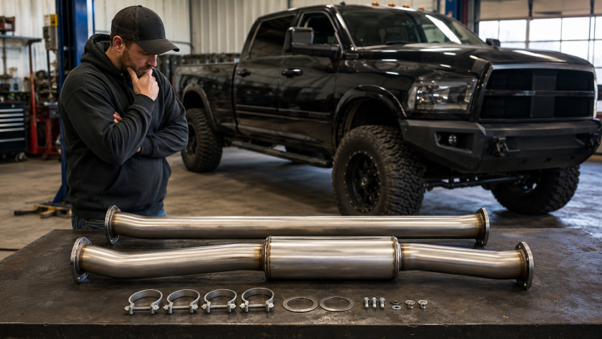
Buy the delete pipe with a muffler. It sounds almost as good as a straight pipe, it costs you next to nothing at the wheels, and it keeps the cab quiet on the highway. For a truck that actually gets driven, that’s the right call.
The straight pipe only makes sense when the truck is a toy. If you tow, commute, or take long trips, the drone will wear you out fast. Your answer depends on how you use the truck, your noise tolerance, and what your state allows.
The biggest mistake is thinking a muffler defeats the purpose of the delete. It doesn’t. A straight-through diesel muffler only costs 2 to 3 horsepower on a dyno, and it kills the low-frequency hum that rattles the cab at cruising speed.
This guide shows what changes when the DPF comes off, how the two setups compare on tone, drone, and power, and how to pick the one that fits the way you drive.
What Changes When the DPF Comes Off
A DPF delete pipe replaces the filter and the rest of the stock exhaust with a straight run of tubing. From there you get two choices. Keep a muffler in the system, or run nothing but pipe all the way out.
Either way, the sound changes completely. The DPF does about 80 percent of the silencing work on a stock truck. Inside the can is a ceramic honeycomb that soaks up sound as exhaust passes through. Take it out, and raw exhaust pulses run straight to the tailpipe. The turbo whistle gets loud too, especially on a 6.7 Powerstroke with its variable geometry turbo.
The delete is about more than noise. Exhaust gas temps drop roughly 100 to 180 degrees under load, which is easier on the turbo and the engine. With a proper tune, you also pick up power and a touch of fuel economy.
Know the Rules in Your State First
Removing the DPF is illegal on a truck that uses public roads. The Clean Air Act covers it, and delete parts are sold for off-road and race use only. That label is not a formality.
California, Colorado, and New York are the strictest. Deleted trucks fail their inspections, and California owners have been fined when inspectors found block-off plates. Most farm states are more relaxed. Texas, Wyoming, and much of the Midwest still pass deleted trucks, because the test, if there is one, is just a scan.
Warranty is the other side of this. One scan at the dealer and they’ll see the DPF is gone, which gives them a clean reason to deny powertrain claims. And if you ever trade the truck in, a dealership may ask you to put the factory parts back on.
Check your state’s rules before you order, and keep the factory exhaust in a box. Swapping back is work, but it’s a lot easier when the parts are still there.
The Sound and Drone Difference
Here’s where the two setups split. This is what you’ll actually hear from the driver’s seat.
The Muffler Keeps the Deep Rumble
A muffled delete pipe keeps the deep diesel rumble and dials back the sharp stuff. The turbo whistle stays noticeable but controlled. A straight pipe is raw. The whistle turns into a scream under throttle, and the note gets raspy at low rpm.
The Straight Pipe Drones at Cruise RPM
Drone is why most owners pull a straight pipe back off. It’s a low-frequency hum that peaks around 1,800 to 2,000 rpm, which is exactly where you cruise on the highway. A straight pipe makes it bad. On a long trip it vibrates the cab, drowns out conversation, and gives you a headache. A good muffler takes almost all of it out. Owners who add a high-flow muffler or resonator to a straight pipe say it kills about 90 percent of the drone while keeping most of the volume.
The Muffler Costs Almost No Power
This is the part people get wrong. A straight-through diesel muffler doesn’t restrict flow the way a factory muffler does. You can look straight through one end and see out the other. On a dyno, the gap between a straight pipe and a muffled delete pipe is about 2 to 3 horsepower. Nobody feels that. The drone relief is worth far more.
Pick the Right Setup for Your Truck
Start with how the truck actually gets used, then size the pipe. And keep the tune in mind, because a delete pipe needs a delete tune, which runs about $400 to $800. Budget for it before you commit.
Match It to How You Drive
If the truck tows, hauls the family, or does highway miles, buy the muffled delete pipe. It drops EGTs and adds power without making every trip a chore. If the truck is a dedicated off-road rig or a weekend toy, a straight pipe is fine. Loud is the point. Just know what you’re signing up for on the way to the trail.
Watch the Pipe Diameter
Diameter changes the sound too. A 4-inch pipe is sharper and raspier, with less drone. A 5-inch pipe sounds deeper and flows more, but it raises the risk of cab drone. For a daily driver or a lightly tuned truck, 4-inch is the safer bet. For a big build that tows heavy, 5-inch is the usual choice.
Final Thoughts
The short version is this. A delete pipe with a muffler gives you the performance and keeps the deep diesel tone, minus the drone that ruins long trips. A straight pipe only makes sense on a truck that rarely sees the road. And the muffler is not a power killer. Two or three horsepower is nothing next to hours of cabin hum.
Check your state’s laws before you order, keep the factory parts, and budget for the tune. Get those three things right and the delete pipe will do exactly what you wanted.
Ready to order? Start your search at xkvracing and compare the delete pipes for your truck.