What Is Concrete Damage Under Repeated Loading?
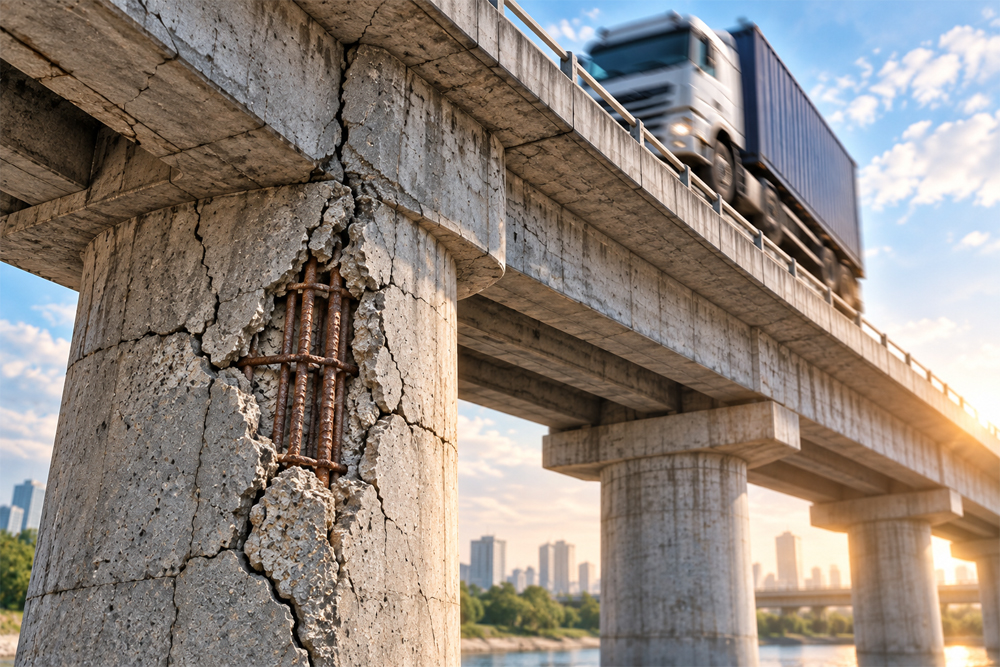
Concrete damage under repeated loading occurs when a concrete element is subjected to the same or varying loads over a large number of cycles. Unlike sudden failure caused by a single excessive load, fatigue damage develops progressively.
Repeated stress creates local changes within the concrete. Existing microscopic defects can become active, new microcracks can develop and individual cracks can gradually connect. As the number of loading cycles increases, the concrete may experience increased deformation, reduced stiffness and changes in its load-bearing behaviour.
The damage can occur in plain concrete as well as reinforced and prestressed concrete. In reinforced concrete structures, repeated loading can also affect reinforcement, bond between steel and concrete, and crack control.
Where Does Repeated Loading Occur?
Repeated loading is common in structures and facilities exposed to regular movement, vibration or cyclic forces.
Common examples include:
- Highway and airport pavements
- Bridge decks and bridge girders
- Railway sleepers and concrete track structures
- Industrial floors
- Parking structures
- Crane-supporting structures
- Wind turbine foundations
- Precast concrete components
- Offshore and marine structures
- Concrete structures supporting vibrating machinery
- Loading and unloading areas
- Runways and heavy-duty pavements
The number of load cycles can vary considerably depending on the application. A bridge may experience repeated vehicle loading every day, while an industrial floor may be subjected to recurring forklift or equipment movement throughout its service life.
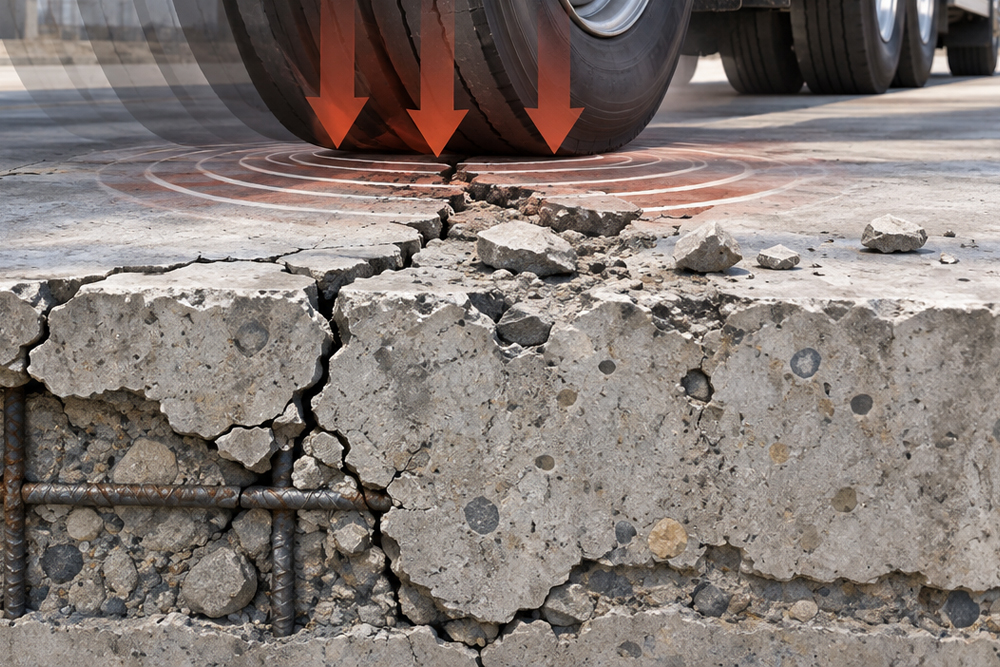
How Repeated Loading Causes Concrete Damage
1. Development of Microcracks
Concrete contains pores, interfaces between aggregates and cement paste, and other microscopic imperfections. When repeated stresses are applied, these locations can experience local stress concentrations.
Small microcracks can form around aggregate particles and within the cement paste. Initially, these cracks may not be visible during routine visual inspection.
With continued loading, however, the microcracks can increase in length and number.
2. Crack Propagation
Once microcracks develop, repeated loading can cause them to extend.
Individual cracks may remain stable for a period, but continued cycles can cause cracks to connect with neighbouring cracks. This creates a progressively damaged region within the concrete.
The process generally involves:
- Crack initiation
- Crack growth
- Crack interaction
- Crack coalescence
- Increased deformation
- Reduction in stiffness
3. Loss of Stiffness
One of the important effects of repeated loading is a gradual reduction in stiffness.
As cracking increases, the concrete member may deform more under the same applied load. This can affect serviceability even before the member approaches its ultimate failure condition.
Increasing deflection or vibration under a repeated load can therefore provide an indication that damage is progressing.
4. Reduction in Load-Carrying Capacity
Continued fatigue damage can eventually reduce the ability of the member to carry repeated loads.
The failure mechanism depends on the type of structure and loading. Damage may occur in the concrete, reinforcement, bond interface or other structural components.
Factors Affecting Concrete Damage Under Repeated Loading
Stress Level
The magnitude of the repeated stress has a major influence on fatigue behaviour.
A relatively high stress applied repeatedly can cause damage much faster than a lower stress. Therefore, fatigue assessment considers not only the maximum load but also the stress range during each cycle.
Number of Loading Cycles
The number of cycles is another major factor.
A concrete member may withstand a particular stress for a limited number of cycles without significant damage. The same stress, when repeated many more times, can result in progressive deterioration.
Loading Frequency
The frequency at which loads are applied can influence concrete response. Structures subjected to rapidly repeated loads can behave differently from structures exposed to slower cyclic loading.
Concrete Quality
Concrete quality has a direct influence on fatigue resistance.
Important factors include:
- Concrete strength
- Water-cement ratio
- Aggregate quality
- Aggregate grading
- Cement paste characteristics
- Air content
- Curing quality
- Existing defects
Poor-quality concrete containing honeycombing, excessive voids or inadequate curing may be more vulnerable to repeated loading.
Existing Cracks
Pre-existing cracks can influence fatigue performance. Cracks can act as stress concentration points and may extend under continued cyclic loading.
This is particularly important in older structures where cracking has already developed because of shrinkage, thermal effects, corrosion or previous loading.
Moisture Conditions
The moisture condition of concrete can affect its response to repeated loading. Structures exposed to water, wet-dry cycles or changing environmental conditions may therefore require additional consideration during fatigue assessment.
Concrete Fatigue in Reinforced Concrete
Repeated loading affects both concrete and reinforcement in reinforced concrete members.
When a reinforced concrete beam is repeatedly loaded, cracks can form in the tensile concrete. The reinforcement then carries a larger proportion of the tensile force across cracked sections.
Repeated stress cycles can affect:
- Reinforcing steel
- Concrete-steel bond
- Crack width
- Bar anchorage
- Development length
- Member stiffness
Bond deterioration can cause reinforcement slip and alter the way loads are transferred between concrete and steel.
In some cases, fatigue damage in reinforcement can become an important consideration, particularly where reinforcement is subjected to large stress ranges over a high number of cycles.
Types of Damage Caused by Repeated Loading
Fatigue Cracking
Repeated stress can cause existing cracks to grow and new cracks to form.
Concrete Crushing
Localised crushing can occur when repeated compressive stresses become sufficiently high.
Reinforcement Fatigue
Repeated tensile stresses can contribute to fatigue damage in reinforcing steel.
Bond Deterioration
Repeated movement between reinforcement and surrounding concrete can reduce bond performance.
Spalling
Progressive cracking and deterioration can eventually result in concrete pieces separating from the surface.
Excessive Deflection
Loss of stiffness can result in increasing deflection under recurring loads.
Surface Wear
Structures such as industrial floors and pavements can also experience surface abrasion from repeated vehicle and equipment movement.
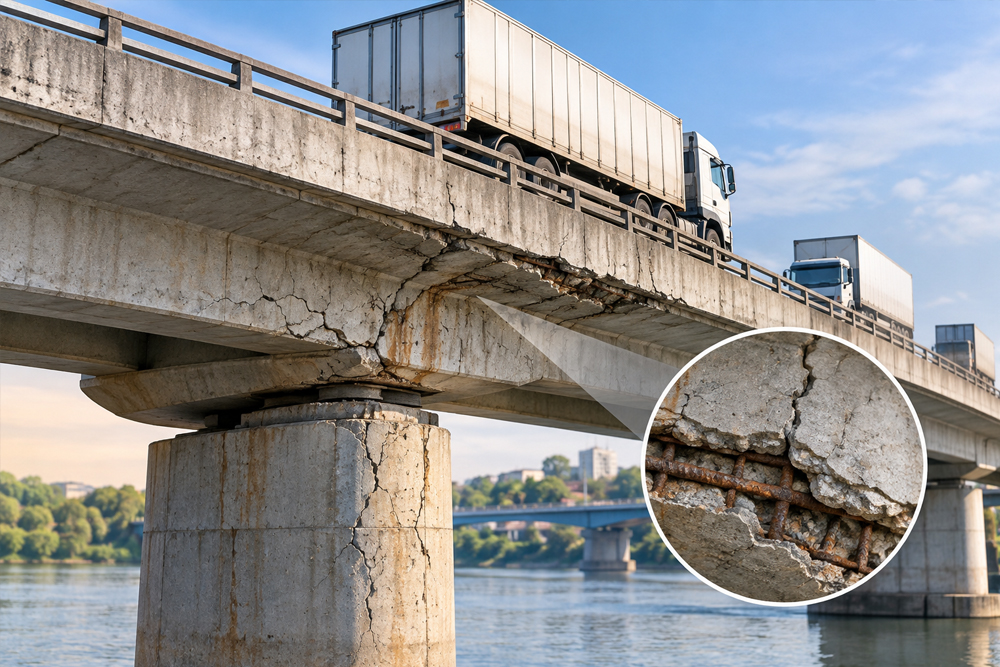
Concrete Damage in Bridges
Bridges are continuously exposed to changing traffic loads during their service life.
Every vehicle crossing creates a loading cycle, although the magnitude of the cycle varies depending on vehicle weight, axle configuration and position on the bridge.
Repeated traffic loading can contribute to:
- Flexural cracking
- Shear-related cracking
- Increased deflection
- Reinforcement fatigue
- Bond deterioration
- Joint deterioration
- Local concrete damage
Heavy traffic volumes can significantly increase the number of cycles experienced by bridge components.
Regular inspection is therefore important for identifying changes in crack width, crack patterns, deformation and surface deterioration.
Concrete Damage in Pavements
Concrete pavements are another major application where repeated loading is important.
Vehicle wheels apply repeated stresses to pavement slabs. Heavy commercial vehicles can produce considerably higher stresses than passenger vehicles.
Over time, repeated loading can contribute to:
- Transverse cracks
- Longitudinal cracks
- Slab cracking
- Joint deterioration
- Corner breaks
- Punchouts
- Surface deterioration
Pavement design therefore considers expected traffic loading and cumulative fatigue damage over the design life.
Concrete Damage in Industrial Floors
Industrial floors may experience thousands of repeated wheel movements every day.
Forklifts, pallet trucks, automated guided vehicles and other equipment can repeatedly load the same floor areas.
Problems may develop when repeated loading is combined with:
- Inadequate slab thickness
- Poor subgrade support
- Improper joint detailing
- Low concrete quality
- Inadequate reinforcement
- Poor curing
- Heavy point loads
Cracking around joints, localised surface deterioration and increased deflection can indicate that the floor is not adequately accommodating the repeated loading.
Concrete Damage in Railway Structures
Railway sleepers, track slabs and other concrete components experience repeated wheel loads at relatively high frequencies.
The load is transferred through the rail and supporting system to the concrete structure. Repeated loading can contribute to cracking, loss of stiffness and deterioration around fastening and support areas.
The combination of dynamic loading, vibration and environmental exposure makes fatigue assessment important for railway concrete components.
Warning Signs of Fatigue Damage
Fatigue damage may initially be difficult to identify. Regular inspection can help detect early changes.
Important warning signs include:
- Increasing crack width
- Increasing number of cracks
- Longer cracks
- Repeated cracking in the same location
- Increasing deflection
- Excessive vibration
- Local concrete crushing
- Surface spalling
- Exposed reinforcement
- Rust staining
- Joint deterioration
- Reinforcement slip
- Changes in structural response
A change in structural behaviour under a familiar load can be particularly useful as an early warning indicator.
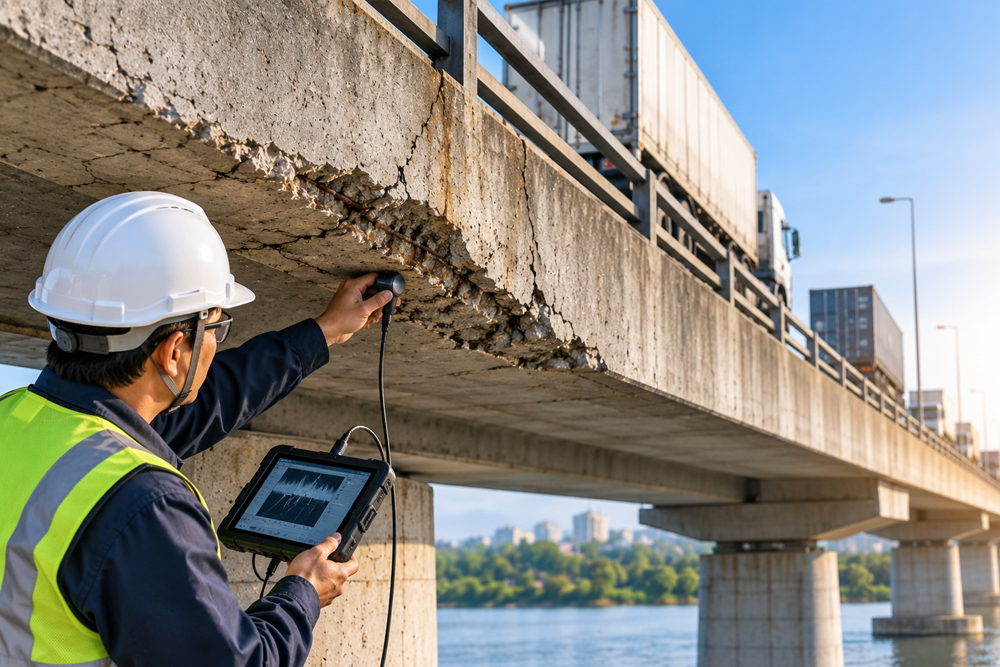
Inspection and Testing Methods
Visual Inspection
Visual inspection is generally the first step.
Engineers should record crack location, length, width, orientation and pattern. Areas with spalling, exposed reinforcement or local crushing should receive particular attention.
Crack Monitoring
Crack gauges or other monitoring systems can be used to determine whether cracks are stable or progressively widening.
Deflection Monitoring
Measurements taken under similar loading conditions can help identify changes in structural stiffness.
Ultrasonic Testing
Ultrasonic methods can help identify internal discontinuities and assess concrete uniformity.
Rebound Hammer Testing
Rebound hammer testing can provide an indication of surface hardness and help identify variations in concrete quality.
Ground-Penetrating Radar
Ground-penetrating radar can assist in locating reinforcement and identifying internal conditions within concrete members.
Acoustic Emission Monitoring
Acoustic emission techniques can detect energy released during crack development and can be useful for monitoring active damage.
Preventing Concrete Damage Under Repeated Loading
Proper Structural Design
Structures subjected to recurring loads should be designed considering expected stress ranges and the number of loading cycles during their service life.
Suitable Concrete Mix Design
Concrete should be designed to achieve the required strength, workability and durability.
Proper aggregate grading, controlled water-cement ratio and suitable admixture selection can help produce consistent concrete.
Adequate Reinforcement
Correct reinforcement quantity, spacing, anchorage and detailing help control cracking and distribute stresses.
Good Compaction
Poor compaction can create voids and weak areas that become vulnerable under repeated loading.
Concrete should be properly consolidated without causing segregation.
Proper Curing
Adequate curing helps concrete develop its required strength and reduces the risk of early-age cracking.
Poorly cured concrete can contain a weaker surface layer and may be more susceptible to deterioration.
Control of Construction Joints
Construction joints should be properly planned and executed because weak joints can become locations for repeated-load damage.
Regular Maintenance
Small cracks, joint defects and local deterioration should be assessed and repaired before they develop into larger structural problems.
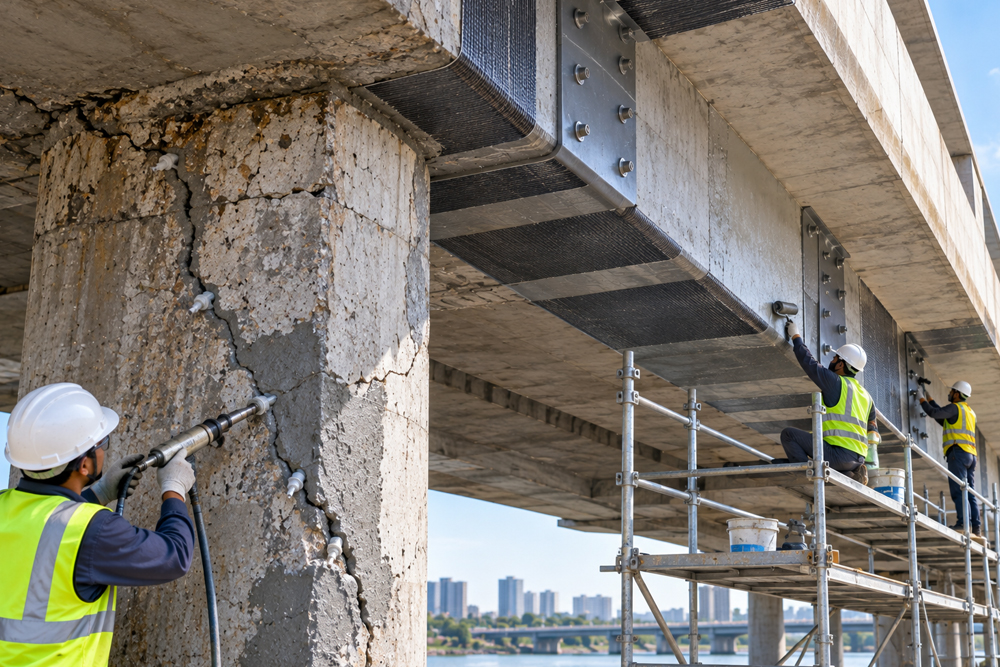
Repair and Strengthening of Fatigue-Damaged Concrete
The repair approach depends on the extent and cause of damage.
Possible measures include:
- Crack injection
- Surface repair
- Concrete patching
- Joint repair
- Reinforcement treatment
- Section enlargement
- Steel plate strengthening
- Fibre-reinforced polymer strengthening
- External post-tensioning
- Replacement of severely damaged concrete sections
Before selecting a repair method, the underlying cause of the repeated-load damage should be established.
Simply filling visible cracks may not be sufficient if excessive stress or movement continues to affect the structure.
How to Improve Fatigue Resistance
Several measures can improve the ability of concrete structures to withstand repeated loading:
- Reduce unnecessary stress concentrations
- Improve concrete quality
- Provide adequate reinforcement
- Control crack widths
- Improve joint detailing
- Ensure adequate curing
- Maintain proper drainage
- Protect reinforcement from corrosion
- Monitor high-load areas
- Repair defects at an early stage
- Consider actual traffic and operational loads during design
The combination of good design, construction quality and maintenance is more effective than relying on a single measure.
Conclusion
Concrete damage under repeated loading develops gradually through the accumulation of small changes within the material and structural system. Microcracking can progress into visible cracking, stiffness loss, increased deformation and, in severe cases, structural failure.
Bridges, pavements, railway structures, industrial floors and other infrastructure exposed to recurring loads require particular attention to fatigue behaviour. The number of loading cycles, stress range, concrete quality, reinforcement detailing, existing cracks and environmental conditions all influence the rate of deterioration.
Proper design and construction can reduce the risk of fatigue damage, while regular inspection and timely repair can help prevent local defects from developing into larger structural problems. For structures exposed to millions of loading cycles, fatigue should be considered as a long-term performance issue rather than only a failure condition.