
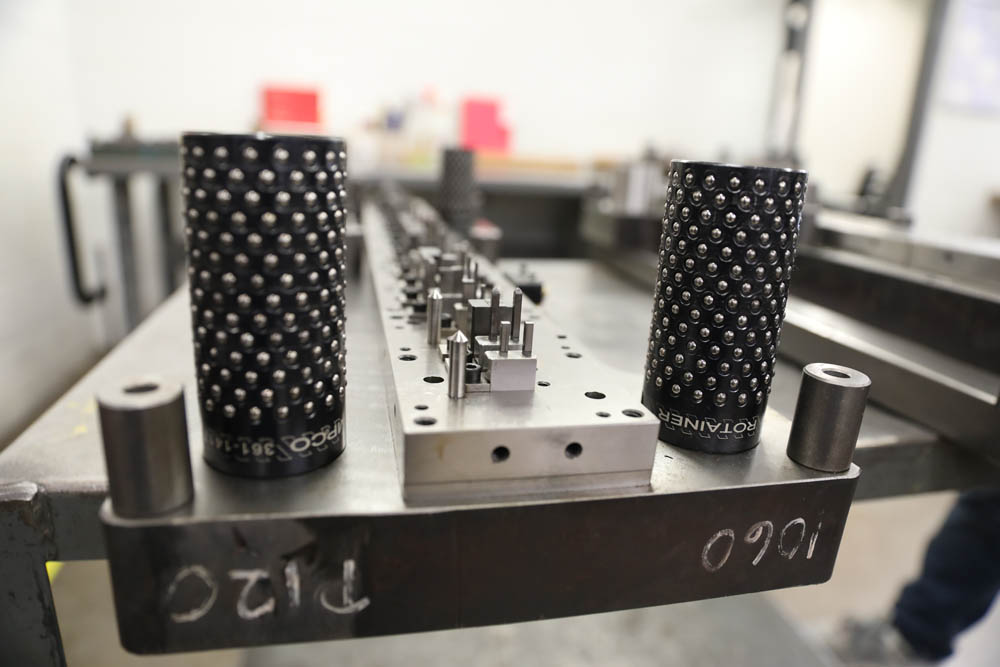
Every precision stamped part begins long before the press ever cycles. It starts at the design stage, where engineers turn a part print into tooling capable of producing that component reliably across millions of cycles. Tool and die design is the discipline that makes high-volume precision manufacturing possible, transforming concepts into production-ready tooling built to hold tolerance, resist wear, and run dependably under demanding conditions. At CTE Inc., expert tool and die design is the foundation of everything we build, and it determines the quality of every part that follows.
What Is Tool and Die Design?
Tool and die design is the engineering process of developing the specialized tools and dies used to cut, form, and shape metal into finished components. A die gives a part its shape during stamping, while the broader tooling system controls how material feeds, advances, and is processed through the press.
Strong tool and die design blends mechanical engineering, materials knowledge, and hands-on manufacturing experience. The designer must understand the geometry of the desired part, how the chosen material behaves under forming forces, how the tool will wear over time, and how the die will integrate with the press and downstream operations. Done well, the result is precision tooling that delivers repeatable performance from the first hit through long-term production.
Why Tool and Die Design Matters
The importance of tool and die design comes down to a straightforward truth: the tool defines the part. A well-engineered die produces consistent, in-spec components run after run, while a poorly designed one introduces variation, increases scrap, and drives up cost through frequent maintenance and downtime.
In high-volume environments, these effects compound quickly. When a die is engineered correctly from the start, manufacturers benefit from tighter tolerances, longer tool life, and fewer interruptions. This is why investing in expert tool and die design upfront pays dividends across the entire production program. It reduces risk, improves part quality, and ensures stamping dies perform predictably under real production conditions.
About CTE Inc.
CTE has been engineering precision tooling since its founding in 1977 at its current location in York, Pennsylvania. As part of the Composidie family of companies, CTE operates as a full-service contract manufacturing partner dedicated to meeting the exact tooling and production stamping requirements of its customers. The company specializes in precision, thin-metal progressive stampings tailored to the automotive, telecommunications, consumer electronics, and medical segments of the electrical and electronic connector industry.
CTE’s reputation is built on its leadership in high-speed progressive dies and its proficiency in the design, fabrication, and conditioning of dies and tooling. Working across materials that include steel, carbide, and high-speed steel, the team produces precision tooling that contributes directly to the success of each customer project. Backed by ISO-certified quality systems, CTE pairs the agility and personal attention of a focused manufacturer with the resources of a larger organization.
The CTE Tool and Die Design Process
Effective tooling does not happen by accident. CTE follows a disciplined process that begins with understanding the customer’s requirements and ends with a validated tool ready for production.
Project Review and Part Evaluation
The process starts with a review of the part print, CAD data, material, and target volumes. The team evaluates formability, critical features, and tolerance requirements, then flags risks early so the tooling approach is aligned before design work begins.
Tooling Strategy and Engineering Design
Next, CTE defines the tooling path based on part geometry, material behavior, and production needs. This includes selecting the forming and cutting sequence, estimating tonnage, and planning for wear points, maintenance access, and part handling. Using advanced CAD and simulation tools, engineers then design each die with material flow, clearances, wear surfaces, and serviceability in mind, ensuring the tool maintains tight tolerances over long runs.
In-House Building and Tryout
All tooling is built in-house by experienced toolmakers using high-precision machining, grinding, and EDM processes. This vertical integration allows for tighter quality control and faster adjustments. Each completed tool then undergoes structured tryout and testing to validate part quality and press performance before it is released for production with full documentation and ongoing support.
Key Principles Behind Durable Stamping Dies
Successful die engineering balances several competing priorities, each affecting how the tool performs over its service life. These priorities guide every decision CTE makes during the design phase:
- Hold critical tolerances across the full production run
- Maximize tool life through smart material and component selection
- Enable fast, straightforward maintenance and component replacement
- Reduce scrap through optimized strip layouts and controlled forming
- Support the production volume and part complexity required
Durability sits at the center of these principles. A die must withstand the repeated stress of high-volume stamping without losing dimensional control, which is why CTE specializes in carbide and high-speed steel for cutting and forming components. Maintainability matters just as much, so tools are designed for service access and efficient component replacement that minimizes downtime.
The Advantage of Integrated Tool and Die Design
The greatest benefits of tool and die design emerge when it is part of an integrated manufacturing operation. At CTE, design, in-house tool building, and stamping all happen under one roof, turning the process into a unified system rather than a series of disconnected handoffs.
This integration creates tighter feedback loops between engineering and the floor. In-house stamping capabilities provide constant performance data that enables real-time improvements to die designs. In-house machining, grinding, and EDM mean tooling components can be modified quickly without waiting on outside vendors. The outcome is reduced risk, better part quality, shorter lead times, and precision tooling that performs consistently from prototype through full production.
CTE also accelerates early-stage work through its Universal Die Matrix, a system of company-owned development dies that speeds the delivery of prototypes and pre-production quantities while managing cost. This approach reflects the company’s commitment to efficient, cost-effective solutions for every customer.
Industries That Depend on Precision Tooling
A wide range of industries rely on expert tool and die design to meet their production requirements. Automotive manufacturers depend on it for high-volume electrical contacts and terminals. The telecommunications and consumer electronics sectors require precise stamping dies for connectors and related components. Medical applications demand tooling engineered for tight tolerances and dependable, long-term performance.
In each of these sectors, the common need is reliable, production-ready precision tooling built for high-volume environments. CTE’s tool and die design provides the foundation that makes consistent, scalable manufacturing possible.
Engineering Tooling Built to Perform
Tool and die design is far more than a preliminary step in manufacturing. It is the engineering foundation that determines whether a production program thrives or struggles. By combining careful analysis, advanced modeling, durable construction, and integrated stamping expertise, CTE delivers tooling that holds tolerance, reduces risk, and runs reliably from first hit through long-term production. For engineers and manufacturers seeking consistent quality at scale, partnering with CTE for tool and die design is an investment in the success of the entire stamping process.






