

The modern creative department is currently grappling with a “throughput paradox.” On paper, the ability to generate a dozen visual concepts in under a minute should have solved the perennial bottleneck of asset production. In reality, many teams find that their delivery velocity—the rate at which final, approved assets actually leave the building—has remained stubbornly stagnant. The friction has simply shifted from the “making” phase to the “vetting” phase. When you can produce 10x more assets, you inadvertently create a 10x larger backlog for creative directors and stakeholders to review.
This bottleneck is the result of applying legacy review cycles to high-velocity tools. Traditional pipelines were built on the assumption that every draft was expensive and time-consuming, so reviews were treated as high-stakes, infrequent events. To unlock the actual value of generative models, creative operations must pivot away from batch-processed delivery toward a continuous, micro-iterative feedback loop.
The Velocity Trap: Why Raw Speed Fails Without Process Reform
Efficiency in creative operations is often mismeasured by “generation velocity”—the raw volume of images a team can produce in an hour. However, in a professional agency or internal brand environment, generation velocity is a vanity metric. If a designer uses an AI tool to create fifty variations of a hero image, but the Creative Director only has time to review three, the remaining forty-seven represent wasted compute and cognitive overhead.
We are seeing evidence that traditional pipelines break when hit with the sheer volume of assets that modern models provide. The friction isn’t just in the time spent looking at images; it’s in the decision fatigue that sets in when stakeholders are presented with too many “almost perfect” options. Without a process reform that prioritizes curation over creation, the speed of tools like Kimg AI can actually slow down a project by complicating the approval path.
Delivery velocity requires a filter. The goal should not be to show the client everything the AI can do, but to use the speed of the tool to arrive at the “right” direction faster, effectively discarding the noise before it ever reaches the review table.
Micro-Iterative Cycles: Deploying Kimg AI for Rapid Prototyping
The most effective way to collapse the feedback loop is to separate the conceptual phase from the high-fidelity production phase. This is where lightweight, low-latency models become indispensable. Using Nano Banana Pro for the early stages of a project allows creators to explore visual directions without the heavy resource commitment or the “wait time” associated with larger, more complex models.
In this context, the critical KPI changes from “Images per Hour” to “Time to First Approval.” By utilizing Nano Banana for rapid-fire pre-visualization, a creator can sit with a stakeholder and cycle through composition, lighting, and color theory in real-time. This “low-stakes” prototyping encourages pivots early in the process. If a specific art direction isn’t working, it is better to find out in thirty seconds using a fast model than to spend three hours refining a high-resolution output that ultimately gets rejected.
This approach also manages the cognitive load of the creator. When the latency between a prompt and a result is minimized, the creative process feels less like “ordering from a menu” and more like “sketching.” This fluidity is essential for maintaining a creative flow state, which is often interrupted by the multi-minute wait times of high-parameter video or image models.
The Middle-of-Funnel Bottleneck: Upscaling and Editorial Control
Once a conceptual direction is approved via a fast prototype, the pipeline shifts toward production-grade output. The transition from a Banana AI draft to a final asset is where many teams fail. They treat the AI output as a finished product rather than a sophisticated “plate” that requires further refinement.
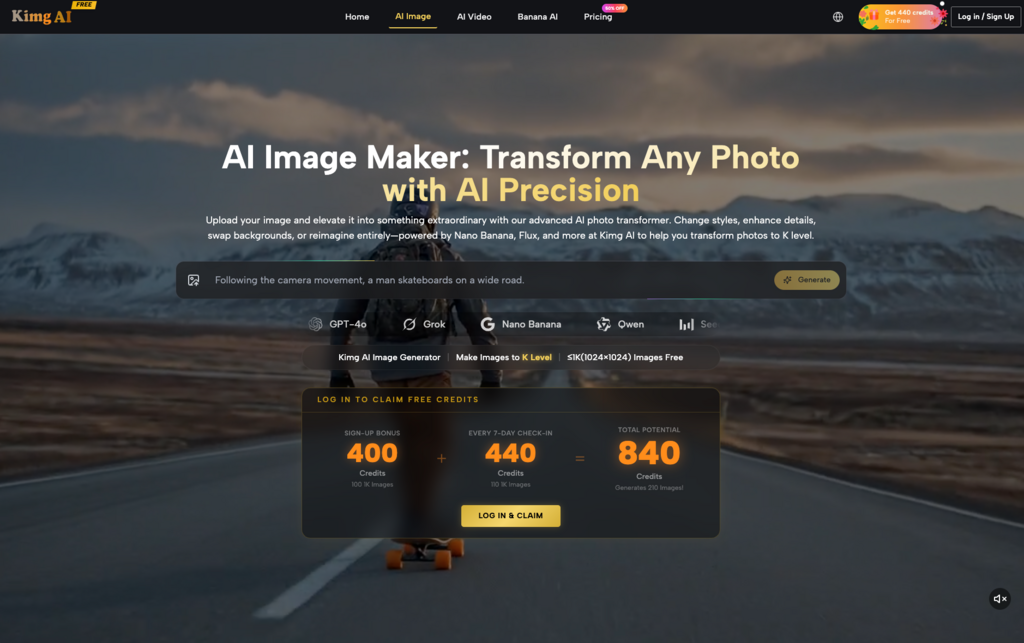
The “90% done” problem is a significant hurdle in generative media. A model might generate a stunning landscape but hallucinate an extra limb on a character or place a nonsensical object in the background. In a professional workflow, these errors cannot be ignored. Utilizing the broader Kimg AI framework allows for the necessary surgical corrections. Features like inpainting and outpainting are not just “extras”; they are the primary tools for achieving editorial control.
Creative leads must exercise practical judgment on when to stop iterating. For a social media ad that will be viewed on a mobile screen for two seconds, a standard high-definition output is sufficient. However, for print or large-scale digital displays, upscaling to K-level resolution is a hard requirement. Defining these “good enough” benchmarks for different delivery channels is the only way to prevent the pursuit of perfection from grinding the pipeline to a halt.
Stakeholder Psychology and the Evidence-First Review
The introduction of real-time generation into stakeholder meetings fundamentally changes the power dynamics of a project. Historically, a creative team would retreat for a week, return with three options, and the client would choose one. Now, the conversation can shift to: “What if the lighting was more cinematic?” or “Can we see this in a different setting?”
This ability to adjust prompts live in a session using Banana AI or Nano Banana AI can drastically reduce the total number of revision rounds. Instead of a “we’ll show you next week” cycle, the adjustment happens in the moment. This creates an evidence-first review environment where stakeholders can see the consequences of their requests immediately.
However, there is a distinct risk of “infinite choice.” When anything can be changed instantly, decision-makers may feel paralyzed by the lack of constraints. It is the responsibility of the creative operations lead to limit the variables during these live sessions. The goal is to facilitate a decision, not to demonstrate the infinite permutations of the model. We have observed that without clear boundaries, live-editing sessions can easily devolve into aimless experimentation that fails to produce a final, signed-off asset.
Uncertainty and the Technical Debt of Generative Workflows
While the potential for efficiency is clear, there are several areas where we must remain cautious. The first is the unresolved challenge of long-term brand consistency. Because generative sessions are often disconnected, ensuring that a character or environment looks identical across a six-month campaign remains difficult without significant manual intervention or custom model training.
Furthermore, we cannot yet conclude that AI-first pipelines will lead to a reduction in total headcount. While the “maker” role is changing, the need for “curator” and “operator” roles is increasing. A person who can effectively steer a model like Nano Banana and then fix the resulting artifacts in a high-fidelity editor is a specialist, not a generalist. The labor is shifting from manual execution to high-level orchestration, but the human-in-the-loop remains the most expensive and slowest part of the pipeline.
There is also the looming issue of technical debt. Unlike a layered Photoshop file where a single element can be tweaked months later, an AI-generated image is “baked.” If a client wants to change a small detail six months after a campaign has launched, it often requires re-generating the entire asset, which may lead to unintentional changes in other areas of the image. Until we have better ways to manage the “layers” of a generative output, the long-term maintenance of these assets will remain more complex than traditional digital files.
Ultimately, the successful re-engineering of the asset pipeline depends on realizing that speed is only half the equation. The other half is the structural reform of the review process, ensuring that the velocity of tools – from Pixel Art Upscaler to advanced asset-generation workflows – is matched by the decisiveness of the team. The friction of perfection isn’t just about how long it takes to render or upscale an image; it’s about how long we allow ourselves to stare at it before moving to the next.






