High-rise buildings have become a defining feature of modern urban landscapes. As cities grow vertically to accommodate increasing population density and limited land availability, the demand for faster, safer, and more efficient construction methods has increased significantly. One of the most transformative approaches addressing these demands is prefabrication in high-rise building construction.
What is Prefabrication in High-Rise Construction?
Prefabrication in high-rise construction involves producing standardized building components off-site in factories and assembling them on-site to form multi-storey structures. Unlike traditional construction, where most work is done sequentially on-site, prefabrication shifts a major portion of the work to controlled environments.
In high-rise projects, prefabrication typically includes:
- Precast concrete structural elements (columns, beams, slabs)
- Steel structural frames or modules
- Prefabricated façade panels (glass, aluminum, composite panels)
- Bathroom and kitchen pods
- Elevator shafts and staircases
- Mechanical, electrical, and plumbing (MEP) modules
These components are designed using advanced digital tools such as BIM (Building Information Modeling) to ensure precision and seamless integration during assembly.
Types of Prefabrication Used in High-Rise Buildings
1. Component Prefabrication
Individual elements like beams, slabs, and columns are manufactured off-site and assembled on-site. This is widely used in reinforced concrete high-rise structures.
2. Panelized Systems
Wall panels, floor panels, and façade systems are prefabricated and installed on-site. This method improves speed and ensures uniform quality.
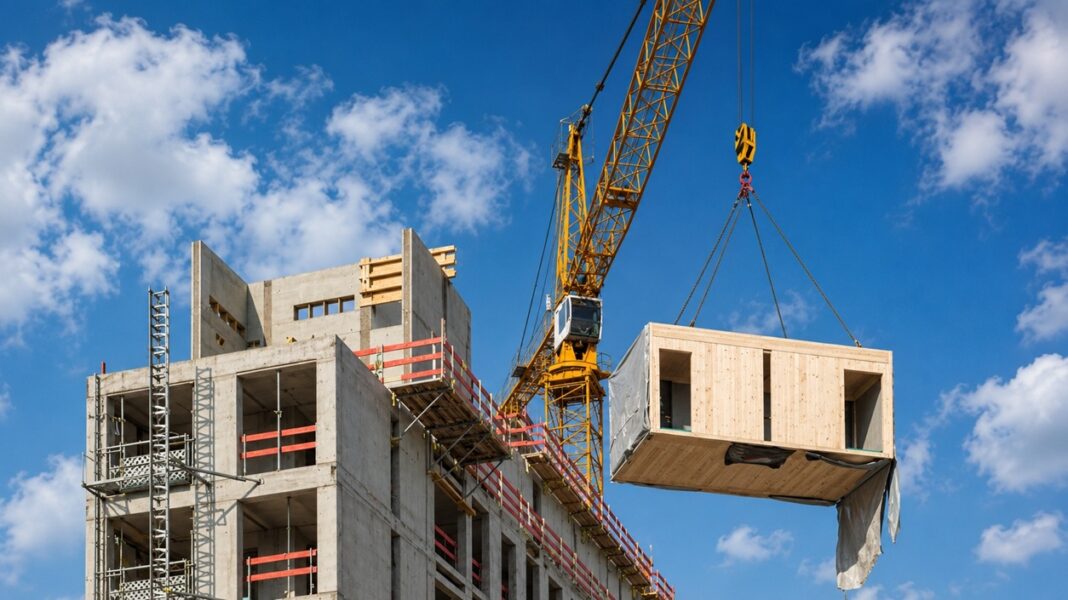
3. Volumetric Construction (Modular Construction)
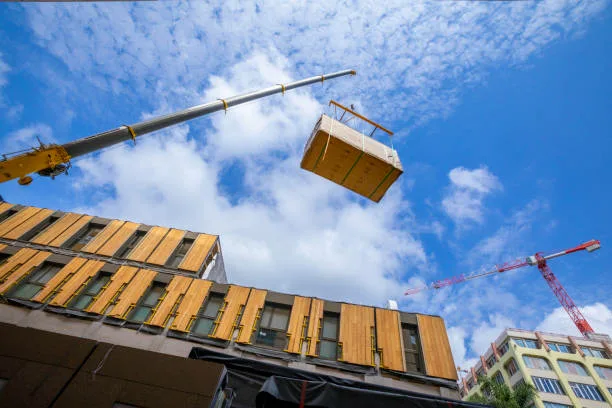
Entire room-sized units, such as hotel rooms or apartment modules, are manufactured in factories and stacked at the site. This is one of the fastest methods of high-rise construction.
4. Hybrid Systems
A combination of traditional structural frameworks with prefabricated modules. For example, a concrete core with steel modular rooms attached externally.
Construction Process in Prefabricated High-Rise Buildings
The construction process follows a structured sequence:
1. Design and Planning
The process begins with detailed architectural and structural design using BIM. Every component is modeled digitally, ensuring accuracy in dimensions, load calculations, and connections.
2. Manufacturing in Factory
Building components are produced in controlled factory environments. This ensures:
- High precision
- Better quality control
- Reduced material wastage
- Faster production cycles
3. Transportation to Site
Finished components are transported to the construction site using specialized logistics. Planning is critical due to the size and weight of modules.
4. On-Site Assembly
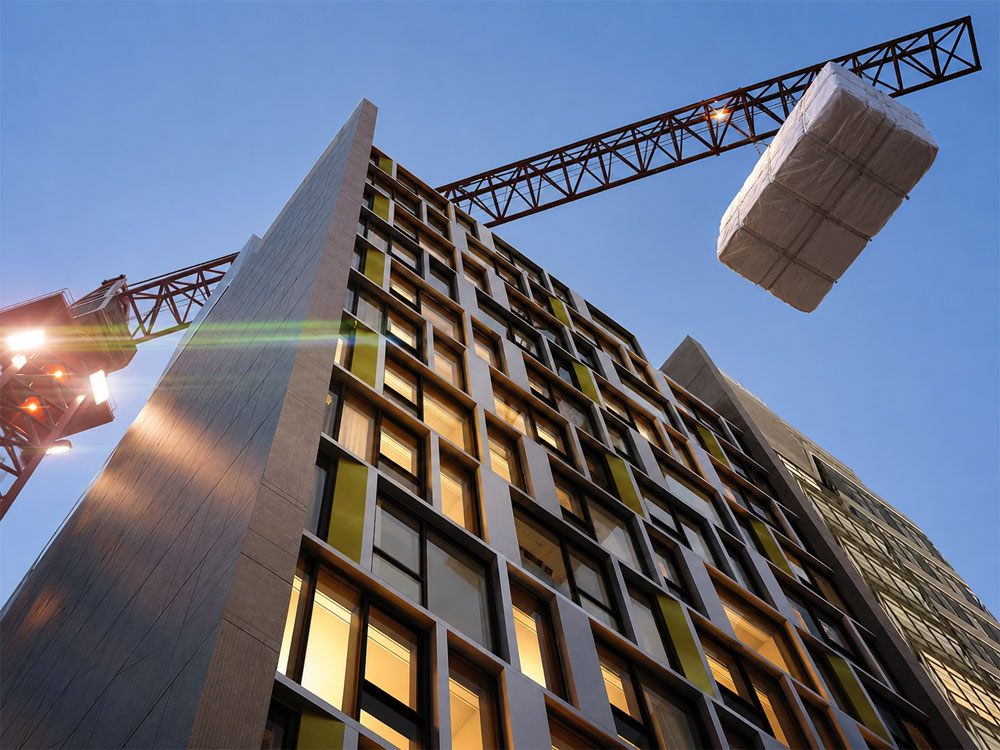
Cranes lift and assemble prefabricated units into position. Structural connections are secured using bolts, welds, or concrete joints depending on design requirements.
5. Finishing and Integration
Final finishing works such as sealing joints, connecting utilities, and installing interior elements are completed on-site.
Advantages of Prefabrication in High-Rise Construction
1. Faster Construction Time
Prefabrication allows simultaneous off-site manufacturing and on-site foundation work. This parallel workflow can reduce project timelines by 30–50%.
2. Improved Quality Control
Factory conditions ensure consistent quality, precision, and reduced human error compared to on-site construction.
3. Enhanced Safety
Since a large portion of work is done in factories, on-site labor exposure to risks such as working at heights is significantly reduced.
4. Cost Efficiency
Although initial design and setup costs may be higher, overall project costs are reduced due to:
- Lower labor costs
- Reduced material wastage
- Faster completion and earlier occupancy
5. Sustainability Benefits
Prefabrication supports green construction through:
- Reduced waste generation
- Efficient material usage
- Lower carbon emissions from reduced on-site activities
6. Reduced Site Disruption
Urban construction sites often face space constraints and noise restrictions. Prefabrication minimizes on-site activities, reducing disturbance in densely populated areas.
Applications in High-Rise Buildings
Prefabrication is widely used in various types of high-rise developments:
Residential Towers
Modular apartments and bathroom pods are increasingly used in urban housing projects.
Commercial Buildings
Office towers use prefabricated façade systems, steel frames, and service cores.
Hotels
Hotels are one of the best examples of modular construction, where identical rooms are prefabricated and stacked.
Mixed-Use Developments
Projects combining residential, retail, and office spaces use hybrid prefabrication systems for efficiency.
Structural Considerations in High-Rise Prefabrication
High-rise buildings must withstand significant vertical and lateral loads. Therefore, prefabricated systems must be designed with:
- Wind load resistance
- Earthquake resistance
- Fire safety compliance
- Load transfer efficiency between modules
- Structural stability during erection stages
The building core (usually concrete) often plays a crucial role in providing stiffness, while prefabricated modules are attached around it.
Role of Technology in Prefabrication
Modern prefabrication heavily depends on advanced technologies:
Building Information Modeling (BIM)
BIM enables precise 3D modeling, clash detection, and coordination between disciplines.
Automation
Factories use automated machines for cutting, welding, and assembling components with high precision.
Digital Twins
Digital replicas of buildings help monitor performance during construction and operation phases.
Future of Prefabrication in High-Rise Construction
The future of high-rise construction is strongly linked to prefabrication. Several trends are emerging:
- Increased use of full modular skyscrapers
- Expansion of off-site manufacturing hubs
- Integration of smart building systems within modules
- Greater adoption of sustainable and recyclable materials
- Faster urban housing development using plug-and-play building units
Conclusion
Prefabrication in high-rise building construction represents a major shift in how modern cities are built. By moving significant portions of construction work off-site, it improves speed, safety, quality, and sustainability. Although challenges such as transportation logistics, design constraints, and initial investment exist, technological advancements are rapidly overcoming these barriers.
As urban populations continue to grow, prefabrication will play an increasingly important role in delivering efficient, cost-effective, and environmentally responsible high-rise structures. It is not just an alternative method but a key driver of the future of construction.