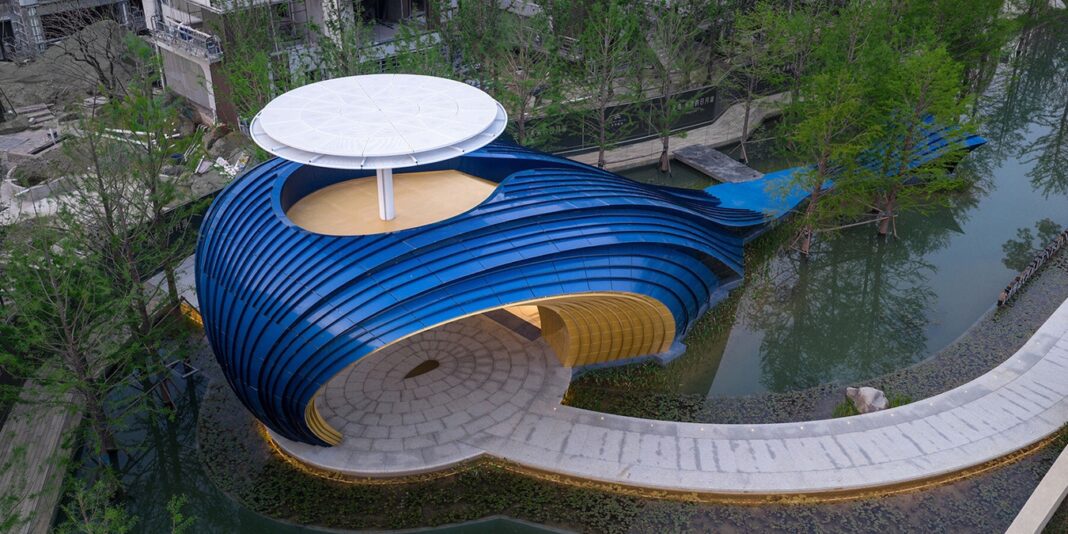
Whale Gate, designed by Wutopia Lab, is an entrance structure for the Golden Island residential development in Shangqiu, Henan Province, China. Rather than functioning as a typical residential gate, the project is conceived as a symbolic and experiential threshold
. It transforms the simple act of entering a gated community into a narrative journey shaped by mythological references, landscape design, and highly engineered architectural form. Positioned within a setting of water, vegetation, and dispersed residential buildings, the gateway appears like a sculptural object emerging from nature rather than a conventional built structure.
- The design is grounded in the idea of “islands” as both a spatial and conceptual framework.
- The residential masterplan is organized like an archipelago, with buildings separated by water and greenery, creating a fragmented yet cohesive environment.
- Within this landscape, architect Yu Ting of Wutopia Lab introduces a narrative layer inspired by mythical islands in Chinese cultural imagination.
- These imagined islands represent places beyond the ordinary world, suspended between reality and fiction.
- The gate becomes the first point of encounter with this fictionalized residential world, marking the transition into it.
A central metaphor of the project is the whale. Instead of representing it literally, the design abstracts the whale into a curved architectural volume. The whale acts as a symbolic mediator between worlds—much like in maritime mythology, where whales are often seen as creatures that inhabit boundaries between the known and unknown. This idea becomes the conceptual driver of the project, turning the entrance into a passage through a living metaphor.
Key conceptual ideas
The project is built around several interwoven design intentions:
- The residential community is imagined as an “island world” separated from urban chaos
- The gate acts as a ritual threshold between city and domestic landscape
- The whale represents a liminal creature, symbolizing transition and mystery
Form, spatial experience, and symbolism
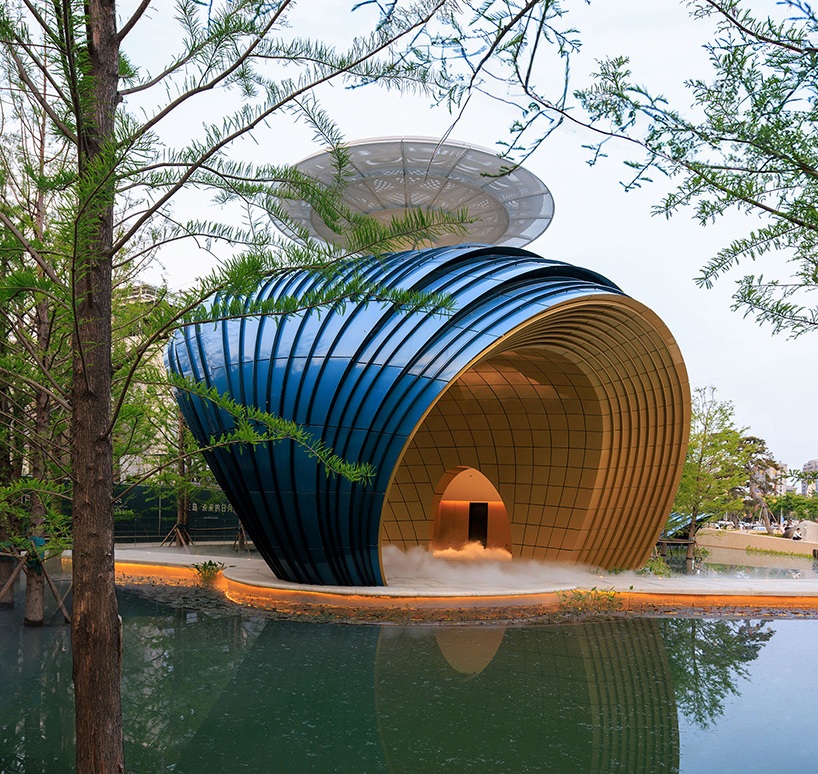
The architectural form is defined by a flowing blue curved surface that suggests the body of a whale emerging from the ground. This mass is not static; it appears to rise and bend, responding to the surrounding landscape. A sharp vertical golden slit cuts through the volume, forming the main passageway. This contrast between soft curvature and precise incision creates a strong sense of transition.
Above the entrance, perforated white aluminum panels extend outward, evoking the image of water spray or foam. These elements also function as a canopy, filtering light and adding atmospheric depth to the experience. The spatial sequence is carefully designed so that movement through the gate feels like entering another realm rather than simply passing through a boundary.
- A blue curved volume represents the abstract body of a whale
- A golden vertical opening forms the entry path
- White perforated panels suggest water spray and provide shading
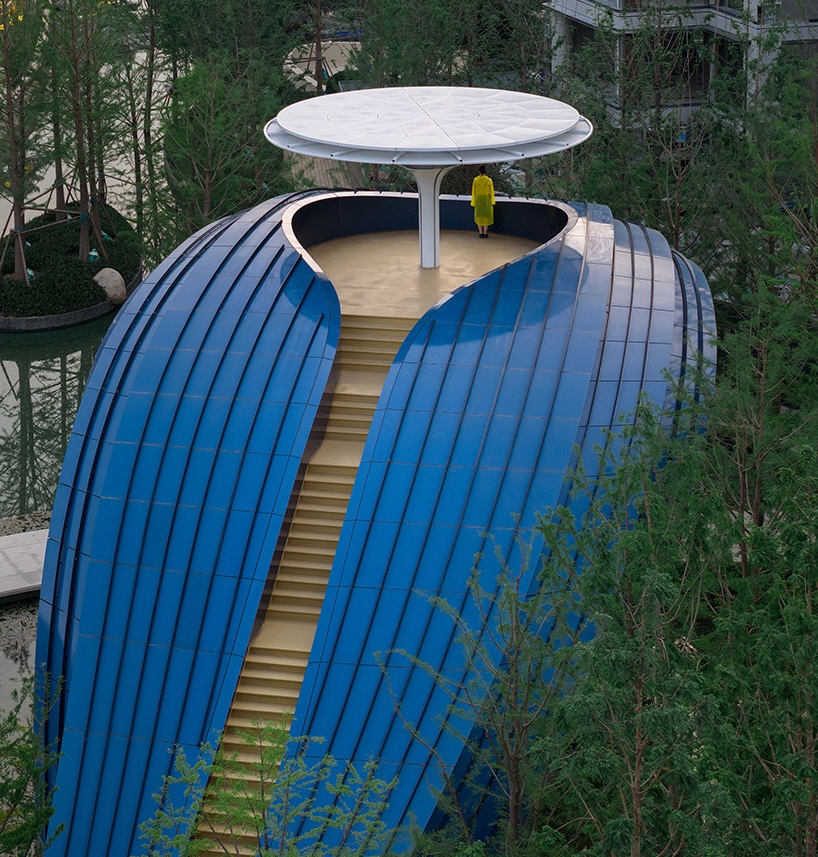
- A raised viewing platform sits above the gate for residents
- Golden stairs connect users to elevated panoramic views
Construction system and engineering complexity
Whale Gate is also a highly technical structure, requiring advanced fabrication and precise coordination. The form’s double curvature demanded a fully customized construction system.
The structure consists of a layered assembly:
- Steel framework as the primary structural support
- Connection rods and secondary aluminum substructure
- Waterproofing layer for environmental protection
- Double-curved aluminum honeycomb composite panels
- Fin-like edge profiles for surface articulation
In total, the structure weighs around 60 tons and includes approximately 4,000 individual components. Because of the complexity of the geometry, nearly every part had to be custom-made. Steel columns were divided into multiple segments, and thousands of spatial coordinate points were used to control alignment and ensure millimeter-level accuracy.
Material strategy and fabrication
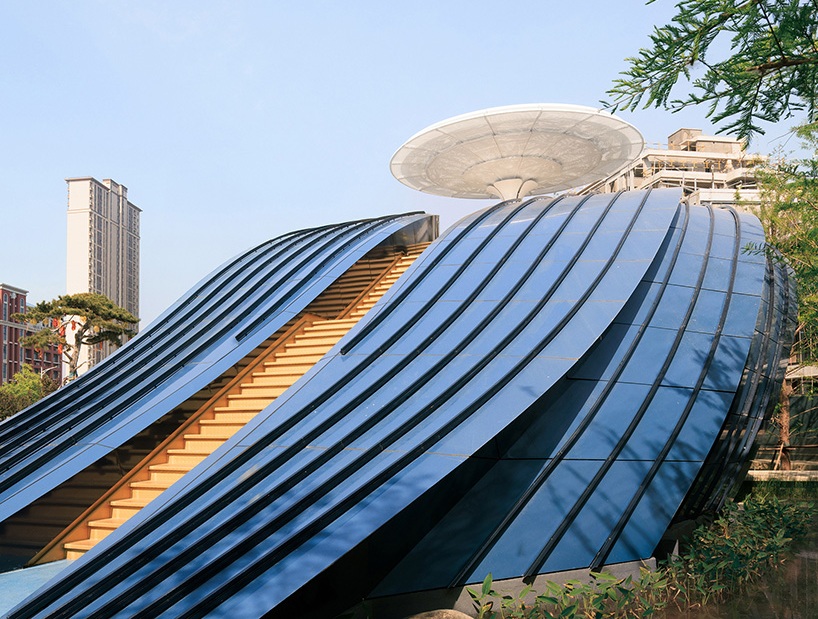
A key material choice in the project is aluminum honeycomb composite panels. These panels were selected because they offer a balance of light weight, structural strength, and adaptability to complex curvature. The system allows smooth, continuous surfaces without visible segmentation, which is essential for maintaining the whale-like effect.
- Around 1,170 uniquely shaped panels were fabricated
- Each panel contributes to a continuous double-curved skin
- The aluminum system enables lightweight yet stable construction
- Custom fabrication ensures no repetition in surface geometry
This approach transforms the building into a continuous “skin,” reinforcing its identity as an organic form rather than a collection of parts.
Beyond its physical construction, Whale Gate operates as an experiential and symbolic device. It reframes arrival as a moment of transformation rather than routine movement. The passage through the structure becomes a staged transition between two worlds: the external city and the enclosed residential landscape.
Ultimately, Whale Gate demonstrates how contemporary architecture can merge storytelling, digital fabrication, and landscape design into a unified experience. It is both infrastructure and narrative, both object and environment. By combining mythological symbolism with precise engineering, Wutopia Lab creates a gate that is not just entered—but experienced as a shift in perception, atmosphere, and meaning.
Reference- www.designboom.com/