

Modern commercial buildings are becoming increasingly dependent on automated controls to manage heating, ventilation, air conditioning, lighting, electrical equipment, access control and other building services. A Building Automation System (BAS) brings these functions together through sensors, controllers, communication networks and software, allowing building operators to monitor and control services from a central interface.
For construction projects, building automation is no longer limited to post-completion facility management. BAS requirements increasingly influence MEP design, equipment selection, cable routing, electrical provisions, plant-room layouts, commissioning and building handover. Early coordination between architects, MEP consultants, contractors and automation specialists can help avoid installation conflicts and improve system performance.
Why Building Automation Matters in Commercial Construction
Commercial buildings contain multiple services that operate simultaneously. Without coordinated controls, these services may operate independently, resulting in unnecessary energy consumption, limited visibility of equipment performance and greater dependence on manual intervention.
BAS allows building services to communicate through defined control sequences. For example, occupancy information can be used to adjust HVAC operation and lighting in selected areas. Similarly, operating schedules can be configured so that equipment runs according to building occupancy rather than remaining continuously operational.
For construction teams, BAS also creates additional requirements that need to be addressed during the design and installation stages. Control panels, sensors, communication cables, network infrastructure and equipment interfaces must be incorporated into the building design.
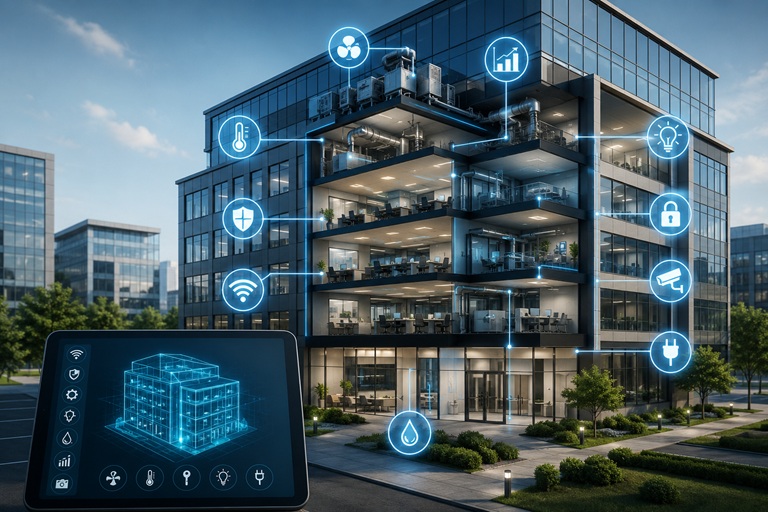
Major Components of a Building Automation System
1. Sensors
Sensors provide information to the BAS. Depending on the application, these may measure temperature, humidity, pressure, carbon dioxide concentration, occupancy, airflow, energy consumption or water flow.
Correct sensor location is important. A poorly positioned temperature sensor, for example, can provide readings that do not represent the actual conditions within a space.
2. Controllers
Controllers receive information from sensors and execute programmed control logic. They can regulate HVAC equipment, valves, dampers, pumps and other connected devices.
Controllers are generally distributed throughout the building according to the system architecture.
3. Actuators
Actuators convert control signals into physical movement or adjustment. They can operate valves, dampers and other mechanical components.
4. Communication Network
The communication network connects field devices, controllers and supervisory software. Common communication protocols used in building automation include BACnet, Modbus and KNX, depending on the application and equipment.
5. Supervisory Software
The supervisory interface provides building operators with information about equipment status, alarms, trends, schedules and energy consumption. Operators can use the interface to modify selected settings and identify equipment requiring attention.
Applications of Building Automation Systems
1. HVAC Control
BAS can monitor and control chillers, air handling units, pumps, fans, dampers and valves. Temperature and pressure sensors provide operating data, allowing HVAC equipment to respond to building requirements.
2. Lighting Automation
Lighting can be controlled through occupancy sensors, schedules and daylight sensors. This can help reduce unnecessary lighting operation in offices, meeting rooms, corridors and common areas.
3. Energy Management
Energy meters connected to BAS can provide information on electricity consumption across different building services. Operators can analyse consumption patterns and adjust operating schedules and equipment settings.
4. Indoor Air Quality Monitoring
Sensors can monitor parameters such as temperature, humidity and carbon dioxide levels. BAS can use this information to support ventilation control and maintain indoor environmental conditions.
5. Occupancy-Based Control
Occupancy sensors can provide information about space utilisation. HVAC and lighting operation can then be adjusted according to occupancy in selected zones.
6. Equipment Monitoring
BAS provides information about the operating condition of pumps, fans, chillers, AHUs and other equipment. Alarms can notify facility teams when equipment operates outside defined parameters.
7. Fire and Smoke Control Integration
BAS can interface with fire and smoke control equipment to provide monitoring and selected control functions. Life-safety functions remain governed by dedicated fire protection systems and applicable requirements.
8. Access and Security Integration
Commercial buildings can integrate access control and selected security information with the building automation interface, allowing operators to monitor building status from a common platform.
9. Water Management
BAS can monitor water tanks, pumps, flow meters and selected plumbing equipment. Automated controls can support pump scheduling and equipment monitoring.
10. Data Centre Monitoring
In data centres, BAS can monitor cooling equipment, temperature, humidity, power consumption and other facility parameters, subject to the requirements of the data-centre control architecture.
11. Lift and Escalator Monitoring
BAS can receive operational information from lifts and escalators, allowing facility teams to monitor equipment status and selected alarms.
12. Plant Room Monitoring
Chiller plants, pump rooms and other mechanical areas can be monitored through a central interface, providing operators with equipment status, alarms and operating data.
Advantages of Building Automation Systems
1. Improved Energy Management
BAS can help reduce unnecessary operation of HVAC, lighting and other equipment through scheduling, occupancy-based control and monitoring.
2. Centralised Monitoring
Building operators can monitor multiple services through a common interface rather than checking individual equipment separately.
3. Better Equipment Control
Automated control allows equipment to operate according to predefined parameters, schedules and operating conditions.
4. Reduced Manual Intervention
Routine operations such as equipment scheduling, temperature adjustment and lighting control can be automated, reducing the need for continuous manual intervention.
5. Faster Fault Identification
Alarms and equipment-status information can help facility teams identify abnormal operating conditions and respond more quickly.
6. Improved Occupant Comfort
Automated temperature, ventilation and lighting control can help maintain more consistent indoor conditions across occupied areas.
7. Preventive and Predictive Maintenance
Operating data collected by BAS can help maintenance teams identify changes in equipment performance and plan maintenance activities.
8. Better Facility Management
Historical trends, equipment status and energy data can support facility managers in analysing building performance and making operational decisions.
9. Scalability
A BAS can be expanded as building requirements change. Additional sensors, meters, controllers and equipment can be incorporated depending on the system architecture.
10. Support for Sustainable Buildings
By providing greater control over energy-consuming equipment and building services, BAS can support energy-efficiency objectives and building performance targets.
11. Reduced Operating Costs
Better scheduling, monitoring and equipment control can reduce avoidable energy consumption and help identify maintenance issues before they result in extended equipment downtime.
12. Data-Based Building Management
BAS converts information from sensors, meters and equipment into operational data. Facility managers can use this information to evaluate building performance and optimise operating strategies./
BAS and HVAC Integration
HVAC is often one of the largest areas of BAS application in commercial buildings.
A BAS can monitor and control:
- Chiller operation
- Cooling tower operation
- Air handling units
- Variable air volume systems
- Pumps
- Fans
- Valves
- Dampers
- Temperature setpoints
- Pressure levels
- Operating schedules
For example, an air handling unit can be programmed to respond to temperature and occupancy conditions. Pressure sensors can also provide feedback for fan control.
BAS can therefore help operators coordinate HVAC operation with actual building requirements instead of relying entirely on manual control.
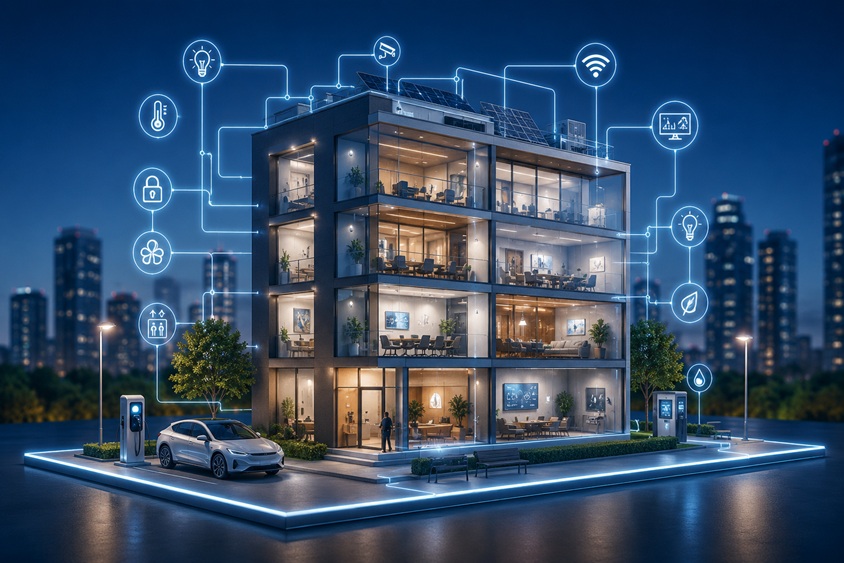
Building Automation and Lighting
Lighting control is another important application.
Occupancy sensors can identify whether spaces are occupied, while daylight sensors can measure available natural light. The BAS can use this information to control lighting in selected areas.
Commercial buildings can incorporate:
- Occupancy-based lighting
- Time-based schedules
- Daylight-responsive control
- Centralised lighting monitoring
- Automated switching
- Dimming controls
Lighting controls should be coordinated with electrical design during construction. Control panels, communication wiring, sensors and switching equipment must be incorporated into the electrical layout.
Energy Management Through BAS
Building automation can provide building operators with data about energy consumption and equipment operation.
Energy meters can be connected to the automation network to monitor consumption across different areas or equipment categories. This information can help facility managers identify unusual consumption patterns.
BAS can also support:
- Equipment scheduling
- Setpoint management
- Load monitoring
- Peak demand monitoring
- HVAC optimisation
- Lighting control
- Energy-use analysis
However, automation alone does not guarantee energy savings. The results depend on equipment efficiency, control logic, commissioning, maintenance and actual building operation.
BAS During the Construction Stage
One of the important changes in modern commercial construction is the need to consider BAS during the design and construction stages rather than treating it as a final-stage installation.
Design Coordination
BAS requirements should be incorporated into MEP coordination drawings. The locations of sensors, controllers, panels and communication pathways need to be identified.
Equipment Selection
HVAC and other equipment should have suitable control interfaces. The automation contractor and equipment suppliers need to establish communication and control requirements before installation.
Cable Routing
BAS communication and control cables require appropriate routes and containment. These routes should be coordinated with electrical, fire protection, HVAC and plumbing services.
Control Panel Locations
Automation panels require accessible locations with suitable environmental conditions and adequate space for installation and maintenance.
Sensor Installation
Sensors should be installed according to the manufacturer’s requirements and the control strategy. Locations must be coordinated with architectural finishes, HVAC layouts and other services.
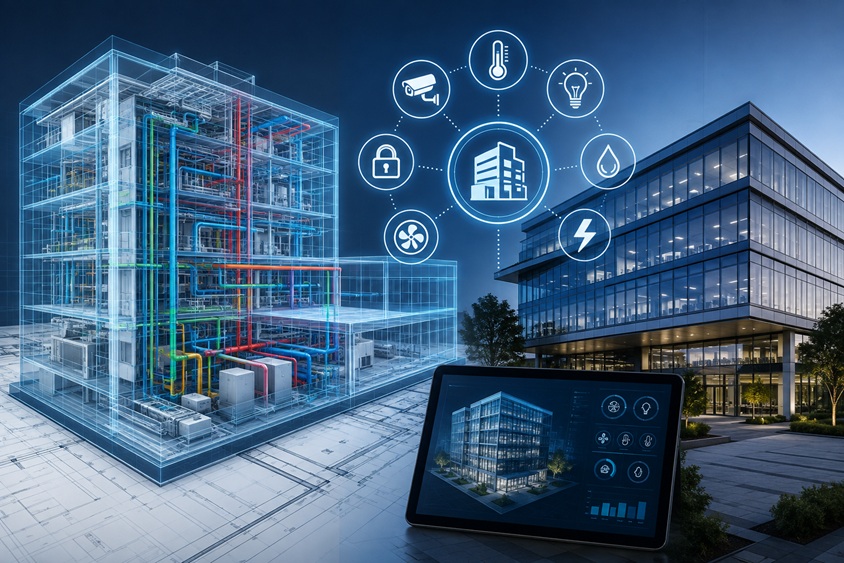
BIM and Building Automation
Building Information Modelling can support BAS coordination by providing a digital representation of building services.
BIM models can help teams coordinate:
- HVAC equipment
- BAS panels
- Sensors
- Cable pathways
- MEP services
- Plant rooms
- Equipment access zones
BIM can also help identify clashes before installation begins.
A growing area of interest is BIM-to-BAS integration, where information generated during design and construction can support building operation after handover.
Future of Building Automation in Commercial Construction
The development of IoT devices, cloud platforms, artificial intelligence and digital twins is expanding the role of building automation.
Future systems are expected to place greater emphasis on data analysis, predictive maintenance, occupancy-based control and integration between building services.
AI-based analytics can analyse equipment operating data and identify unusual patterns. Digital twins can provide a digital representation of building assets and their operating conditions.
At the same time, cybersecurity is becoming increasingly important because building automation networks are connected to IT infrastructure and, in some cases, external networks.
Conclusion
Building Automation Systems are becoming an important part of modern commercial building design and construction. Their role extends beyond controlling HVAC and lighting to include energy monitoring, equipment management, environmental monitoring and integration of building services.
For construction projects, successful BAS implementation depends on early design coordination, suitable equipment interfaces, proper cable routing, sensor placement, clear control sequences and comprehensive commissioning.
As commercial buildings become more connected and data-driven, BAS will increasingly form part of the building’s operational infrastructure. Integrating automation requirements into the construction process from the design stage can help create buildings that are easier to monitor, operate and maintain.






