
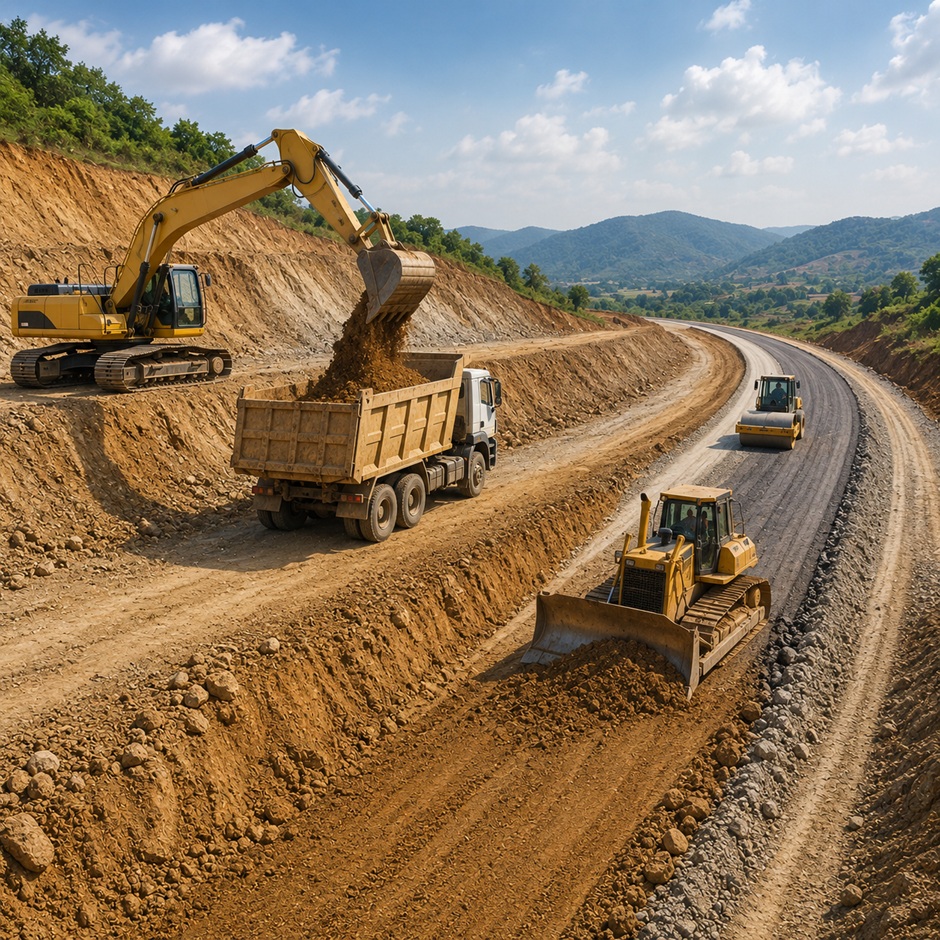
Cut-and-fill construction is a fundamental earthwork method used in highway projects to create a suitable formation level for road pavement. The method involves excavating soil or rock from elevated areas, known as cut sections, and using suitable excavated material to raise low-lying areas, known as fill sections. This approach helps establish the required horizontal and vertical alignment of a highway while reducing the need to transport large quantities of earth from distant locations.
Highway routes frequently pass through terrain with varying ground elevations. Natural ground levels rarely match the designed road profile, making earthwork necessary before pavement construction can begin. Cut-and-fill operations modify the existing terrain to achieve the required formation level, gradients, drainage conditions and geometric requirements.
The method is used for expressways, national highways, state highways, rural roads, access roads and other infrastructure projects. Its effectiveness depends on proper surveying, earthwork calculations, soil assessment, excavation, transportation, placement and compaction.
The basic process can be represented as:
Existing terrain → Survey and design → Excavation in cut areas → Transportation of suitable material → Placement in fill areas → Layer-wise compaction → Formation preparation → Pavement construction
The objective is to create a stable and properly graded road formation that follows the designed alignment.
Advantages of Cut-and-Fill Methods
Cut-and-fill construction offers several benefits for highway projects.
Efficient terrain modification: It allows the natural ground to be adjusted to the required highway profile.
Reuse of excavated material: Suitable material can be reused in embankments.
Reduced borrow requirements: Balanced earthwork can reduce the need for external fill material.
Improved construction planning: Mass haul analysis helps organise material movement.
Adaptability: The method can be applied across flat, rolling and hilly terrain.
Preparation for pavement construction: Properly constructed earthwork provides the foundation for subsequent pavement layers.
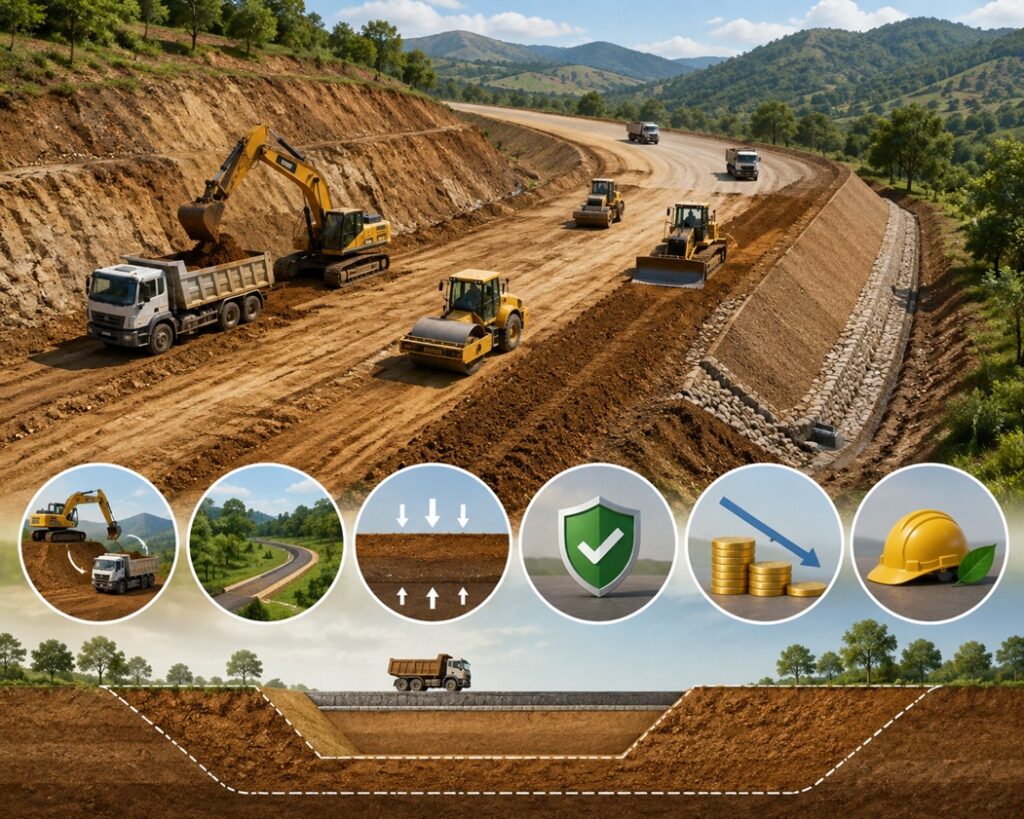
Objectives of Cut-and-Fill Work
The main objectives include:
- Achieving the designed highway alignment
- Establishing the required formation level
- Maintaining specified longitudinal gradients
- Creating suitable road cross-sections
- Balancing excavation and embankment quantities
- Reducing unnecessary transportation of earth
- Preparing a stable subgrade
- Providing adequate drainage
- Minimising changes to surrounding terrain where practical
Properly planned earthwork can have a significant influence on project cost and construction time because excavation, hauling and embankment formation account for substantial highway construction activities.
Site Survey and Investigation
Before cut-and-fill work begins, the existing terrain must be surveyed.
Topographic surveys establish ground elevations along the proposed highway alignment. Survey data is then used to develop the existing ground profile and cross-sections.
Geotechnical investigation is also required to determine soil and rock characteristics. Important information includes:
- Soil classification
- Moisture content
- Bearing characteristics
- Density
- Plasticity
- Shear strength
- Rock condition
- Groundwater conditions
- Existing drainage
The investigation helps determine whether excavated material can be reused in embankments.
Not all excavated soil is suitable for fill. Organic soils, highly compressible materials, contaminated material and other unsuitable soils may require removal and disposal or treatment.
Development of the Highway Profile
The proposed road profile is established based on highway design requirements.
Engineers consider:
- Horizontal alignment
- Vertical alignment
- Design speed
- Road gradient
- Sight distance
- Drainage
- Pavement thickness
- Existing terrain
- Flood levels
- Intersections
- Structures
The vertical profile determines where excavation and embankment will be required.
Where the proposed formation is below the existing ground, the section becomes a cut section. Where the formation is above the existing ground, it becomes a fill section.
Cut Sections in Highway Construction
Cut sections are commonly required when highways pass through hills, elevated terrain or natural slopes.
Excavation may involve soil, weathered rock or hard rock depending on site conditions.
The excavation method is selected according to material characteristics.
Soil Excavation
Soil can generally be excavated using equipment such as:
- Hydraulic excavators
- Bulldozers
- Motor graders
- Scrapers
- Wheel loaders
The excavated material may be transported directly to nearby fill areas if it meets project specifications.
Rock Excavation
Rock excavation requires different techniques depending on rock strength and site conditions.
Mechanical excavation may be possible for weathered or fractured rock. Hard rock may require controlled drilling and blasting, subject to project requirements and applicable safety regulations.
Excavated rock can sometimes be processed and reused as embankment material, sub-base material or aggregate where it meets specified requirements.
Fill Sections and Embankment Construction
Fill sections are formed by placing suitable material over low-lying ground to achieve the required road formation level.
Before filling begins, vegetation, organic material and unsuitable surface soil are removed where specified.
The foundation is then prepared and compacted.
Fill material is placed in controlled layers. Each layer is spread to the required thickness and compacted using suitable equipment.
Typical equipment includes:
- Vibratory rollers
- Smooth-wheel rollers
- Pneumatic rollers
- Sheep-foot rollers
- Motor graders
- Bulldozers
The selection depends on soil type and project specifications.
Layer-Wise Placement
Earth should not generally be placed as one thick uncontrolled layer.
Instead, fill material is spread in successive layers of specified thickness. Moisture content is adjusted where necessary before compaction.
The material is then compacted until the required density is achieved.
Layer-wise construction helps produce a more uniform embankment and reduces the possibility of differential settlement.
Compaction of Fill Material
Compaction is one of the most important stages of cut-and-fill construction.
The purpose of compaction is to reduce air voids and increase the density and stability of the soil.
Compaction requirements depend on the project specifications and location within the embankment.
Field density tests are performed to verify whether the required degree of compaction has been achieved.
If the material is too dry, water may be added. If it contains excessive moisture, aeration or other approved methods may be used to bring it closer to the required moisture range.
Balancing Cut and Fill Quantities
One of the important objectives in highway earthwork planning is to achieve an efficient balance between cut and fill.
If suitable material excavated from cut sections can be reused in nearby fill sections, the project may reduce:
- Borrow material requirements
- Disposal quantities
- Haul distance
- Truck movement
- Material procurement costs
This process is often referred to as mass haul planning.
A mass haul diagram can be used to understand the movement of earth along the highway alignment. It helps engineers determine where material should be excavated, transported, placed or disposed of.
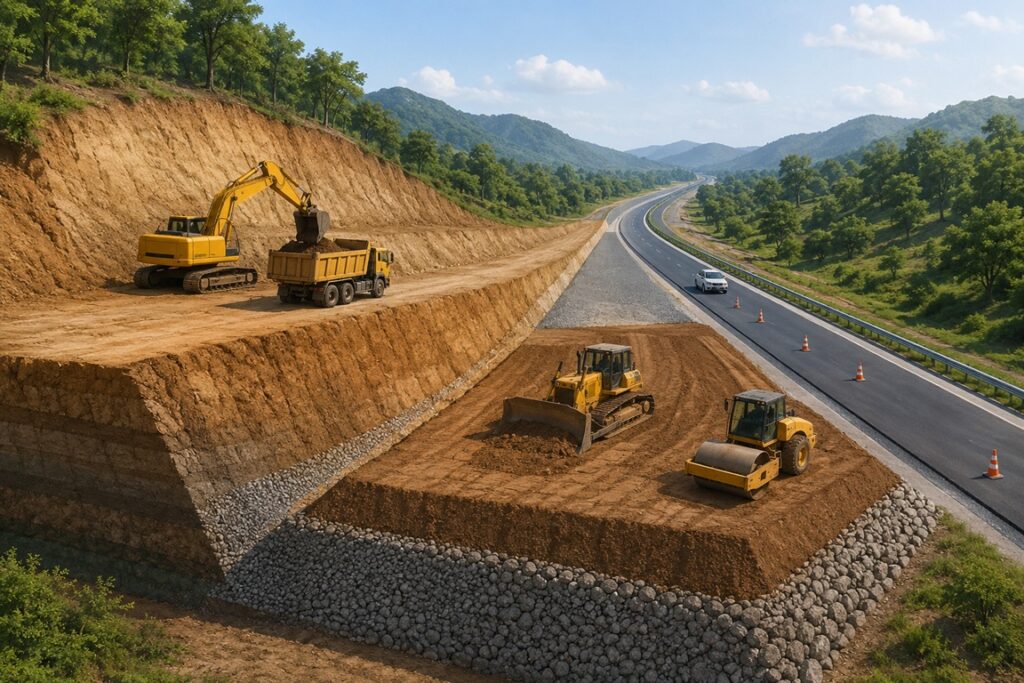
Borrow Areas
When the quantity of suitable fill obtained from excavation is insufficient, additional material may need to be sourced from approved borrow areas.
Borrow material is tested before use to determine whether it meets project requirements.
The use of borrow material increases transportation requirements, so earthwork planning should attempt to maximise the beneficial reuse of suitable excavated material.
Disposal of Surplus Material
In some projects, excavation quantities exceed the amount that can be reused.
Surplus material must be transported to designated disposal areas or used for approved landscaping, land formation or other project requirements.
Disposal planning should consider haul distance, environmental requirements, traffic movement and site availability.
Uncontrolled disposal can create drainage problems, erosion and environmental impacts.
Cut-and-Fill Slopes
The side slopes of cut and fill sections must be designed according to soil or rock conditions.
A stable slope depends on factors such as:
- Soil type
- Shear strength
- Slope height
- Groundwater
- Rainfall
- Surface drainage
- Seismic conditions
- Existing geological features
Steeper slopes may require additional stabilisation measures.
Possible measures include:
- Retaining walls
- Reinforced soil
- Geosynthetics
- Gabions
- Shotcrete
- Rock bolting
- Drainage arrangements
- Erosion control measures
The appropriate method should be determined through geotechnical assessment.
Drainage in Cut-and-Fill Sections
Drainage is an important consideration during earthwork.
Water accumulation within or near embankments can reduce soil strength and contribute to erosion or instability.
Cut sections may require:
- Side drains
- Catchwater drains
- Chutes
- Cross-drainage structures
- Subsurface drainage
Fill sections require suitable surface drainage to prevent erosion and uncontrolled water flow over embankment slopes.
Drainage provisions should be completed progressively rather than waiting until all earthwork is finished.
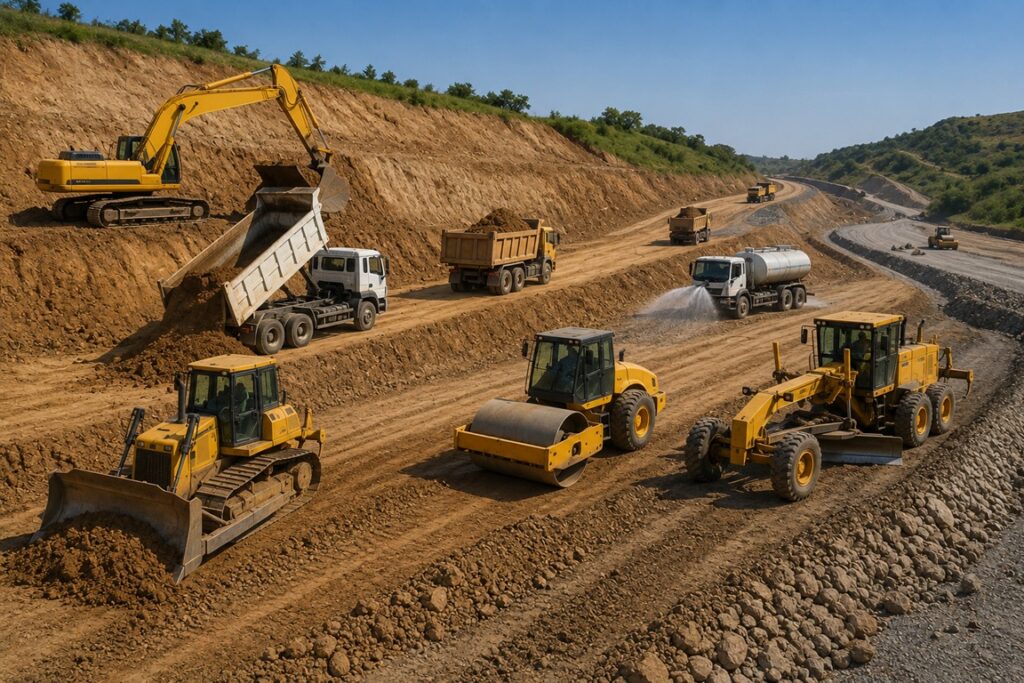
Construction Equipments
Cut-and-fill operations require coordinated use of earthmoving equipment.
Excavators
Excavators are used for digging soil and rock and loading material into transport vehicles.
Bulldozers
Bulldozers are used for pushing, spreading and rough grading earth.
Scrapers
Scrapers can excavate, carry and spread soil over relatively short distances and are useful for large earthwork projects.
Dump Trucks
Dump trucks transport excavated material from cut areas to fill locations or disposal areas.
Motor Graders
Graders are used to achieve the required formation profile and surface level.
Rollers
Rollers compact fill material to the required density.
Equipment selection should consider project volume, haul distance, material type, terrain and construction schedule.
Environmental Considerations
Cut-and-fill operations can modify natural terrain and may generate dust, noise, erosion and material movement.
Environmental management measures can include:
- Dust suppression
- Silt control
- Surface drainage
- Slope protection
- Controlled disposal
- Vegetation management
- Reuse of excavated material
- Restoration of temporary work areas
Balancing cut and fill can also reduce the movement of material over long distances, potentially reducing fuel consumption and haulage-related emissions.
Conclusion
Cut-and-fill methods form a major part of highway earthwork construction, converting existing terrain into the required road formation. The method involves excavation of higher ground, transportation and reuse of suitable material, construction of embankments in controlled layers, compaction and preparation of the final formation.
The most effective cut-and-fill strategy is not simply to move soil from one location to another. It is to optimise the entire earthwork operation so that excavation, material reuse, transportation, embankment construction, compaction, drainage and slope stability work together to produce a stable and accurately graded highway formation.






