The Mumbai-Ahmedabad High-Speed Rail (MAHSR) project has achieved further progress, with 365 km of viaduct construction completed as of August 2026, according to the latest progress report released by the National High Speed Rail Corporation Limited (NHSRCL). The project has also completed pier work across 455 km of the 508-km corridor.
Civil construction is advancing across multiple sections of the high-speed rail corridor, which will connect Mumbai and Ahmedabad through Maharashtra, Gujarat and Dadra and Nagar Haveli. Around 90 per cent of the alignment is being developed as an elevated corridor, with the remaining sections comprising tunnels, bridges and station areas.
NHSRCL has installed 299 km of noise barriers along the completed sections of the viaduct. The organisation has also completed 15 steel bridges and 17 river bridges as part of the corridor’s civil works.
Tunnel construction is progressing as well. Four mountain tunnels have been excavated, while another 5 km of tunnel excavation has been completed using the New Austrian Tunnelling Method (NATM). The use of NATM is part of the project’s approach to constructing sections that require underground alignment.
Track construction has also moved forward alongside the civil works. Around 222 km of reinforced concrete track bed has been completed, while track slabs with CAM injection have been laid across 98 km. These works form part of the track system required for high-speed train operations.
Electrification work is progressing on several sections of the corridor. More than 9,100 overhead electrification (OHE) masts have been installed across 203 km. The OHE system will provide power to the high-speed trains once the respective sections are commissioned.
Phased Opening Of Bullet Train Corridor
The Mumbai-Ahmedabad high-speed rail corridor is planned to open in phases. The Vapi-Surat section is targeted for completion by December 2026, after which testing and associated works are expected to begin.
The Surat-Bilimora section is expected to become the first operational stretch of the corridor in 2027. Railway Minister Ashwini Vaishnaw has earlier said that the inaugural 100-km run between Surat and Vapi is planned for August 2027.
The first operational section will form part of the wider phased commissioning strategy for the corridor. Other planned sections include Vapi-Surat, Vapi-Ahmedabad and Thane-Ahmedabad before the complete Mumbai-Ahmedabad route becomes operational.
The entire 508-km corridor is expected to be completed by December 2029.
Indigenous High-Speed Train Under Development
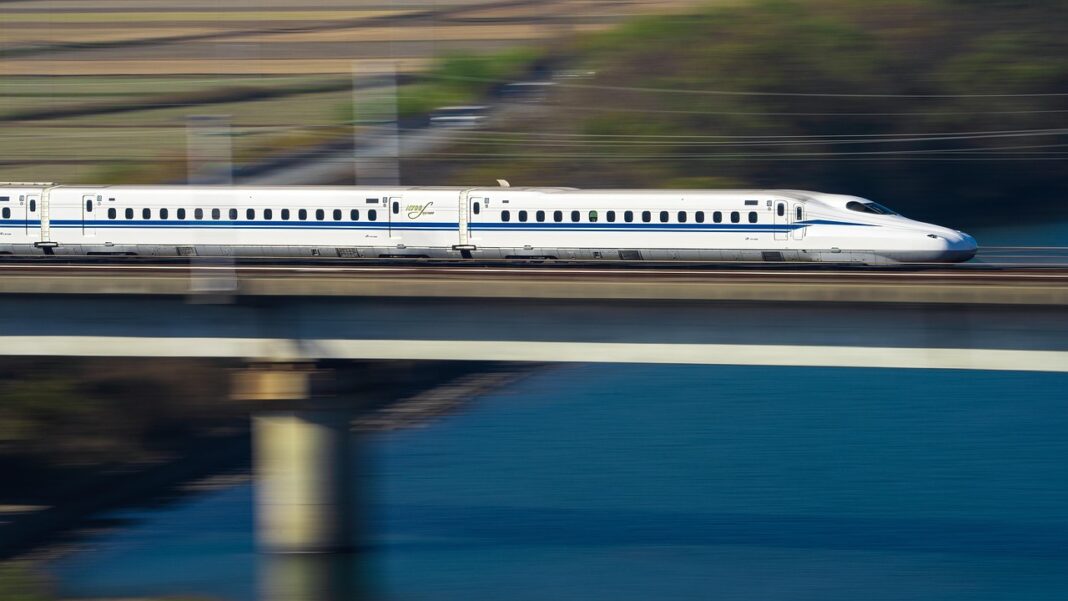
Alongside infrastructure construction, work is also progressing on India’s indigenously developed high-speed train. The first body frame has been completed and is undergoing structural testing.
According to the latest project updates, the train is expected to begin track trials around May-June 2027. The development of an indigenous high-speed train is being undertaken alongside the construction of the dedicated infrastructure required for the Mumbai-Ahmedabad corridor.
The project will have 12 stations along its 508-km alignment. The corridor is being developed to support train speeds of up to 320 kmph.
Once fully operational, the high-speed rail service is expected to significantly reduce travel time between Mumbai and Ahmedabad. According to statements by Vaishnaw, a Mumbai-Ahmedabad journey with four stops is expected to take around 1 hour 58 minutes. A service stopping at all 12 stations is expected to take approximately 2 hours 17 minutes.
The latest construction figures indicate that major civil structures are progressing alongside track and electrification works. With viaduct construction, pier work, bridges, tunnels, track beds and OHE installation advancing in parallel, the project is moving towards phased testing and commissioning beginning with sections in Gujarat.