Water accumulation is a common challenge during excavation and foundation work. Groundwater, rainfall, surface runoff and seepage can affect excavation conditions, delay construction activities and create safety concerns if they are not properly managed.
Effective construction site dewatering therefore requires more than simply removing accumulated water. The approach needs to account for the source and volume of water, site conditions, solids content, pumping distance and the duration of the construction activity. Understanding these factors helps contractors select equipment that matches actual site demands rather than relying on a one-size-fits-all solution.
The following overview looks at why water management matters during excavation and foundation work, where the water typically comes from, the practical challenges contractors face when pumping it out, and the types of equipment commonly used to keep a site workable from groundbreaking through to completion.
Why Water Management Matters on Construction Sites
Maintaining Stable Excavation Conditions
When water is allowed to pool at the base of an excavation, it softens the surrounding soil and can compromise the stability of trench walls and foundation bases. Prolonged exposure to standing water often turns excavation floors muddy, making it difficult to inspect footings, place reinforcement or pour concrete. Consistent construction site water management keeps the excavation bottom workable and reduces the risk of localized soil failure.
Reducing Delays and Operational Disruptions
Rainy seasons and rising groundwater tables are among the most common causes of schedule slippage on excavation projects. Without adequate pumping capacity, crews may need to pause work until water levels drop on their own. A properly planned construction dewatering setup allows teams to keep pace with the project timeline instead of working around the weather.
Protecting Workers and Construction Areas
Standing or moving water increases slip hazards, limits equipment access, and can obscure trip hazards around an active excavation. In foundation work especially, keeping the work area dry supports safer movement of personnel and machinery. Reliable excavation dewatering is as much a safety measure as it is a productivity one.
Common Sources of Water During Excavation and Foundation Work
Groundwater
In areas with a high water table, excavating below grade often exposes groundwater almost immediately. As digging progresses, water can continue to seep in from the surrounding soil, requiring ongoing groundwater management and groundwater dewatering to keep the work area usable.
Rainfall and Surface Runoff
Temporary excavations are particularly vulnerable to heavy rainfall, since they rarely have permanent drainage infrastructure in place. Water running off adjacent grading or paved surfaces can collect quickly in open trenches or foundation pits. Basic site drainage measures, such as perimeter berms or drainage channels, are often used alongside pumping to manage this type of inflow, and construction site drainage planning is typically addressed early in the earthworks phase.
Seepage and Subsurface Water
Depending on soil conditions, water can migrate slowly through the ground and enter an excavation from the sides or base rather than pooling on the surface. This kind of underground water movement is sometimes harder to anticipate, particularly near existing structures or where soil layers vary across the site. In mixed soil profiles, seepage can appear gradually over several days rather than immediately after excavation begins, which is why ongoing monitoring is often just as important as the initial site assessment.
Key Challenges in Construction Dewatering
Variable Water Flow
Water volume rarely stays constant throughout a project. Flow rates can shift significantly between dry and wet periods, or as an excavation gets deeper and intersects new water-bearing layers. A dewatering system needs enough flexibility to handle these fluctuations without being oversized for most of the job.
Suspended Solids and Construction Debris
Water pumped from an active construction site is rarely clean. It typically carries mud, sand, gravel and general construction debris. Pumps that aren’t built to handle suspended solids can clog quickly or suffer premature wear, which is why solids handling pump capability is an important consideration rather than an afterthought.
Pumping Distance and Required Head
Where water needs to be discharged also affects equipment selection. Longer discharge distances, elevation differences and pipe friction all add up, increasing the total dynamic head the pump has to overcome. Underestimating pump head requirements is a common reason dewatering setups underperform on site.
Limited Access and Temporary Construction Conditions
Many excavation and foundation sites lack permanent power supply or easy vehicle access, and equipment often needs to be relocated as work progresses. This favors mobile dewatering equipment that can be set up, moved and reconnected with minimal downtime, such as trailer-mounted pump units.
Dewatering Methods and Equipment Used on Construction Sites
Submersible Pumps
Submersible pumps sit directly in the water, making them a straightforward option for sumps, pits and small flooded areas. They are compact and simple to deploy, and their fully submerged design means they don’t require priming before use. However, their solids-handling capability and flow range are generally more limited than surface-mounted alternatives, which makes them better suited to smaller, more contained volumes of relatively clean water.
Self-Priming Trash Pumps
A self-priming trash pump remains above the water surface and draws water in through a suction hose, which makes it easier to access for monitoring and maintenance. This type of pump is commonly chosen for muddy water containing solids, and it is well suited to temporary construction dewatering where the pump needs to be moved between locations as excavation work progresses.
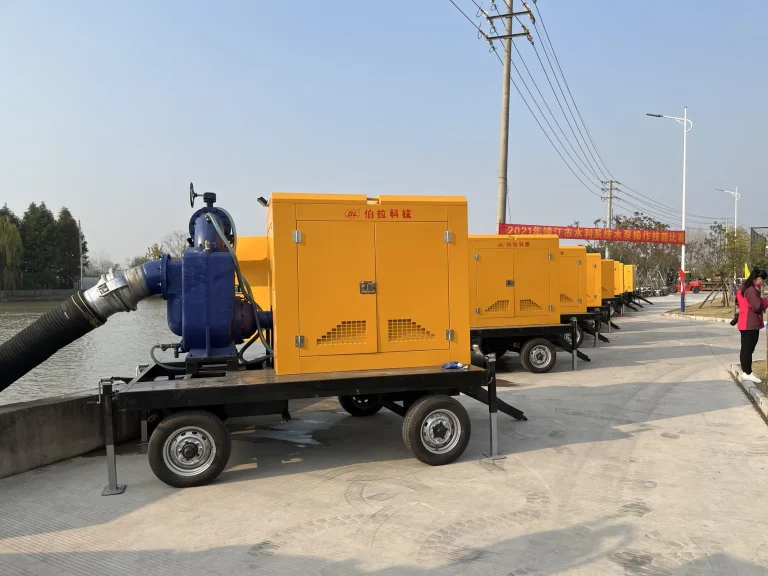
Trailer-Mounted Diesel Pumping Systems
For sites without a fixed electrical supply, trailer-mounted diesel dewatering pumps offer independent, self-contained operation. Their mobility makes them practical for remote construction sites. Diesel-powered units can be useful where high-volume pumping is required over extended periods, particularly on sites without a reliable fixed electrical supply.
Equipment Examples for Different Construction Conditions
SCPY Self-Priming Diesel Trash Pump
Self-priming diesel trash pumps can be useful on construction sites where water contains suspended solids and the pumping unit needs to remain accessible above the water level. This configuration combines a self-priming design with trailer mounting and diesel power, making it suitable for applications where water contains suspended solids and the pumping unit needs to remain mobile. The SCPY series from CANNASPRING is one example of this type of trailer-mounted pumping configuration, offering solids handling up to 76 mm, flow rates from 80–600 m³/h, and suction lift of up to 7.6 m.
ZBCY Diesel Trailer Dewatering Pump
Larger excavation projects may require substantially higher flow rates or greater discharge heads than smaller sump or trash pumps can provide. Trailer-mounted diesel dewatering pumps can provide a practical option where high-capacity pumping and mobility are required across an extended project timeline. The ZBCY series from CANNASPRING is designed for heavy-duty dewatering applications, with flow rates up to 3,000 m³/h and heads up to 120 m, depending on configuration.
How Contractors Can Match Dewatering Equipment to Site Conditions
| Site Condition | Important Consideration |
|---|---|
| Shallow accumulated water | Flow capacity |
| Muddy water with solids | Solids handling |
| Deep excavation | Pump head |
| Remote site | Diesel power |
| Frequently changing locations | Trailer-mounted mobility |
| Long-duration pumping | Continuous-duty capability |
In practice, site conditions determine equipment configuration more than any single specification. A dewatering pump that performs well on one excavation may be poorly matched to another site with different soil, water volume or access constraints, which is why matching equipment to conditions — rather than defaulting to a standard setup — remains central to reliable site dewatering.
Planning a More Reliable Construction Dewatering System
Before selecting dewatering equipment, it helps to work through a few basic questions: what is the source of the water, what flow rate needs to be handled, how much head the pump must overcome, whether solids are present, where the discharge will go, and how site or weather conditions might change over the course of the project.
Effective dewatering is ultimately a combination of appropriate equipment, properly designed discharge arrangements and continuous monitoring of changing site conditions.