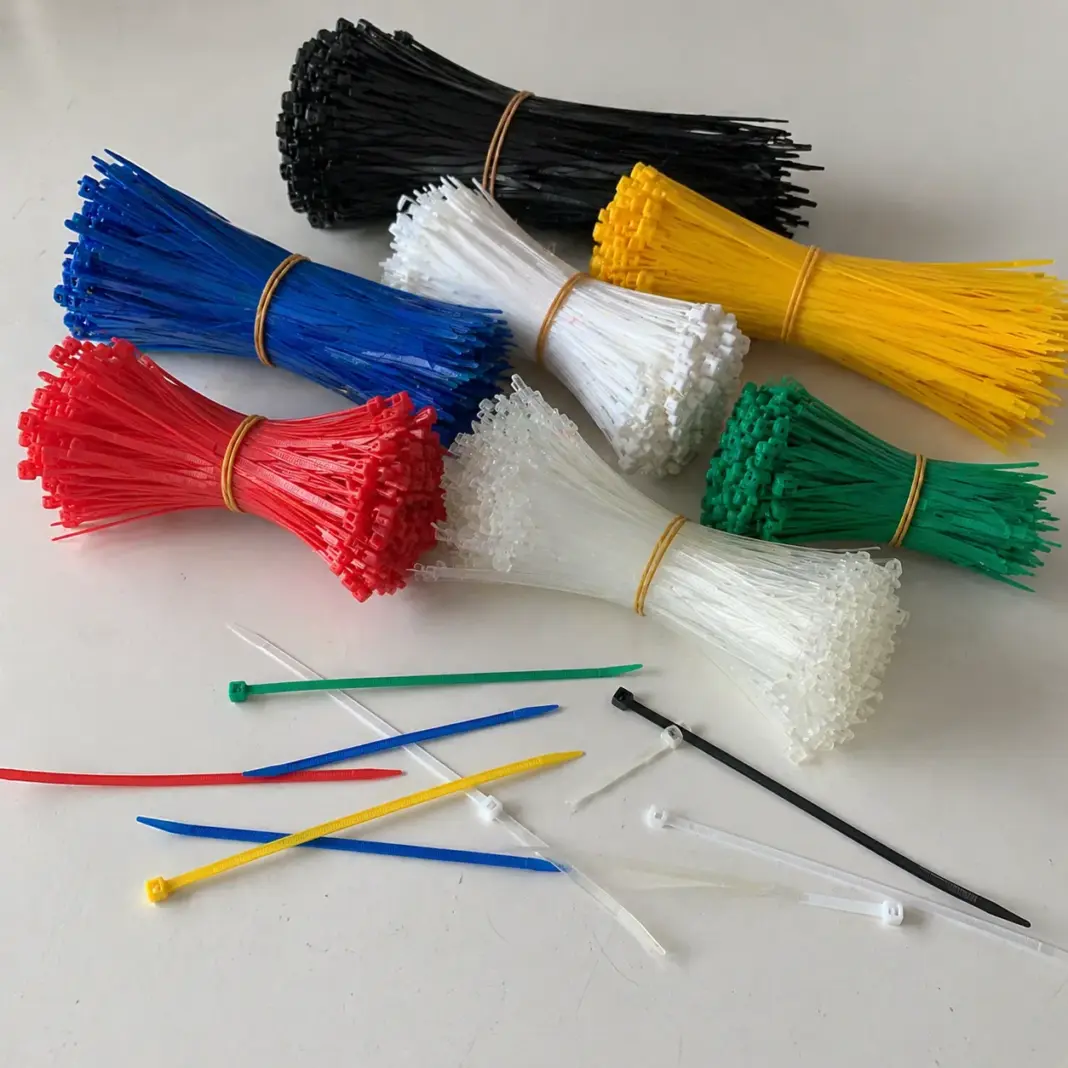
Cable ties occupy an awkward place in project procurement. Individually they cost a fraction of a rupee, so nobody wants to spend time on them. Collectively, a large infrastructure or commercial project can consume several lakh pieces across electrical, mechanical and temporary works — at which point the purchasing decision is worth several days of somebody’s attention.
What usually happens instead is that ties get bought the way stationery gets bought: in small quantities, locally, on demand, from whoever delivers fastest. That works, and it also quietly costs the project money on every carton.
This article looks at how cable tie pricing is actually built up, what changes when you move to volume purchasing, and what to define in an enquiry so that competing quotations can be compared honestly.
Why the unit price varies so widely between quotations
Buyers are often surprised by how far apart two quotations for “the same” tie can sit. There are four reasons, and only one of them is supplier margin.
Material and grade
Nylon PA66 is the baseline. UV-stabilised grades for outdoor and rooftop work cost more than indoor grades. Polypropylene sits differently again, and stainless steel is in another price bracket altogether — frequently an order of magnitude above nylon. A quotation that looks cheap is often quoting a different material to the one you assumed.
Size and tensile rating
A 100 mm light-duty tie and a 500 mm heavy-duty tie are not variants of one product; they are different products with different material content. Price rises with both length and tensile rating, and the two compound.
Order volume
This is the variable the buyer actually controls, and it moves the price more than the other three combined. Factory pricing is tiered, and the step between a small trade quantity and a genuine production run is substantial.
Packaging and customisation
Plain bulk cartons are the cheapest form. Branded bags, barcode labels, custom colours and printed straps all add cost — disproportionately so on smaller runs, because the setup is amortised across fewer pieces.
What actually changes at volume
Two things change when a project moves to bulk cable ties purchased against a project schedule rather than topped up from local stock.
The first is the obvious one: per-piece cost falls as the order moves up the pricing tiers. Manufacturer minimums for wholesale pricing commonly begin around ten thousand pieces per size and colour, with meaningful further steps at fifty thousand and above.
The second is less obvious and often matters more on a programme-driven project: consistency. A single production batch gives you the same material, the same colour and the same tensile performance across the whole installation. Topping up locally means four different suppliers across an eighteen-month programme, and no realistic way to trace a failure back to a batch.
The markup chain
When a project buys from a local hardware supplier, it is rarely buying from whoever made the product. Each stage in the chain carries genuine cost and genuine risk — and adds margin accordingly.
| Stage in the chain | What it adds | Effect on your landed cost |
| Factory | Manufactures to specification | Base cost |
| Importer / trading house | Brings stock into the country, carries currency and shipping risk | First margin added |
| Distributor | Warehouses, breaks bulk, holds local stock | Second margin added |
| Reseller / hardware supplier | Sells in small quantities on demand | Third margin added |
Illustrative structure. The number of stages varies by product and market.
None of those stages is illegitimate. A distributor holding local stock and delivering the same afternoon is providing a real service, and for small or urgent requirements that service is worth paying for. The question is simply whether a project consuming several lakh pieces on a known schedule needs to buy that way for its entire requirement.
For most large projects the answer is a split: the bulk of the requirement planned and ordered against the programme, with a local supplier retained for genuine emergencies.
Establish who is actually manufacturing the product
Before a large order is placed, it is worth knowing whether you are dealing with the factory or with somebody reselling another factory’s stock. The distinction decides what can be committed to in writing.
Established manufacturers can confirm material grade, tensile data, packing structure and batch traceability directly, and will quote tiered pricing against a project schedule. DIFVAN, for instance, has manufactured cable ties and wiring accessories in Zhejiang, China since 1997, produces nylon, polypropylene and stainless steel ties under ISO 9001:2015, and supplies distributors and contractors in more than 50 countries. A trading house reselling stock frequently cannot answer the same questions, because it does not control the production line.
The practical test is simple. Ask for the tensile derating data across your service temperature, the moisture-conditioning practice after moulding, and the inner packing quantities. A manufacturer answers all three from its own records. A reseller has to go and ask somebody else — and often does not come back.
Packing data — the part that gets left out of the enquiry
This is where volume purchasing most often goes wrong, and it has nothing to do with price.
A quotation that states only a unit rate tells the project nothing about how the material arrives. Stores staff then discover that a consignment occupies four times the space they allowed, or that cartons have to be broken open and recounted because inner quantities were never specified.
Ask for the packing structure in writing at enquiry stage:
| Question to ask | Why it matters on site | Where it appears |
| Pieces per polybag | Determines how the material is issued to gangs without opening bulk stock | Packing list |
| Bags per carton, pieces per carton | Drives store space, stock counting and reconciliation | Packing list / invoice |
| Carton dimensions and gross weight | Needed for freight quotation and site handling | Shipping documents |
| Cartons per pallet, pallets per container | Determines whether the order fills a container efficiently | Loading plan |
| Labelling on inner and outer cartons | Size, colour, tensile and batch must be readable without opening | Agreed at PO stage |
Inner and outer quantities vary considerably by size and by manufacturer — confirm the actual figures on your own quotation rather than assuming a standard.
Landed cost, not unit price
The lowest quoted rate is not automatically the lowest cost to the project. Before comparing quotations, bring them onto the same basis:
- Freight — sea freight is inexpensive per unit at volume; air freight is not, and reverses the arithmetic entirely.
- Duties and clearance — varies by origin and classification. DDP terms fold this into a single figure; FOB and EXW do not.
- Lead time — ready stock typically moves in one to two weeks; made-to-order and custom specifications take longer. A rate that cannot meet the programme has no value.
- Order minimums — dropping below a pricing tier to save on quantity can cost more than it saves.
- Failure and rework — a tie that degrades on an exposed run costs access equipment and labour to replace, long after the saving has been forgotten.
A procurement checklist
Define these eight items and competing quotations become genuinely comparable. Leave them undefined and every supplier quotes a slightly different product.
- Material and grade — PA66, UV-stabilised PA66, polypropylene, SS304 or SS316.
- Dimensions — length and width, plus the actual bundle diameter range in service.
- Minimum loop tensile strength, stated as a figure rather than as a description.
- Colour, and whether outdoor-grade material is required, stated explicitly.
- Total quantity, broken down by size and colour, and the call-off schedule.
- Packing requirement — inner quantities, carton labelling, palletisation.
- Certification required — quality system, flammability rating, and any project-specific standard.
- Delivery terms and destination — DDP, FOB or EXW, and the required delivery window.
The scale at which this becomes worth doing
Volume purchasing is not the right answer for every project. It becomes worthwhile once three conditions hold together: the total requirement is large enough to reach a genuine pricing tier, the programme is predictable enough to order against, and there is somewhere to store the consignment.
Below that threshold, a local distributor’s convenience is worth the premium and the exercise is not worth the effort.
Above it, cable ties stop being a consumable and start behaving like any other bought-out component — specified properly, ordered against the programme, and priced on landed cost rather than on the rate at the top of the quotation.
About the author
Contributed by the technical team at DIFVAN (Wenzhou Difvan Electric Co., Ltd), a cable tie and wiring accessories manufacturer operating from Zhejiang, China since 1997.