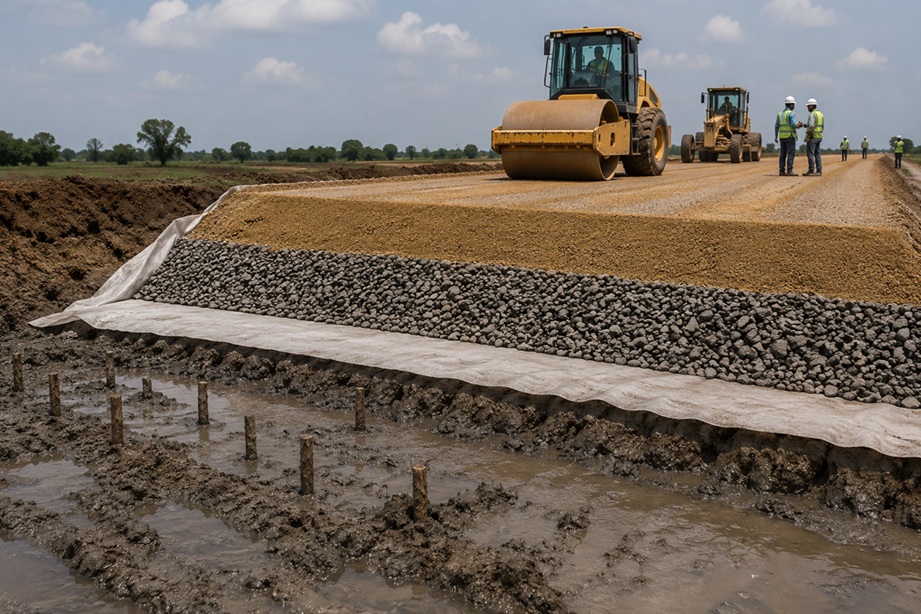
Road construction over weak soil presents engineering challenges because the subgrade may not have sufficient strength or stiffness to support construction traffic and long-term pavement loads. Soft clay, loose silt, expansive soil, organic soil and poorly compacted fill can undergo excessive settlement, rutting, lateral movement and shear failure if they are not properly treated before pavement construction.
The selection of a suitable treatment method depends on soil properties, groundwater conditions, embankment height, traffic loading, project duration, available materials and construction cost. Site investigation and geotechnical evaluation therefore play an important role before deciding the pavement and ground improvement approach.
Understanding Weak Soil Conditions
Weak soil generally refers to soil with low bearing capacity, high compressibility or poor drainage characteristics. Typical problematic soils encountered in road projects include:
- Soft clay
- Organic and peat soils
- Loose silty soils
- Expansive clay
- Saturated alluvial deposits
- Poorly compacted fill
- Collapsible soils
- Highly compressible subgrade
The engineering behaviour of these soils can vary considerably. A soft clay layer may experience long-term consolidation settlement, while expansive soil can undergo volume changes with variations in moisture content.
A road built directly over such soil can develop differential settlement, longitudinal cracking, transverse cracking, potholes, rutting and pavement deformation.
Site Investigation Before Construction
A detailed investigation should be undertaken before selecting the construction method. The investigation normally includes soil profiling, groundwater assessment and laboratory testing.
Important parameters include:
- California Bearing Ratio (CBR)
- Shear strength
- Moisture content
- Atterberg limits
- Grain-size distribution
- Dry density
- Consolidation characteristics
- Swelling potential
- Permeability
- Groundwater level
Field investigations may involve trial pits, boreholes, Standard Penetration Tests (SPT), Cone Penetration Tests (CPT) and other appropriate geotechnical investigations.
The investigation should establish the depth, thickness and extent of weak layers, rather than assessing only the soil immediately below the pavement.
Removal and Replacement
Where the weak soil layer is relatively shallow, excavation and replacement can be one of the simplest approaches.
The unsuitable soil is excavated and replaced with suitable granular material or engineered fill. The replacement material is placed in controlled layers and compacted to the specified requirements.
This method is particularly suitable when:
- Weak soil occurs at shallow depth
- Suitable replacement material is available
- Excavation is practical
- Groundwater does not make excavation difficult
However, excavation becomes less attractive when the weak deposit is deep because excavation quantities and disposal requirements can increase substantially.
Mechanical Stabilisation
Mechanical stabilisation involves improving the engineering properties of the subgrade by blending weak soil with suitable granular materials.
Aggregates can improve:
- Bearing capacity
- Particle interlock
- Drainage
- Compaction characteristics
- Resistance to deformation
The final mixture must be designed based on laboratory testing rather than simply adding aggregate to the soil.
Chemical Soil Stabilisation
Chemical stabilisation can be used when excavation and replacement are not economical.
Lime Stabilisation
Lime is commonly used for suitable clayey soils. It can reduce plasticity and improve workability and strength.
Cement Stabilisation
Cement can be used to improve the strength and stiffness of suitable soils. Cement-treated layers can provide a stronger platform for pavement construction.
Fly Ash and Other Binders
Depending on local availability and soil characteristics, fly ash and other binders can also be considered.
The selection of the stabilising agent should be based on soil chemistry, laboratory trials and required engineering performance.
Geosynthetics
Geosynthetics are used in road construction over weak subgrades for separation, reinforcement, filtration and drainage.
Different products perform different functions:
- Geotextiles can provide separation and filtration.
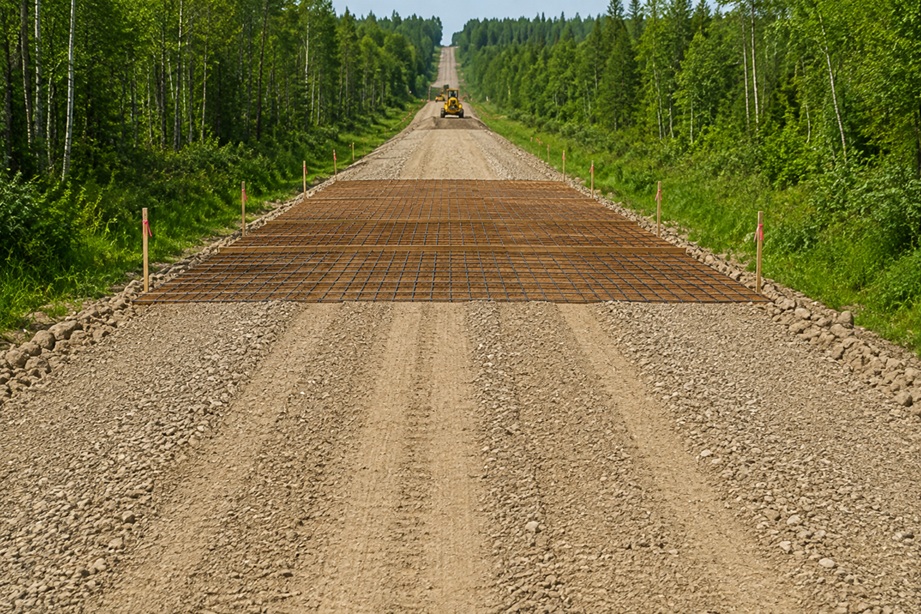
- Geogrids can provide reinforcement.
- Geocells can provide three-dimensional confinement.
- Geocomposites can combine drainage, separation and reinforcement functions.
For example, a geotextile placed between weak subgrade and granular material can help prevent intermixing of the two layers. Geogrids can improve aggregate confinement and load distribution.
The choice should be based on the required function rather than simply selecting a geosynthetic product by name.
Preloading and Surcharge
Preloading is useful for soft, compressible soils where settlement needs to be addressed before pavement construction.
A temporary surcharge load is placed over the proposed road formation. The additional load accelerates consolidation of the underlying soil.
After sufficient settlement has occurred, the surcharge can be removed and pavement construction can proceed.
The method requires adequate time and reliable monitoring of settlement and pore-water pressure.
Prefabricated Vertical Drains
For thick deposits of soft clay, Prefabricated Vertical Drains (PVDs) can be combined with preloading.
PVDs provide drainage paths through which pore water can escape more readily. This can accelerate consolidation compared with natural drainage alone.
The design needs to consider:
- Drain spacing
- Drain depth
- Soil permeability
- Consolidation characteristics
- Required degree of consolidation
- Embankment loading rate
Stone Columns
Stone columns can be used to improve certain soft soil deposits by introducing compacted granular columns into the ground.
They can improve:
- Bearing capacity
- Settlement behaviour
- Drainage
- Shear resistance
However, their suitability depends strongly on the properties of the surrounding soil. They are not a universal solution for every type of very soft ground.
Deep Soil Mixing
Deep soil mixing involves mechanically mixing in-situ soil with a cementitious binder to create improved soil columns or panels.
It can be considered where weak soil extends to significant depths and conventional excavation is impractical.
The method can provide increased strength and reduced compressibility, but quality control is important because the final properties depend on soil conditions, binder dosage, mixing efficiency and curing.
Lightweight Embankment Fill
Where the weight of a conventional embankment is likely to cause excessive settlement, lightweight materials can reduce the stress imposed on weak soil.
Potential materials include:
- Expanded polystyrene blocks
- Lightweight aggregate
- Foamed concrete
- Other engineered lightweight fills
Reducing embankment weight can help control settlement and improve slope stability.
Basal Reinforcement
For road embankments constructed over very soft soil, geosynthetic basal reinforcement can be installed at or near the foundation level.
It can help:
- Improve embankment stability
- Distribute loads
- Reduce lateral spreading
- Provide construction support
This approach becomes particularly relevant where the underlying soil has low undrained shear strength.
Managing Construction Risks
Construction over weak soil requires careful control of the construction sequence.
Control the Embankment Construction Rate
Rapid placement of embankment fill can generate excess pore-water pressure and potentially reduce short-term stability.
Monitor Settlement
Settlement plates and other monitoring instruments can be used to measure ground movement during construction.
Monitor Pore-Water Pressure
Piezometers can help assess changes in pore-water pressure and provide information about consolidation and stability.
Control Compaction
Excessive construction traffic on untreated weak soil can cause rutting and disturbance. A suitable working platform may therefore be required before heavy equipment is allowed onto the formation.
Drainage Is Essential
Poor drainage can significantly worsen weak-subgrade conditions.
Road design should provide appropriate:
- Side drains
- Cross drainage structures
- Subsurface drainage
- Filter layers
- Culverts
- Roadside drainage channels
Water infiltration into expansive or moisture-sensitive soils can also change their engineering properties. Therefore, drainage should be considered as part of the overall ground and pavement design.

Choosing the Right Method
There is no single treatment method suitable for all weak-soil road projects.
| Ground Condition | Potential Approach |
| Shallow weak layer | Removal and replacement |
| Low-strength clayey soil | Lime/cement stabilisation |
| Soft clay with long consolidation period | Preloading + PVD |
| Weak soil requiring separation | Geotextile |
| Weak subgrade requiring reinforcement | Geogrid/geocell |
| Certain soft deposits | Stone columns |
| Deep weak soil | Deep soil mixing |
| Very soft foundation below embankment | Basal reinforcement |
| Highly compressible soil | Preloading or staged construction |
| Weak soil with drainage issues | Drainage improvement |
The final selection should be based on geotechnical investigation, design calculations, field trials and life-cycle cost, rather than initial construction cost alone.
Equipments and Tools Used in Road Construction Over Weak Soil
Different types of equipment are used for excavation, ground improvement, material placement, compaction, drainage and monitoring during road construction over weak soil. The selection depends on the soil condition, treatment method and project scale.
- Excavators for removing weak soil, trenching and general earthwork
- Bulldozers for soil stripping, grading and spreading fill
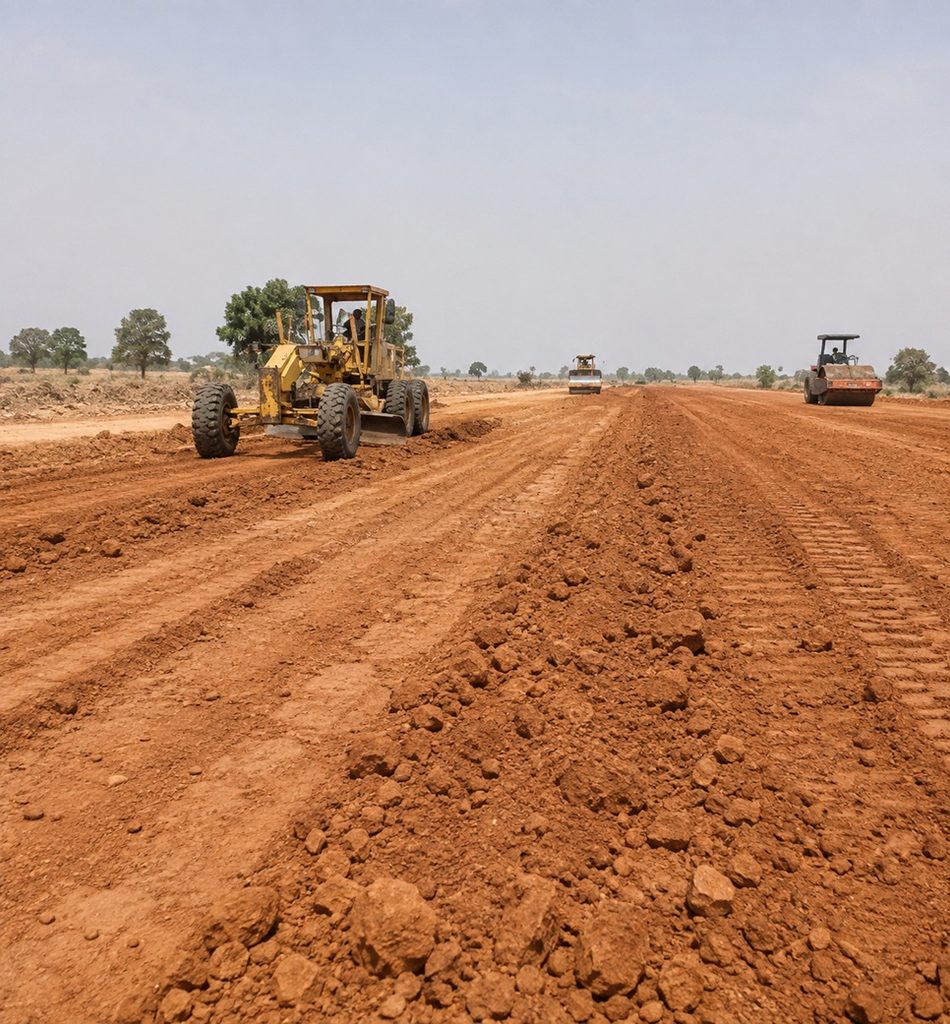
- Motor graders for formation preparation and surface levelling
- Dump trucks for transporting excavated soil, aggregates and replacement material
- Vibratory rollers for compacting granular fill and pavement layers
- Pneumatic rollers for achieving uniform compaction of suitable materials
- Water tankers for moisture conditioning during compaction
- Soil stabilisation machines for mixing lime, cement or other binders into the soil
- Pulverisers and recyclers for in-situ soil mixing and stabilisation
- Geosynthetic installation equipment for placing and securing geotextiles, geogrids and geocells
- PVD installation rigs for installing prefabricated vertical drains
- Stone column rigs for forming and compacting granular columns
- Deep soil mixing rigs for mixing in-situ soil with cementitious binders
- Cranes and lifting equipment for handling specialised ground improvement materials
- Piling and drilling rigs where deep ground treatment or reinforcement is required
- Compaction testing equipment for checking field density and moisture conditions
- Settlement plates and survey equipment for monitoring ground settlement
- Piezometers for monitoring changes in pore-water pressure
- CPT and SPT equipment for assessing subsurface soil conditions
- Surveying instruments and GPS equipment for controlling levels, alignment and construction progress
Quality Control During Road Construction
Quality control should continue throughout ground improvement and pavement construction.
Important checks include:
- Soil moisture
- Compaction
- Stabiliser dosage
- Treated-soil strength
- Geosynthetic installation
- Layer thickness
- Drainage installation
- Settlement monitoring
- Pavement material quality
Field testing should confirm that the treated formation achieves the required performance before subsequent pavement layers are placed.
Conclusion
Road construction over weak soil requires a combination of geotechnical investigation, ground improvement, drainage, controlled construction and monitoring. Methods such as excavation and replacement may be effective for shallow weak layers, while stabilisation, geosynthetics, preloading, vertical drains, stone columns and deep soil mixing can address more complex conditions.
The objective is not simply to increase the strength of the soil. The treatment should also control settlement, drainage, stability and long-term pavement performance. Selecting the appropriate method at the design stage can reduce construction delays, premature pavement failures and rehabilitation requirements over the road’s service life.