Pricing a site prep job is rarely as simple as multiplying square footage by a unit price.
A parking lot might need milling before the new asphalt goes down. Another project may require extensive grading because the existing elevations do not work with the proposed site. Some areas may need undercutting, aggregate replacement, or additional drainage work before paving can even begin.
The estimator’s challenge is figuring out how all those pieces fit together.
A reliable asphalt paving estimate starts with the quantities, but it does not end there. Site conditions, production rates, hauling, equipment, material prices, and the sequence of work can all move the final number.
The plans tell you what needs to happen
Before pricing anything, site prep teams need to understand the scope of work across the entire site.
Start with the civil and grading plans, then work through the pavement details, existing conditions, profiles, sections, specifications, and notes. The goal is to understand what is being removed, what is being moved, and what is being installed.
For asphalt work, that could mean new pavement, an overlay, or full-depth reconstruction. Milling may be limited to certain areas or cover the entire existing surface. Grading quantities can change depending on proposed elevations and the amount of cut and fill required.
This is where many estimating errors begin. An estimator can measure the right area but apply the wrong scope.
Asphalt pricing starts with a good takeoff
Once the scope is understood, the estimator can build the quantities.
For paving, that usually means measuring parking areas, drive aisles, roadways, shoulders, and other paved surfaces. The pavement section then determines how those areas translate into asphalt tonnage.
Both thickness matters and specified mix matters. A surface course and binder course should generally be separated rather than treated as one generic asphalt quantity.
The same applies to base and subbase. Their quantities need to match the areas and thicknesses shown in the plans.
This is where paving estimation software like Beam AI can make the estimating process more manageable. Instead of manually measuring every paved area and transferring those numbers into a spreadsheet, digital tools can organize measurements by scope and make revisions easier to track. Our blog on Asphalt Estimation Process offers a more detailed look at the broader workflow
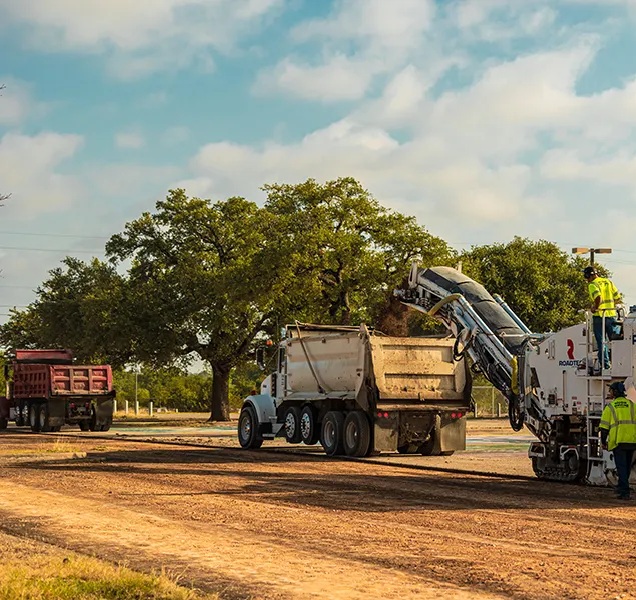
Milling has its own cost equation
Milling is easy to underestimate because the quantity itself can look simple.
The estimator may only need to measure the area being milled and identify the required depth. But that measurement needs to be connected to production and disposal.
A 1-inch mill across a large parking lot is a very different operation from deeper milling on a roadway with several layers of existing pavement. The number of passes, machine productivity, truck cycle time, haul distance, and disposal location all affect the cost.
The milled material may also have value if it is reclaimed or transported to a recycling facility. That can change the economics of the job.
Rather than applying one standard milling rate to every project, experienced estimators look at the actual conditions and work sequence.
Grading is where the site starts to tell the story
Grading estimates require more than measuring an area.
The estimator needs to understand existing and proposed elevations and determine how much material has to be cut, filled, moved, imported, or exported. A site with relatively balanced cut and fill can have a very different cost profile from one that requires thousands of cubic yards of imported material.
Hauling distance matters here. So does the location of the stockpile, disposal site, and borrow source.
Equipment productivity also becomes important. Excavators, dozers, graders, loaders, and trucks all have different roles, and their utilization depends heavily on site layout and material movement.
A grading estimate that ignores those logistics may have technically correct quantities and still miss the actual cost.
Labor and equipment should follow the production plan
Once quantities are established, pricing becomes a question of how long the work will take.
For asphalt, that could include milling, sweeping, tack application, paving, rolling, joint work, and cleanup. Grading may involve excavation, loading, hauling, spreading, fine grading, and compaction.
Crew productivity should reflect the project, not a generic rate from an estimating database.
A constrained commercial site, for example, may slow down equipment that would normally operate efficiently on an open roadway. Truck turnaround time can become a bottleneck. Night work or phased construction can affect labor costs. Weather can change the number of productive paving days available.
These are pricing considerations, not details to address after the estimate is submitted.
The hidden costs are usually in the logistics
Material and labor often get the most attention. Site prep logistics can be just as important.
Think about trucking. How far does excavated material travel? Where will millings go? Can trucks enter and leave without waiting? Is there enough room for equipment to work without constantly repositioning?
Then look at mobilization. Large grading equipment and paving equipment may require separate mobilizations, especially when the work is phased.
Traffic control, temporary access, erosion control, dust management, and site protection can also add cost depending on the project.
A strong asphalt paving estimate accounts for these conditions rather than relying only on production rates and material prices.
Keep subcontractor pricing connected to the estimate
Site prep work often involves multiple parties. A GC may need paving, striping, concrete, trucking, excavation, or other specialty subcontractors priced together.
That makes subcontractor software useful when it can keep quotes, scope, and estimate information organized in one workflow. The important part is not simply collecting the lowest number. The estimator needs to compare what each subcontractor actually included.
A low paving quote may exclude milling. A grading quote may not include export hauling. Another subcontractor may have assumed the owner is providing aggregate.
Identify those differences before comparing the numbers.
Review the estimate against the site sequence
The final review should not be limited to checking whether the spreadsheet adds up.
Walk through the project in the order the work is expected to happen.
What gets removed first? Where does that material go? When does grading happen? When can the base be placed? Is paving dependent on another scope being completed first?
Looking at the estimate this way often exposes costs that are difficult to spot when reviewing individual line items.
It also helps explain why estimating software is becoming more useful for site contractors. The objective is not to remove the estimator from the process. It is to reduce the repetitive measurement and data-entry work so more attention can go toward scope, pricing, and risk.
Price the work, not just the quantities
A competitive site prep estimate is built from more than square footage and unit costs.
The estimator needs accurate paving quantities, realistic milling production, a defensible grading plan, current material and subcontractor pricing, and a clear understanding of how the site will be executed.
That is what turns a takeoff into a bid.
When those pieces are connected, contractors can price asphalt and sitework with greater confidence and spot the risks that a simple quantity-based estimate can easily miss.