
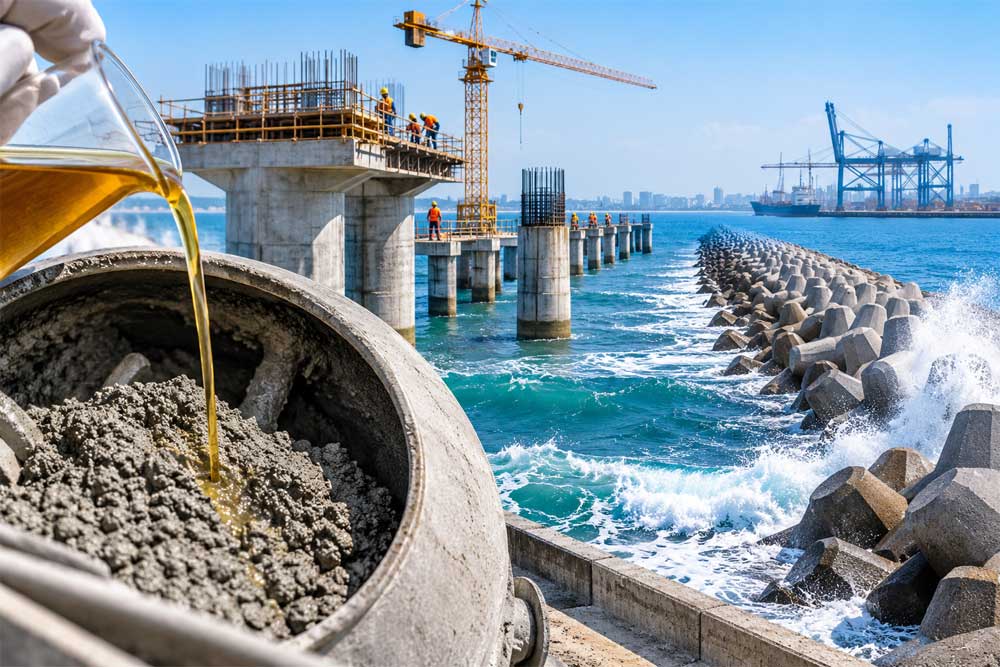
Marine and coastal infrastructure is exposed to some of the most demanding conditions for concrete. Ports, jetties, seawalls, offshore structures, bridges, marine terminals, breakwaters and coastal buildings are repeatedly exposed to chlorides, moisture, wetting and drying cycles, carbonation, sulphates, abrasion and temperature variations. In such environments, concrete durability depends not only on strength but also on permeability, crack control and resistance to the movement of aggressive agents through the concrete.
Concrete admixtures can play an important role in improving these properties. When correctly selected and combined with an appropriate mix design, admixtures can help reduce water demand, control permeability, improve workability, reduce cracking and provide additional protection against corrosion.
Marine Exposure and Its Effect on Concrete
The primary durability concern in reinforced concrete structures located near the sea is the ingress of chloride ions. Chlorides can penetrate concrete through capillary pores, cracks and other connected pathways. When chloride concentration reaches the reinforcement, it can disrupt the passive layer around steel and initiate corrosion.
The corrosion process can eventually cause:
- Loss of reinforcement cross-section
- Expansion of corrosion products
- Cracking and delamination of concrete cover
- Spalling of concrete
- Reduction in bond between reinforcement and concrete
- Progressive loss of structural durability
Marine structures also experience repeated wetting and drying. Tidal zones can be particularly demanding because concrete may remain wet for extended periods and then dry, allowing aggressive salts to concentrate near the surface.
Other exposure mechanisms include sulphate attack, abrasion from waves and suspended particles, erosion, carbonation and deterioration associated with temperature changes.
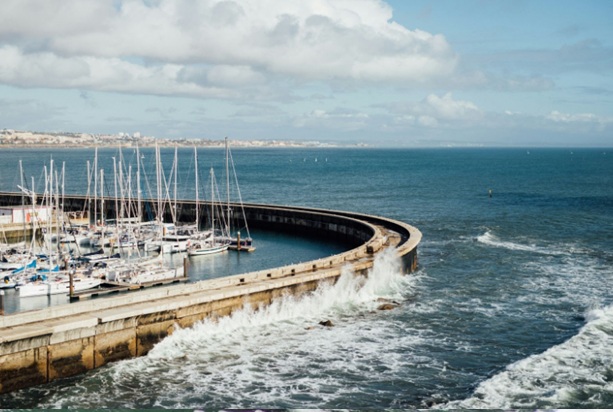
Reducing Permeability Through Water-Reducing Admixtures
One of the most important strategies for improving concrete durability is reducing its permeability.
High-range water-reducing admixtures, commonly known as superplasticisers, can produce the required workability at a lower water content. Polycarboxylate ether (PCE)-based admixtures are widely used in modern concrete because they can provide substantial water reduction while maintaining workability.
A lower water-to-cementitious-material ratio generally produces a denser cementitious matrix when the concrete is properly proportioned, placed and cured.
This can help reduce the pathways through which:
- Chloride ions enter concrete
- Water moves through the concrete
- Carbon dioxide penetrates the concrete
- Sulphates reach susceptible cementitious phases
However, reducing water alone does not guarantee durable concrete. Cementitious material selection, aggregate quality, curing, cover depth, crack control and construction quality remain important.
PCE-Based Admixtures for Marine Concrete
PCE technology has become an important component of high-performance concrete because of its ability to disperse cement particles efficiently.
For marine applications, PCE-based admixtures can be used to achieve:
- Low water-to-binder ratios
- High workability
- Extended slump retention
- Improved pumpability
- High early and later-age strength
- Dense concrete microstructure
Slump retention is particularly relevant to large marine projects where concrete may need to travel considerable distances or remain workable during complex placement operations.
The admixture system must nevertheless be compatible with the cement and supplementary cementitious materials being used. Changes in cement chemistry, mineral additions, temperature and transportation time can affect admixture performance.
Corrosion-Inhibiting Admixtures
Corrosion-inhibiting admixtures are another category that can be considered for reinforced concrete exposed to marine environments.
These admixtures are designed to delay or reduce reinforcement corrosion by influencing the electrochemical conditions around embedded steel. They may be particularly useful where reinforcement is exposed to chloride-containing environments.
Their use should be considered as part of a broader corrosion-control strategy rather than as a substitute for good concrete quality.
The overall system may include:
- Low-permeability concrete
- Adequate concrete cover
- Proper reinforcement detailing
- Crack control
- Appropriate curing
- Surface protection
- Corrosion-inhibiting admixtures where specified
Integral Waterproofing Admixtures
Integral waterproofing admixtures can be incorporated into the concrete mix to reduce water penetration.
Depending on the technology, these products may work by modifying capillary pore structure, blocking water pathways or introducing water-repellent characteristics.
They can be considered for applications such as:
- Marine retaining structures
- Basements in coastal developments
- Seawalls
- Underground structures near coastlines
- Water-retaining structures
- Marine infrastructure components
Integral waterproofing should not be viewed as a replacement for structural waterproofing detailing. Construction joints, movement joints, cracks and penetrations still require appropriate design and treatment.

Shrinkage-Reducing Admixtures and Crack Control
Cracks can create direct pathways for chlorides and water to enter concrete. Controlling cracking is therefore an important part of marine durability.
Shrinkage-reducing admixtures can help reduce drying shrinkage under suitable conditions. This can contribute to crack control when combined with appropriate reinforcement detailing, curing and mix design.
For large marine structures, crack control can be particularly important because restrained shrinkage and thermal effects can create cracking even when the concrete has adequate compressive strength.
Supplementary Cementitious Materials and Admixture Compatibility
Marine concrete often uses supplementary cementitious materials such as fly ash, ground granulated blast-furnace slag and silica fume.
These materials can modify pore structure and improve resistance to chloride penetration and other exposure mechanisms. However, their use also changes the behaviour of the concrete mix.
The interaction between supplementary cementitious materials and chemical admixtures needs to be evaluated carefully.
Potential considerations include:
- Slump retention
- Setting time
- Early-age strength
- Air content
- Water demand
- Compatibility with PCE admixtures
- Temperature sensitivity
- Pumpability
Trial mixes are therefore important before large-scale marine concrete production.
Admixtures for Mass Concrete in Coastal Projects
Large marine foundations, quay structures, bridge piers and other massive concrete elements can generate considerable heat during cement hydration.
Excessive temperature differences between the interior and surface can contribute to thermal cracking.
Retarding admixtures can help control setting and placement time, while suitable water-reducing admixtures can support lower cementitious water demand.
The admixture system should be selected alongside the thermal control strategy, which may include:
- Optimised cementitious content
- Low-heat binders
- Supplementary cementitious materials
- Temperature monitoring
- Controlled placement temperature
- Appropriate curing
- Pour sequencing
Admixtures for Tidal and Splash Zones
The tidal and splash zones often represent particularly severe exposure conditions because concrete is repeatedly subjected to seawater, drying and salt deposition.
Concrete in these areas requires a dense and well-cured matrix with controlled cracking.
Admixture selection may focus on achieving:
- Low permeability: Reduces the movement of chlorides and water.
- High workability: Helps ensure proper placement and consolidation.
- Slump retention: Supports transportation and placement on large projects.
- Crack control: Reduces pathways for aggressive agents.
- Durability: Supports long-term performance under repeated marine exposure.
Importance of Admixture Compatibility
Using multiple admixtures does not automatically improve concrete durability. In some cases, incompatible products or incorrect dosages can create problems with setting, air entrainment, workability or strength development.
Compatibility testing should consider the actual materials that will be used on the project.
Important variables include:
- Cement type and chemistry
- Supplementary cementitious materials
- Aggregate characteristics
- Water quality
- Concrete temperature
- Admixture dosage
- Mixing sequence
- Transportation duration
- Placement method
- Required setting time
A laboratory trial should ideally be followed by field trials before full-scale production.
Role of Curing
Even a well-designed admixture system cannot compensate for inadequate curing.
Proper curing allows hydration to continue and helps develop the intended concrete microstructure. Poor curing can leave the surface more porous and vulnerable to chloride and moisture ingress.
For marine projects, curing practices should therefore be treated as part of the durability design rather than simply a construction-stage activity.
Admixtures Are One Part of a Durability Strategy
Marine durability requires a system-based approach. Admixtures can improve specific properties of concrete, but long-term performance depends on the interaction between materials, structural design and construction practices.
A marine concrete durability strategy may combine:
- Low water-to-cementitious-material ratio
- Suitable cementitious materials
- High-performance water reducers
- Corrosion-inhibiting admixtures where appropriate
- Integral waterproofing technologies where specified
- Controlled cracking
- Adequate reinforcement cover
- High-quality aggregates
- Proper placing and compaction
- Effective curing
- Joint detailing
- Surface protection where required
- Inspection and maintenance
Conclusion
Admixtures have an important role in improving the durability of concrete used in marine and coastal infrastructure. Water-reducing admixtures can support low-permeability concrete, while corrosion-inhibiting, waterproofing, shrinkage-reducing and other specialised admixtures can address specific durability requirements.
For marine infrastructure, the objective is not simply to produce higher-strength concrete. The focus needs to be on producing dense, low-permeability, crack-controlled and properly cured concrete capable of resisting long-term exposure to chlorides, moisture and other aggressive environmental conditions.






