Large construction and infrastructure projects function like temporary industrial zones. Site offices, storage areas, workshops, inspection points and active work fronts may be separated by considerable distances. Engineers, supervisors, safety personnel and maintenance teams can spend a meaningful part of each shift moving between these locations.
For selected personnel movements, affordable e-bikes may provide a lower-cost alternative to repeated pickup truck or utility vehicle trips. They are not replacements for forklifts, telehandlers or specialist material-handling equipment. However, when used on approved routes within controlled private sites, they can help reduce unnecessary walking time, fuel consumption and reliance on larger vehicles.
Where Can E-Bikes Add Value on a Construction Site?
E-bikes are most useful for moving one person and a limited amount of light equipment across a large, controlled project site.
Potential applications include travelling between the main office and work fronts, conducting routine inspections, checking perimeter areas, responding to minor maintenance requests and delivering documents or compact tools. They may also help environmental, surveying and safety teams cover long routes without relying on a motor vehicle for every movement.
This approach is most relevant to expansive sites such as industrial developments, solar farms, road projects, logistics parks, large residential communities and infrastructure corridors.
Construction logistics planning already requires managers to coordinate personnel, vehicles, materials and equipment. Poorly organised movement can create delays, congestion and additional costs, while clearly planned routes support smoother operations.
An e-bike should therefore be treated as part of the site logistics system, not as an informal personal vehicle.
Can E-Bikes Reduce Travel Time?
They can reduce travel time when employees regularly walk long distances or wait for shared vehicles.
Consider a supervisor who needs to inspect several separated work zones during a shift. Walking may be slow, while requesting a pickup requires coordination and may delay other employees who also depend on that vehicle. An e-bike allows the supervisor to travel independently without moving a larger machine through the site.
The potential benefit becomes greater when the same journey is repeated several times each day. Even small time savings per trip can accumulate across project teams and project duration.
However, speed should not be the primary objective. Construction sites contain heavy machinery, blind corners, temporary barriers, changing ground conditions and workers on foot. Route design, visibility and controlled operating speeds matter more than an e-bike’s maximum performance.
The purpose is to remove avoidable waiting and walking time—not to encourage faster movement through an active work zone.
Can E-Bikes Lower Operating Costs?
E-bikes may reduce the operating cost of suitable short trips because they consume less energy and generally have fewer routine service requirements than petrol- or diesel-powered site vehicles.
A conventional vehicle used for repeated short journeys may accumulate fuel consumption, engine hours, tyre wear and maintenance costs without carrying a meaningful load. It also occupies more space on internal roads and in parking areas.
An e-bike uses electricity, requires no engine oil and can be charged from a suitable electrical supply. Routine costs are generally associated with tyres, brakes, chains, batteries and periodic mechanical inspection.
The comparison must still be made carefully. Contractors should include:
- Purchase or lease cost
- Charging infrastructure
- Battery replacement
- Preventive maintenance
- Personal protective equipment
- Security and storage
- Operator training
- Downtime and spare-bike requirements
The correct measure is total cost of ownership rather than energy cost alone. Construction equipment decisions should account for maintenance, reliability and the consequences of downtime, not only the initial purchase price.
What Site Conditions Suit an E-Bike Fleet?
E-bikes are best suited to sites with defined internal routes, manageable gradients and surfaces that can be inspected regularly.
Compacted soil, gravel roads, finished access lanes and stable internal tracks may be appropriate. Deep mud, loose demolition debris, steep excavations, unprotected edges and routes dominated by heavy-equipment movements are not.
A fat tire electric bike may offer additional stability on gravel, grass and uneven compacted surfaces. Wider tyres provide a larger contact area and may feel more predictable than narrow road tyres when conditions vary across the site.
Fat tyres do not make unsafe terrain acceptable. They also add weight and rolling resistance. Site managers must still identify approved routes, inspect changing conditions and close sections when rain, excavation or material storage creates new hazards.
What Safety Controls Are Required?
Efficiency cannot come at the expense of site safety.
Before introducing e-bikes, contractors should complete a task- and route-specific risk assessment. The resulting operating procedure should define:
- Who is authorised to ride
- Where bikes may be used
- Maximum site speed
- Required protective equipment
- Pedestrian-priority areas
- Parking and charging locations
- Pre-start inspection requirements
- Incident and maintenance reporting
Riders should receive practical training in braking, low-speed control, turning and riding on loose surfaces. High-visibility clothing, suitable helmets and site-approved footwear should be mandatory.
The e-bike routes should avoid reversing zones, crane operating areas, loading points and narrow passages used by heavy vehicles. Where routes intersect, signage, barriers or priority rules may be needed.
Construction logistics guidance consistently emphasises that clearly marked routes can reduce congestion and prevent accidents, while equipment is only effective when operators are properly trained.
What Specifications Should Contractors Evaluate?
The correct bike should be selected for the site rather than chosen solely by price or motor size.
Tyres and suspension should match the approved surfaces. Brakes must be capable of controlling the bike, rider and permitted load. Range should cover a normal shift pattern with an operational reserve, without depending on the manufacturer’s maximum estimate.
Other important factors include:
- Complete bike weight
- Rider-height compatibility
- Battery certification
- Water-resistance information
- Load capacity
- Replacement-parts availability
- Local service support
- Warranty terms
- Compatible lights, racks and locks
A removable battery can simplify indoor charging, but the charging area must be dry, ventilated and controlled. Only approved chargers should be used, and damaged batteries should be removed from service immediately.
Contractors must also confirm that the vehicle is permitted under local regulations and project rules. Higher-powered e-bikes may be appropriate only on controlled private sites and may not qualify for public-road use in every jurisdiction.
Could the Puckipuppy Beagle 2 Suit Mixed-Surface Site Mobility?
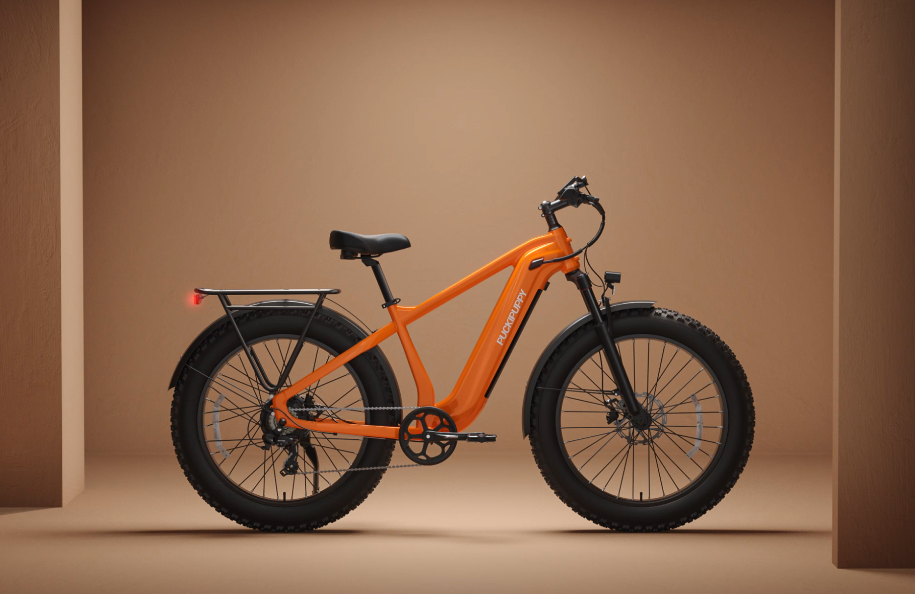
The Puckipuppy Beagle 2 provides an example of a mixed-terrain e-bike that contractors could assess for selected private-site mobility applications.
The model is commonly positioned for outdoor access and is also marketed as an electric bike for adults. The same characteristics that support gravel roads and wooded paths—wide tyres, front suspension, braking capacity and extended range—may also be relevant to controlled construction sites with compacted or uneven internal routes.
The Beagle 2 uses a 750W motor with 960W peak output. Its 48V 15Ah removable battery provides a stated range of 40 to 60 miles, although actual distance varies with terrain, rider weight, cargo, speed and assistance level.
It combines 26-by-4-inch fat tyres with 110mm of front suspension travel and 180mm hydraulic disc brakes. The maximum stated load is 400 pounds, while the complete bike weighs 77.6 pounds. Its battery and electrical system are listed as certified to UL 2271 and UL 2849 by SGS.
These specifications may support supervisors, inspectors or maintenance personnel carrying personal equipment and small approved items. The bike should not be used to transport construction materials or loads that interfere with steering, braking or visibility.
The Beagle 2 can provide assistance up to 28 mph and throttle operation up to 20 mph. Those speeds would be unsuitable for most active work zones. Any site deployment would therefore require enforced internal speed limits, authorised routes and confirmation that the model complies with local laws and insurance conditions.
It is best considered as a mobility option for controlled private property—not as a substitute for road-legal transport, specialist site vehicles or certified material-handling equipment.
How Should Contractors Test E-Bikes Before Wider Deployment?
A limited pilot programme is more appropriate than purchasing a large fleet immediately.
Contractors can begin with one or two bikes assigned to a specific team for a defined period. The pilot should record:
- Number and purpose of trips
- Time saved compared with walking or vehicle use
- Battery consumption
- Maintenance issues
- Near misses or safety concerns
- Rider feedback
- Routes that proved unsuitable
- Vehicle trips avoided
The pilot may reveal that e-bikes are valuable for inspection and supervision but unsuitable for certain work fronts. It can also help determine whether the site needs standard tyres, fat tyres, cargo accessories or a different battery capacity.
Success should be measured through verified operational results rather than assumptions about sustainability or efficiency.
A Small Vehicle Within a Larger Logistics Plan
E-bikes will not transform every construction site, and they are not appropriate for every employee or route. Their value is narrow but potentially useful: moving authorised personnel and light equipment efficiently across large, controlled areas.
When the routes are suitable, the operating rules are clear and the bikes are maintained properly, contractors may be able to reduce walking time and avoid some low-value vehicle movements.
The strongest business case will come from projects that treat e-bikes as managed fleet assets. Route planning, training, charging, maintenance and performance tracking should be established before deployment.
Used within those limits, e-bikes can become a practical part of construction-site logistics—supporting faster coordination and lower operating costs without adding another full-size vehicle to every short journey.