
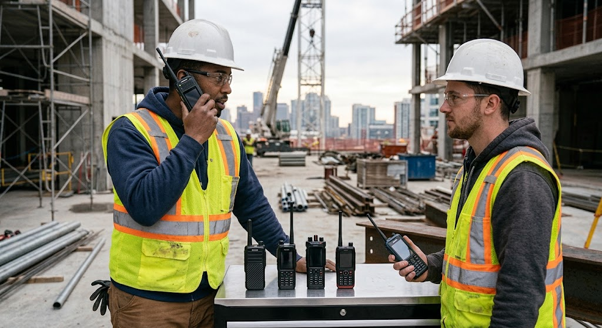
On today’s builds, crews spread across steel-framed cores, basement levels and solar fields hundreds of acres wide, where cell calls go unanswered and old UHF radios fall silent. Text threads pile up unread while concrete trucks idle at the gate.
Superintendents need one button that reaches every foreman at once, which explains why cellular push-to-talk (PTT) has become the go-to tool for wireless safety communication in 2026.
Labor math raises the stakes. Associated Builders and Contractors estimates the industry must bring in 349,000 net new workers this year to keep labor supply and demand in balance. With fewer hands on every shift, each missed instruction turns into rework, idle equipment or a near miss on a crane lift.
This guide covers a side-by-side comparison table, six PTT providers ranked for construction use, real pricing and hardware specs, safety tools such as SOS and man-down alerts, and a closing checklist for choosing the right fit.
Push-to-Talk Providers Compared: Construction Jobsite Snapshot
Use this table to compare cost, network reach, hardware toughness and safety tools at a glance. Prices reflect publicly listed rates; carrier and dealer quotes vary with fleet size. Every option below runs over cellular data, so crews skip the repeaters and towers that traditional radios need.
| Provider | Starting Price | Network | Rugged Hardware | Key Safety Tools | Best For |
| Peak PTT | $24.95/mo unlimited; radios from $129 | Tier-1 4G LTE + Wi-Fi | IP67, 5-ft drop tested, lifetime warranty | SOS with GPS, geofencing | GCs and subs wanting turnkey radios |
| Motorola WAVE PTX | TLK 110 about $399 to $499 + subscription | Multi-carrier LTE + Wi-Fi | IP67, MIL-STD-810H | Man Down, Lone Worker | Firms running MOTOTRBO radios |
| Zello Work | $6.80/user/mo (annual) | Any data network (app) | Bring your own rugged phone | Panic button (Plus plan) | Multilingual smartphone crews |
| AT&T Enhanced PTT | $5/user/mo (Standard) | AT&T LTE + Wi-Fi | Certified rugged phones | Emergency calling (Advanced) | Fleets already on AT&T |
| Verizon Push to Talk Plus | Add-on to Verizon Business lines | Verizon + Wi-Fi | Rugged Kyocera devices | Talker priority, urgent calling | Large multi-site contractors |
| ESChat | Carrier-billed, from about $5/user/mo | Any carrier, private LTE, Wi-Fi | Samsung XCover rugged phones | FirstNet Certified, LMR bridge | Public works and agency-facing jobs |
1. Peak PTT: Best Overall for Construction Crews
Peak PTT ships radios pre-programmed with your talk groups, so new crews go live about two business days after ordering. Service runs on Tier-1 4G LTE and Wi-Fi with sub-300-millisecond latency, no repeaters and no FCC licensing.
- Pricing: $24.95/month unlimited PTT, $19.95 activation, no contracts and a 45-day money-back guarantee.
- Hardware: The PTT-324G ($259) is IP67 rated, 5-foot drop tested and packs dual noise-canceling mics. The PTT-84G ($229) delivers 42 hours of standby.
- Safety: A dedicated SOS button sends exact GPS coordinates, backed by 60-second tracking, geofencing and 90-day location history.
- Support: A 24/7 U.S. team and a lifetime hardware warranty on active service.
Best for: Construction companies of every size needing instant, nationwide crew communication.
2. Motorola WAVE PTX: Best for Hybrid Radio Fleets
Many contractors still own MOTOTRBO radios. WAVE PTX bridges those radios to LTE handhelds, smartphones and dispatch PCs through the WAVE Gateway, so a DMR crew can reach a superintendent across the state.
- Pricing: TLK 110 radios typically run $399 to $499 through dealers, plus a monthly or 30-month WAVE subscription.
- Hardware: The TLK 110 carries IP67 and MIL-STD-810H ratings, while the TLK 150 mounts in trucks for hands-free use.
- Safety: WAVE PTX Safeguard adds a dedicated emergency button, Lone Worker and Man Down fall alerts.
- Extras: Streaming video built on the 3GPP MCVideo standard lets foremen push live footage to dispatch.
Best for: General contractors protecting an existing Motorola radio investment while expanding coverage nationwide.
3. Zello Work: Best App-Based Option for Smartphone Crews
Zello turns the phones crews already carry into walkie-talkies on iOS, Android, PC and Mac. Unlimited channels let you split concrete, framing and electrical teams, and the app runs on any data network, including Wi-Fi in the jobsite office trailer.
- Pricing: Core costs $6.80/user/month billed yearly (8 monthly), and Plus runs $12.75/user/month annually. A 14-day free trial needs no credit card.
- Language tools: Plus adds real-time translations and transcriptions, a strong fit for bilingual and multilingual crews.
- Safety: Plus enables panic buttons, location history and Message Vault recordings for incident reviews.
- Compliance: Zello lists SOC 2 Type II and ISO 27001.
Watch out: Zello sells software only, so budget for rugged handsets or heavy-duty phone cases.
4. AT&T Enhanced Push-to-Talk: Best for Fleets Already on AT&T
If your trucks and supervisors already carry AT&T lines, Enhanced PTT (EPTT) adds walkie-talkie calling for just a few dollars per user. It runs over the AT&T network and Wi-Fi and connects with land mobile radio systems.
- Pricing: Standard starts at $5/user/month. Advanced, built on 3GPP Mission Critical PTT standards, starts at $20/user/month.
- Advanced extras: Emergency calling for workers in distress, user check, remote enable and disable, plus Priority Network Services.
- Management: Web-based admin and dispatch tools record conversations, track locations and set geofences around active job sites.
- Devices: Certified rugged phones, tablets and PTT-only devices that skip separate voice and data plans.
Best for: Contractors consolidating phones, radios and mobile billing under one carrier contract.
5. Verizon Push to Talk Plus: Best for Large Multi-Site Contractors
Verizon PTT+ links basic phones, smartphones, tablets and land mobile radios over the Verizon network or Wi-Fi, with call setup of roughly one second. Its scale suits builders juggling several regional projects.
- Group size: Standard groups hold up to 250 people, broadcast groups reach 500, and the Group Advanced add-on expands groups to 3,000 members.
- Control: Talker priority lets a superintendent cut through chatter, and late join lets workers enter calls already in progress.
- Dispatch: Windows PC dispatch and LMR integration keep office and field on one system.
- Cross-carrier: The app also works on devices using other networks.
- Pricing: Quote-based add-on to Verizon Business lines.
Best for: Regional builders running dozens of crews at once.
6. ESChat: Best for Public Works and Infrastructure Contractors
Road, bridge and utility contractors often share work zones with city crews, traffic police and first responders. ESChat operates across all commercial carriers, private LTE and Wi-Fi, so cross-carrier talk groups work without hardware gateways.
- Pricing: Carrier-billed plans launched at $5/user/month on T-Mobile; direct quotes vary by fleet size.
- Interoperability: RoIP integration connects to LMR networks of any band or radio technology.
- Certification: FirstNet Certified, with priority and preemption available to eligible FirstNet subscribers.
- Devices: Integrates the dedicated PTT and emergency buttons on Samsung Galaxy XCover rugged phones.
- Extras: Live location tracking, mapping and secure group multimedia messaging for photo-based site reports.
Best for: DOT, municipal and utility jobs where agency radios share the site.
Choosing Your Crew’s PTT Platform
Labor remains the tightest resource on any schedule. The AGC and NCCER 2026 Workforce Survey found that 42% of contractors blame worker shortages for project delays, the most cited cause on the list. When crews run thin, minutes lost to phone tag and dead radio zones turn into lost days.
Use these quick rules before signing:
- Want radios that work out of the box with flat pricing? Choose Peak PTT.
- Own MOTOTRBO radios? WAVE PTX protects that investment.
- Crews carry their own smartphones? Zello keeps costs low.
- Committed to one carrier? AT&T EPTT or Verizon PTT+ fits your billing.
- Working beside public agencies? ESChat bridges the gap.
- Need lone-worker checks? WAVE PTX Safeguard and AT&T EPTT Advanced both add them.
Run a two-week pilot with one superintendent, one foreman and your safety lead before a company-wide rollout, and time how fast SOS drills reach supervisors.
Test coverage on your toughest site first: a basement level, a steel-framed core or a remote solar array. Strong jobsite communication protects schedules, and pairing PTT with broader communication systems keeps safety alerts moving the moment a hazard appears.






